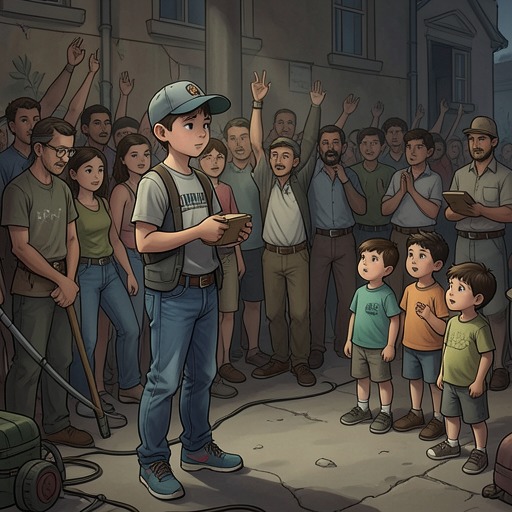
Robert confronts Rich Dad about his wages
Rich Dad Poor DadRobert confronts Rich Dad about his wages after three weeks of dusting canned goods for ten cents an hour, believing that the promised financial instruction has never come. The tense meeting reverses his expectation: Rich Dad treats the boy’s complaint not as a request to settle a wage dispute, but as the opening of a lesson about fear, desire, and the choices people make when life pushes them. The confrontation becomes the first practical demonstration of the book’s claim that the poor and middle class work for money while the rich make money work for them.
The wage dispute
Robert had taken the job because he wanted to learn how to make money from Mike’s father, whom he calls Rich Dad. Instead, he and Mike spent three weeks working for Mrs. Martin, taking canned goods from the shelves, dusting them with a feather duster, and stacking them again. The work was tedious, and the stores’ open doors let dust from the road and parking lots settle inside. By noon each Saturday, Mrs. Martin paid each boy three dimes. At nine years old, Robert found that thirty cents bought little beyond a few comic books; by the fourth week, the small wage and the loss of his Saturdays had made him ready to quit.
Mike revealed that Rich Dad had expected this moment and had told him to arrange a meeting when Robert was ready to give up. The expectation unsettled Robert: he wondered whether he had been set up. His own father, whom he calls Poor Dad, was angry at Rich Dad and considered the arrangement a possible violation of child-labor laws. Poor Dad told Robert to demand at least twenty-five cents an hour and to leave if he did not receive a raise. Robert therefore arrived at Rich Dad’s house on Saturday morning prepared to make his case, but also carrying his father’s competing expectation that the problem should be answered with higher pay or resignation.
Waiting, then confronting Rich Dad
Rich Dad told Robert to sit and wait. Robert found no sign of Mike and sat in the living room beside two women he recognized from an earlier visit. Forty-five minutes passed; the women and another visitor had already left. Robert grew increasingly angry as he waited, hearing Rich Dad in his office but receiving no attention. Although he was ready to walk out, he stayed. At nine o’clock, Rich Dad finally came out and motioned him into the office.
Rich Dad opened by stating that he understood Robert wanted a raise or would quit. Robert responded with the grievance he had rehearsed: he had worked hard and given up baseball, but Rich Dad had not taught him anything, had not kept his word, paid only ten cents an hour, and had made him wait without respect. The nine-year-old accused him of greed and unfairness, and invoked Poor Dad’s government job and child-labor laws. The complaint was emotional and direct, but it also showed that Robert had absorbed the familiar employee response Rich Dad meant him to examine: identify the boss as the problem and demand a better deal.
Rich Dad watched him and remarked that, in less than a month, Robert sounded like many of his employees. Robert did not accept that observation as an answer. He insisted that he had been promised teaching and had received none, because Rich Dad had barely spoken to him. Their disagreement turned on what teaching meant. Robert assumed it meant explanation or lecture; Rich Dad asked whether talking was the only way to teach, then argued that life often teaches by pushing people rather than explaining itself. The unpaid lesson, in his view, had already begun through the boy’s frustration.
The lesson in the confrontation
Rich Dad described different responses to difficulty: some people give up, some get angry and fight back against a boss or job, and a few try to learn what the experience is showing them and move forward. Robert recognized that he had been blaming Rich Dad and fighting back, even though he had asked to learn. Rich Dad warned that a person who never learns from such pressure may spend a lifetime blaming low pay or a boss, waiting for a breakthrough to solve financial problems; someone who always retreats into safety may also let fear determine the course of life. The confrontation thus shifts from whether the wage is fair to what Robert will do with the anger the wage provokes.
Rich Dad explained that he had designed the arrangement to resemble real life. Mike had told him that Robert wanted to learn about money, and Rich Dad believed a lecture would not make the lesson felt. He therefore paid only ten cents an hour and let the boys experience frustration. He also contrasted Robert’s reaction with that of his more than 150 employees: they had asked him for jobs and paychecks, but not to teach them what he knew about money. To Rich Dad, their focus on earning money without understanding it was the pattern the boys needed to see.
The central choice, Rich Dad argued, was whether to treat the employer as the problem or to recognize that one’s own thinking and response could change. Quitting for another job, better opportunity, or higher pay might simply reproduce the same difficulty. Nor, he said, was the answer to accept a meager wage cheerfully or to take a second job while waiting for a raise. When Robert asked what would solve the problem, Rich Dad tapped him gently on the head: the decisive resource was the capacity to think. The lesson was not that low pay itself created wealth, but that an automatic reaction to it could keep a person from seeking a different way forward.
The reversal and its consequences
The confrontation’s principle becomes more visible when Rich Dad later tests the boys by offering progressively higher wages. A raise from ten cents to twenty-five cents, then one dollar and two dollars an hour, makes Robert imagine a bicycle, a baseball glove, and the approval of friends. At two dollars, he badly wants to accept. But when Rich Dad raises the offer to five dollars an hour, the amount strikes him as unreasonable for 1956, and the temptation gives way to calm. Robert looks to Mike and understands that Mike has reached the same decision: neither boy accepts the offer.
Rich Dad uses the test to explain what he calls the Rat Race. Fear of being without money drives people to work; once a paycheck arrives, desire and greed turn their attention to what money can buy. More pay may increase spending rather than end the cycle of working and paying bills. By resisting the escalating offer, the boys have not escaped the need to work, but they have begun to notice how fear and desire can take over their judgment. Rich Dad’s instruction is to recognize those feelings, tell the truth about them, and think rather than react.
The episode also establishes the contrast between the boys’ two fathers. Poor Dad recommends studying hard, earning good grades, and seeking a safe job with benefits; Rich Dad wants Robert to learn how money works so it can work for him. Rich Dad does not dismiss education or employment as useless: he says school and a profession matter, while warning that they do not by themselves teach people to manage money or fear. The wage confrontation is therefore the practical counterpoint to Poor Dad’s advice, not merely a disagreement over ten cents.
Narrative significance
The scene converts an abstract financial principle into an experience Robert initially reads as exploitation and broken trust. Its structure matters: the long wait intensifies the grievance, the confrontation brings the grievance into the open, and Rich Dad’s questions redirect attention from the amount of the paycheck to the boy’s interpretation of the situation. The later pay-raise test extends that lesson from anger to temptation, showing that refusing to blame the employer is only one part of learning to resist emotion-driven choices.
In retrospect, Robert says the encounter widened his vision and helped him recognize a trap that he had not previously seen. The decisive change is not that he receives more money—he does not—but that he begins to distinguish earning a paycheck from understanding money. The episode supplies the book’s first formulation of its governing contrast: the poor and middle class work for money; the rich have money work for them. It makes that claim consequential by showing how the boys’ anger, desire for a higher wage, and eventual refusal of the offer become stages in learning to think about money rather than simply react to it.