Birk Borkason
Ronja, the Robber's DaughterBirk Borkason is the son of Borka and Undis, a member of the rival robber family whose arrival in Matt’s Fort changes the course of Ronia’s childhood. First encountered as a bold boy who can cross Hell’s Gap, he becomes the companion Ronia chooses as a brother. Their relationship ultimately places loyalty to one another, and Ronia’s refusal to accept robbery as a family inheritance, against the demands of the feud that surrounds them.
Identity and Introduction
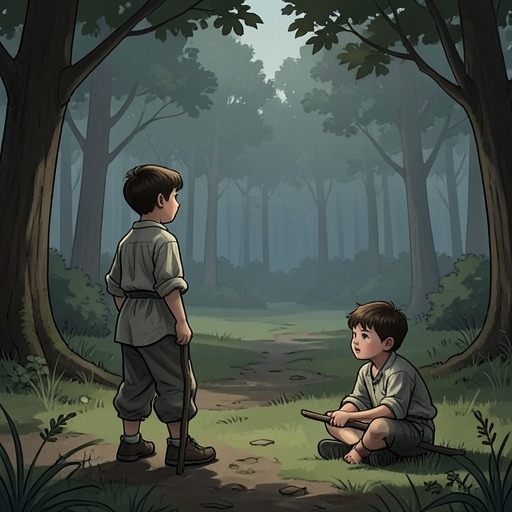
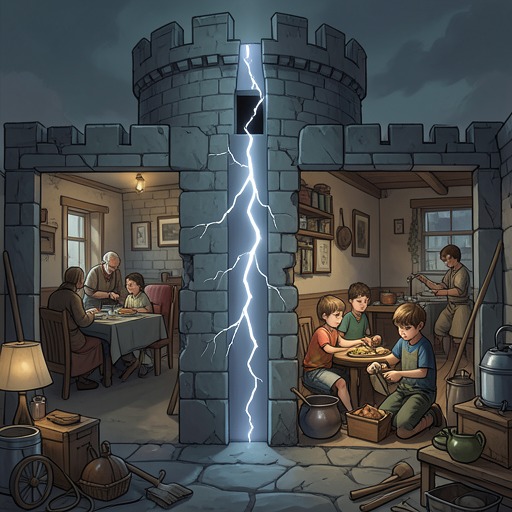
Birk introduces himself to Ronia as Birk Borkason and explains that he lives in the part of Matt’s Fort newly occupied by his family. The group includes Borka, Undis, Birk, and twelve robbers. His arrival makes the old conflict between the two robber households immediate: he is not simply another boy in the woods, but the son of the chieftain whom Ronia’s father regards as his archenemy.
When the children meet, Birk already recognizes Ronia as the robber’s daughter he has seen running in the woods. Their exchange begins with mutual curiosity and quickly turns into a contest. As Ronia prepares to leave, she sees Birk start running toward Hell’s Gap; he jumps across it and challenges her to follow. The crossing establishes his daring, but it also gives their relationship a setting in which separation between the families is a physical fact the children can challenge.
A Rivalry Turned into Kinship
The families’ feud has lasted across generations, and both groups rob travelers along Robbers’ Walk. To the people robbed, it matters little whether the attackers belong to Borka’s or Matt’s band; to the chieftains, the distinction is decisive, and they compete over booty and even rob one another when merchants are scarce. Birk grows up inside that inherited opposition, while Ronia initially knows her father only as the kind, bearded Matt who laughs, sings, and gives her porridge. Her affection for Matt precedes her understanding of what his occupation means.
Their bond changes during a winter separation. When Ronia is stranded in the snow, Birk finds her ski at the bottom of the slope and returns to help her. She is so afraid of being left alone that, when he bends to lift her, she clings to him and begs him not to leave. On the difficult journey home, he follows behind her at a rope’s length until they near Wolf’s Neck, where they must part and he must take a secret route back to Borka’s Keep. At that boundary, Ronia tells him she wishes he were her brother. Birk accepts the idea, and she agrees on the condition that he call her Ronia. Their chosen sibling bond emerges not from family arrangement but from mutual care and an explicit act of naming one another.
The Feud Reaches the Children
The difference between a family rivalry and a personal relationship becomes stark when Matt’s robbers capture Birk. Ronia sees him bound in a corner of the stone hall, with blood on his forehead and desperation in his eyes, while the robbers jeer at him. Matt treats Birk as a means of pressuring Borka and boasts that he can keep the boy in a dungeon until the end of summer if Borka does not leave. Ronia understands that Birk could not survive such confinement and that she would lose her brother.
Her protest is also a direct challenge to Matt’s authority and to the values he has tried to pass on. Ronia tells him that he may rob goods, but that if he robs people she no longer wants to be his daughter. Matt answers by denying that Birk is a person, calling him a captured enemy and insisting that Ronia may choose whether to remain his daughter. Faced with the prospect of losing both her brother and the father she loves, she crosses Hell’s Gap to Borka’s side. The leap turns the divide between the two households into a choice: Ronia acts to protect Birk even though doing so places her beside her father’s enemy.
Moral Conflict and Change
Birk’s significance is not limited to his place in the family feud. Ronia’s growing moral judgment takes shape through her attention to the people harmed by robbery. When Matt explains that a robber takes things without permission, she asks whether those people become angry. Matt later describes his robber ancestry as a legacy he has upheld and says that Ronia is to become a robber chieftain too. She refuses, even though Matt wants her to admire him and worries that she will not.
Her refusal becomes concrete when Birk is held as leverage. What had been an argument about a future occupation now has an immediate human consequence: Matt’s defense of his own power requires him to treat Birk as less than a person, while Ronia sees the boy she has called her brother and understands the danger he faces. Her stand therefore joins compassion for a captive with resistance to the family tradition of taking from others. Birk’s presence makes that choice intimate, but Ronia’s objection reaches beyond him: later, when Noddle-Pete imagines settling the feud through a single combat and uniting the robber bands, she says that the most cunning solution would be to stop robbing altogether.
Narrative Role
Birk’s introduction links the novel’s childhood exploration to its inherited conflict. Ronia’s world expands beyond Matt’s Fort into the forest and river, but the family feud enters that expanding world through the boy who lives across the divide. Their first meeting makes the chasm a dare; their winter reunion makes it the edge of a parting; Ronia’s later crossing makes it the boundary she is willing to defy for him.
The relationship also clarifies the difference between inherited identity and chosen allegiance. Birk is introduced through his name, family, and home among Borka’s people, while Ronia’s bond with him develops through aid, trust, and a promise of siblinghood. That chosen bond does not erase the conflict between their families. Instead, it exposes what the feud costs when its adult strategies reach the children: Birk can be seized as a bargaining instrument, and Ronia must oppose her father to protect him. Through Birk, the story makes family loyalty more than obedience to ancestry; it becomes a relationship the children can form and defend for themselves.