Hell’s Gap
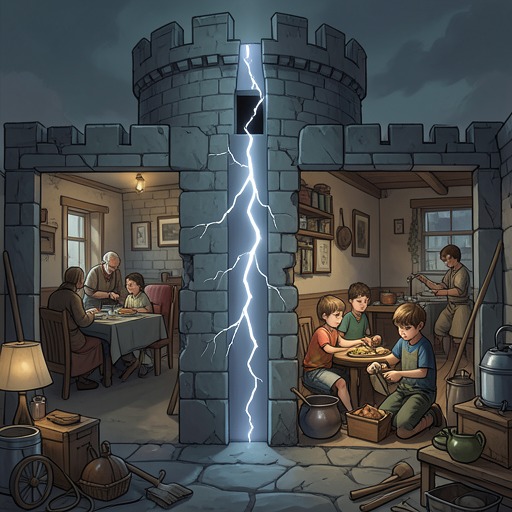
Ronja, the Robber's DaughterHell’s Gap is the deep chasm that splits Matt’s Fort in two when lightning strikes the ancient fortress on Matt’s Mountain. It begins as a physical rupture in a family stronghold and becomes the story’s recurring threshold: a place of danger, daring, encounter, separation, and ultimately return. Its meaning is shaped by the people who cross it and by those left watching from either side.
Formation and Setting
The gap is created when lightning cleaves the fortress from its highest battlements to the deepest vaults of its dungeons. By morning, the building stands as two halves with a chasm between them. The division is severe enough to make the old stronghold two forts, yet the opening is narrow enough that a person can leap across it. The contrast between its manageable width and its terrible depth defines the danger: crossing may be possible, but a fall would mean plunging into an abyss.
The chasm has no protective parapet. When Ronia later crawls toward its edge on her stomach and peers down, she drops a loose stone and hears it land far below. The muffled sound confirms what its appearance already suggests: this is not a shallow fissure but a perilous drop. The fort’s broken architecture makes the gap both a practical hazard and a visible reminder that the families’ shared stronghold has been physically divided.
A Warning Becomes a Meeting Place
Matt explicitly warns Ronia not to tumble into Hell’s Gap while instructing her to swim. His warning gives the chasm a place in their ordinary life at the fort: it is a danger she must learn to navigate, not merely a remnant of the lightning strike. The name itself turns a feature of the fortress into a memorable boundary, one that Ronia is told to watch out for.
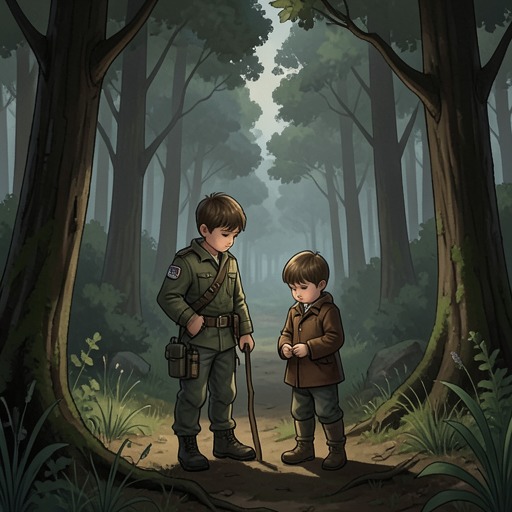
During a time when harpies are making the forest dangerous, Ronia goes onto the roof and approaches the edge to inspect the gap. She has been there before, but not so close to the unguarded drop. After testing its depth with a stone, she notices someone of about her own size sitting on the opposite side, his legs dangling over the chasm. That boy is Birk. The divide that has kept the two halves of the fort apart thus brings the children face to face: it is at once a barrier between their households and the setting for their first encounter.
Daring Crossings and Changing Loyalties
The gap quickly becomes a measure of nerve between Ronia and Birk. When Birk prepares to run and jump across, Ronia tells him that she will punch him if he comes over. He leaps anyway and lands on her side, grinning and challenging her to follow. Their exchange makes the chasm a testing ground: Birk demonstrates that it can be crossed, and Ronia’s anger and surprise meet his playful confidence at the boundary between their families.
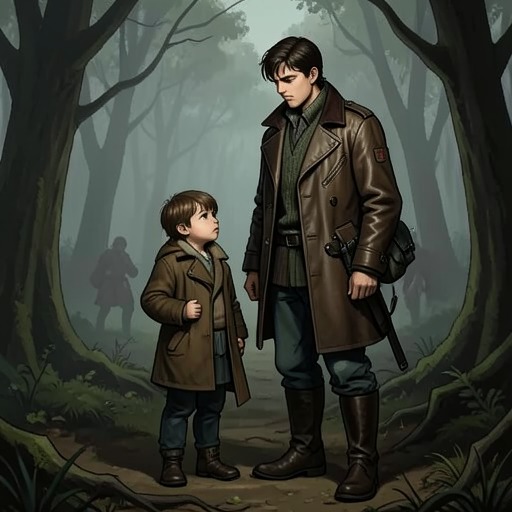
Later, Hell’s Gap carries a much heavier choice. When Matt’s decision puts Birk in danger of being held in a dungeon, Ronia recognizes that she may lose her brother and that her relationship with her father has also become painfully damaged. She runs and leaps across the divide to join Birk on the other side. Matt sees her in midair and cries out; his robbers watch in shock as his daughter lands beside his enemy. The jump turns the gap from a childhood dare into a visible break in allegiance. Ronia does not simply cross from one half of the fort to the other: she places herself with Birk and the family Matt opposes.
Separation, Return, and Significance
The chasm’s divisions do not remain fixed forever. After Ronia and Birk have been separated from Matt, she eventually walks back into the stone hall with him. The return is met first by a silence in which no one dares to cheer. Noddle-Pete breaks that stillness by calling for some sort of greeting when people come home; Matt then laughs, and the robbers join him. Lovis comes in from the sheep pen, and the gathering falls silent again as she greets her lost child. This homecoming gives the earlier crossing a different resonance: the gap once dramatized Ronia’s departure from Matt, while her return helps frame the possibility of renewed family connection.
Hell’s Gap therefore joins architecture to relationship without making the two identical. Lightning creates the physical split, but the children’s encounters and choices give that split its human force. Its depth makes every approach dangerous; its narrowness makes crossing imaginable. The same chasm that separates the two halves of Matt’s Fort becomes the line Birk first jumps for the pleasure of a challenge, the boundary Ronia crosses when she chooses him, and part of the setting against which her eventual return to Matt gains meaning.