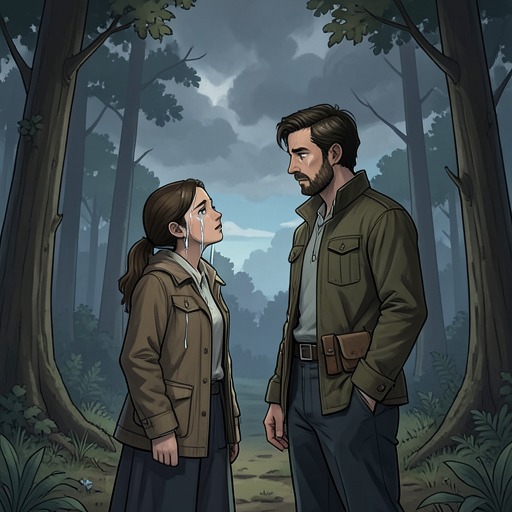
Matt and Ronia’s estrangement
Ronja, the Robber's DaughterMatt and Ronia’s estrangement is the painful consequence of a conflict between inherited loyalty and independent moral judgment. Ronia loves her father, but she will not accept his life as a robber or let that love excuse the theft and coercion it entails. The rupture reaches its sharpest point when Matt holds Birk as leverage and declares that he has no child; Ronia answers by refusing to come home unless she is once again acknowledged as his daughter.## Identity and Background The estrangement begins in a household where robbery is not presented as an incidental occupation but as a family inheritance. Matt tells Ronia that his father and grandfather were robber chiefs and that he has not let them down; he expects her to continue the line. Ronia’s refusal is immediate. When Matt insists that she too will become a robber chief, she answers that she will never do so, even if the people they rob become angry and cry. Her objection rests not on a contest for authority but on the people harmed by the work her father treats as tradition.
Ronia has already begun to recognize what robbery means in practice. Listening as the men speak, she understands that the goods carried home in sacks, bundles, chests, and boxes do not grow in the forest: her father takes them from other people. She asks whether those people are terribly angry when their property is taken. Noddle-Pete confirms that they are, and even describes their distress as pleasurable to hear. The contrast between Ronia’s concern for the victims and the robbers’ amusement makes the family dispute an ethical one: Matt asks for admiration and continuity, while Ronia sees the suffering his occupation dismisses.
Matt tries to justify his conduct by saying that he takes only from the rich, but the justification does not alter Ronia’s refusal. His appeal to family precedent and selective targets cannot make the victims’ anger irrelevant to her. Their separation therefore develops from a difference in what each considers a legitimate claim: Matt invokes inherited identity and his authority as chief; Ronia judges the act by what it does to other people.
The Rupture over Birk
The conflict becomes personal and immediate when Matt takes Birk and uses him to press Borka to leave. Birk stands beside Matt with a rope around his neck, as if being led like a dog. Borka calls Matt hard and vile, objecting in particular to using his child to get what he wants. Ronia is behind Matt, hearing and seeing more than she can bear. The hostage-taking brings the family argument into bodily view: Matt’s power over another person is no longer an abstract feature of his profession, but an action against someone Ronia cares about.
Ronia’s resistance breaks into open confrontation. She beats Matt with her fists and tells him that he may rob money, goods, and rubbish, but he cannot rob people; if he does, she does not want to be his daughter any more. Matt answers by reducing Birk to a string of contemptuous labels and insisting that he intends to clear his father’s fortress. His response refuses the distinction Ronia is trying to establish between taking possessions and taking a person: in her eyes, holding Birk as leverage is itself a form of robbing people.
The argument culminates in an exchange that sounds like a settlement but leaves the deeper injury unresolved. Borka says he will get his son back and Matt will get his child in return. Matt rejects the premise, saying he has no child. Lovis, rather than Matt, asserts that she has a child and demands Ronia back. Matt then turns and walks away heavily. His denial transforms estrangement from a consequence of disagreement into an explicit rejection of the relationship at the moment Ronia is being returned to him.
Silence and Separation
After the exchange, Matt disappears from the stone hall for several days and is absent when the children are exchanged at Wolf’s Neck. Lovis goes in his place. When Matt finally returns to the table, he is glum and so thin that Ronia scarcely recognizes him. He eats without a word; the robbers are silent too. Ronia sits in her usual place but neither looks toward him except for one sideways glance nor finds herself able to leave. She wants to escape and be alone, yet remains seated with her sorrow. Physical proximity has not repaired the bond: father and daughter occupy the same hall while each is held apart by what has been said and done.
The silence has consequences beyond the family. Matt stays in Noddle-Pete’s room, staring at the wall, refusing both to get up and to eat. On the fourth day Lovis summons him to the table; when he appears, the robbers’ horses have stood idle for four days, and the band has not gone out to rob. His estrangement from Ronia thus coincides with a halt in his public role as chief. The story links the loss of the relationship he wanted to the failure of the identity he had tried to pass on: the man who demanded that his daughter admire his calling is left unable to speak or lead.
Distance does not mean Ronia has stopped caring about Matt. When Little-Snip visits, she asks whether Matt ever talks about her and presses him to tell the truth. He says Matt never mentions her name, and no one is allowed to do so in his hearing. Ronia also asks whether Matt is the person who is unwell; she is told that nobody has heard him laugh since the morning she leaped across Hell’s Gap before his eyes. These reports reveal a continued emotional connection under the refusal to return: she wants to know what Matt says and how he fares, even as his prohibition on her name and his silence deepen the separation.
The Terms of Return
Ronia makes the condition of reconciliation explicit. When Little-Snip urges her to come home, she refuses: she will not return for as long as she is not Matt’s child. Her demand is not simply to be brought back into the fort or restored to the household. It is that Matt recognize the relationship he has denied. The distinction matters because Lovis can receive her at Wolf’s Neck and Matt’s men can invite her home, but neither action by itself answers the wound created by Matt’s declaration.
The estrangement also clarifies the difference between returning to a place and accepting its values. Ronia’s concern for other living beings extends beyond her human relationships. When she claims the fox cubs and the woods as hers, Birk reminds her that the cubs belong to themselves and that the forest belongs to foxes, wolves, bears, elk, wild horses, birds, insects, and other creatures. In spring, she and Birk sit quietly among animals without disturbing them, and Ronia accepts that a horse should not be taken away from the woods merely because she wants to ride. These moments echo her rejection of Matt’s possessive logic: kinship, like the forest, cannot simply be claimed as property.
Her actions toward animals make the contrast concrete rather than merely declarative. She persists in riding Villain, holding on through his frightened, full-speed run until Birk catches up on Savage and helps bring the horse to a halt. But when Lia has given enough milk, Ronia thanks the mare and recognizes that the next summer’s milk belongs to her foal, not to the children. Lia later returns to the herd and never becomes domestic, while still answering when Ronia calls her name. Ronia’s care acknowledges another being’s limits and independence—the opposite of treating a person, as Matt does with Birk, as something one can seize to secure an advantage.
Significance
Matt and Ronia’s estrangement tests whether affection can survive without obedience. Matt wants Ronia to love and admire him, yet initially tries to win that love by persuading her that his inherited profession is right. When persuasion fails, his conduct toward Birk and his denial of Ronia’s place in his family make the contradiction unmistakable: he demands loyalty while acting in ways she considers incompatible with it. Her refusal is painful precisely because it does not erase her concern for him; she asks after his silence, his laughter, and his well-being, but will not let concern become consent.
The relationship also gives the wider feud a familial cost. Matt and Borka’s struggle is conducted through forts, robber bands, and claims to territory, but Ronia’s rejection of the hostage exchange’s logic exposes what such contests do to children. Matt and Borka may speak of getting their respective children back as part of a bargain; Ronia insists that she cannot be treated as an object exchanged between chiefs, and Matt’s declaration that he has no child makes the bargain emotionally destructive even before it is completed.
Ronia’s later judgment of the proposed solution to the robbers’ troubles carries the same independence. When Noddle-Pete outlines a single combat intended to settle the dispute and unite the band, she says the most cunning idea would be to stop robbing. The position she first took against her father’s inheritance has become a sustained alternative to the customs organizing the adults around her. The estrangement therefore marks more than a temporary household crisis: it is the cost of her refusing to inherit a violent identity, and the unresolved demand that her father recognize her without requiring her to become him.