Matt’s robbers
Ronja, the Robber's DaughterMatt’s robbers are the loyal, unruly band of outlaws whose home and identity are bound to Matt’s Fort and to Matt’s authority. Their story runs from the danger and revelry surrounding Ronia’s birth, through a bitter feud with Borka’s robbers and the separation of their own families, to a settlement that joins both bands under Matt’s leadership. Their changing fortunes show how a community governed by its own customs can be both a source of protection and part of a wider cycle of robbery and conflict.
Identity and Life at Matt’s Fort
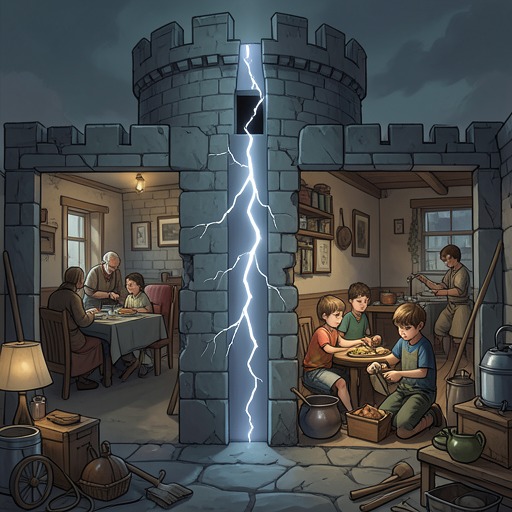
When Lovis gives birth to Ronia in the tower room, Matt’s twelve robbers wait below in the great stone hall, eating and drinking by the fire. They have never seen a child born in Matt’s Fort during their years there. Their boisterous waiting reflects the band’s ordinary life, but the birth briefly makes the fort a household as well as a hideout.
Once the robbers see how fiercely Matt guards his pride in his newborn daughter, they quickly understand that criticism would put him in a bad mood. Instead, they praise the baby, drink tankards of beer in her honor, and watch Matt display her from his high seat. Their behavior is comic, but it also shows their attentiveness to the leader’s temper and their instinct for keeping the group in good order.
Ronia later sees them at the long table, eating soup: bearded, unwashed, noisy, and wild. She nevertheless regards them as her friends, and knows each would go through hell and high water for her. The named members include Noddle-Pete, Shaggy, Pelle, Fooloks, Jutto, Jep, Knuckles, Knott, Tapper, Torm, Bumper, and Little-Snip. Their rough appearance does not cancel the personal loyalty she has found among them.
Matt describes Matt’s Fort as secure as a fox’s lair or an eagle’s nest and warns that soldiers who come looking for trouble will regret it. The boast captures the band’s confidence in its stronghold, but the confidence is tested by the sheriff’s pursuit and by rivals who manage to enter the North Fort without being noticed.
Feud, Authority, and the Forest
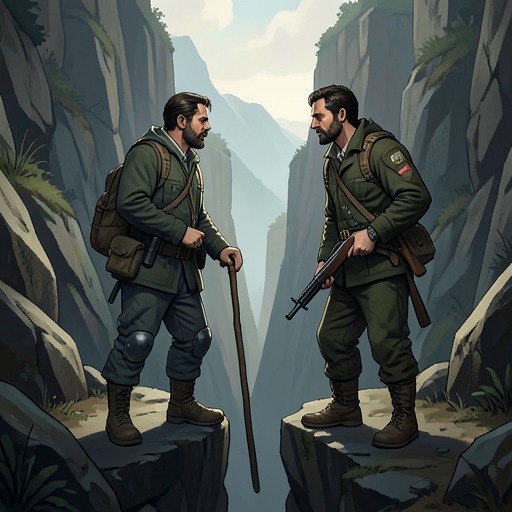
The conflict with Borka’s robbers is inherited: the Borkas and the Matts have been enemies across generations. Both bands prey on travelers passing through Robbers’ Walk, the narrow mountain pass between Borka’s Wood and Matt’s Wood, and both may rob one another when there are too few merchants to provide other booty. To travelers, it makes little difference which band takes their goods; to Matt and Borka, the distinction is the point of a struggle fought over status as well as plunder.
When Borka’s men establish themselves in the North Fort, Matt’s robbers gather around the fire to work out how to remove them. Matt is as troubled by the breach in his defenses as by the occupation itself: everyone approaching Matt’s Fort on foot or horseback must pass through Wolf’s Neck, where a watch is kept day and night, yet no one saw a Borka robber arrive. The incursion exposes a weakness in the vigilance on which Matt’s band relies.
The robbers’ customary authority also rests on Matt’s understanding of what the forest is for. When Ronia talks of her woods and their fox cubs, Matt insists that fox cubs belong to themselves and that the forest belongs not only to foxes, but also to wolves, bears, elk, wild horses, birds, snails, spiders, and ants. This view stands in tension with the band’s own use of the woods as a place to waylay travelers. His description makes the forest a shared home of living creatures rather than simply territory to possess.
Matt expects Ronia to inherit the family trade: he points to his father and grandfather, as well as his great-grandfather, and declares himself the mightiest robber chief in the woods and mountains. The band’s continuity is therefore presented as a family calling, but Ronia’s response to the harm robbery causes complicates that inheritance. Her questions about anger when people’s possessions are taken show that the customs binding Matt’s men do not automatically persuade the next generation.
Strains and Separation
The band’s life is disrupted by the feud’s consequences. After Bumper is wounded, he lies pale and unconscious on a skin before the fire while Lovis kneels beside him to bandage his neck. The other robbers stand gloomily around them, and Matt paces and shouts in anger. The scene makes the cost of rivalry immediate: conflict that might otherwise be discussed as a contest over leadership has injured one of the band’s own members.
Noddle-Pete condemns Borka and explains his view of the conflict to Ronia. His intervention matters because he is not merely a companion in the band; he is also a voice urging Matt to reconsider the feud. Later, Matt himself calls Borka vile for using a child to get what he wants, showing that even within their hostile contest, the robbers can recognize obligations that rivalry should not override.
When Ronia lives apart from Matt’s Fort with Birk, the separation is felt through the family song as well as through the divided households. She tries to sing the wolf song for Birk on their beds of fir branches, but remembering how Lovis sang it for her and Matt when life in the fort was as it used to be leaves her unable to continue. For Matt’s band, the estrangement is part of a wider pause in the old life: during the autumn, little robbery takes place, Borka’s former den is deserted, and the sheriff’s men eventually leave Borka’s Wood without finding him.
Renewal and Union
Spring restores the band’s movement. Snow melts from the cliffs and feeds the river; Wolf’s Neck, once blocked by winter, becomes a rushing stream. Matt and his robbers ride through the narrow pass early one morning, singing and whistling because they believe their robbers’ life is beginning again. The renewed journey contrasts with the winter’s enforced stillness and the period when the usual traffic through Robbers’ Walk had become unexpectedly peaceful.
Matt’s Fort is lively again later, with the robbers singing and dancing while Matt laughs as before. Yet Noddle-Pete continues to warn that two separate bands cannot withstand the sheriff as well as one strong band could. As long as Matt’s and Borka’s men spend their time cheating one another and fighting over plunder, their inherited rivalry leaves both vulnerable to the authorities.
Matt resists the proposal because he will not surrender supremacy. He accepts that Noddle-Pete has a point, but asks who would lead the united band and insists that he intends to remain the mightiest chief. When Borka rides to Wolf’s Neck with news that soldiers are lying in ambush at Robbers’ Walk, however, he comes to warn Matt after Matt’s men have rescued two of Borka’s men from the sheriff’s dungeon. The warning is an act of reciprocal service between enemies, and the danger facing both groups gives Noddle-Pete’s argument renewed force.
The bands agree to settle leadership through single combat. The prospect excites the men so greatly that, on the morning of the fight, Matt’s robbers make enough noise in the stone hall for Lovis to drive them out. The contest follows the rules of a wild beasts’ match: almost any trick or hold is permitted, including breaking, tearing, biting, scratching, and kicking, but a kick between the legs is forbidden and brings immediate defeat. The rules give the confrontation a local form of judgment distinct from the sheriff’s authority.
Matt wins. He stands bloody-faced, his shirt reduced to fluttering rags, but the men acknowledge him as chief, even though the outcome is especially painful for Borka. Matt then calls Borka his brother, grants him a chieftain’s name and fame, and allows him to continue with his own men. The settlement does not erase the difference in rank: Matt’s word is to count for more. It does, however, replace the old division with a single band under a recognized hierarchy.
Aftermath and Significance
That evening, Matt holds a feast in the stone hall for both his own robbers and Borka’s. The shared food and beer make the political agreement communal: the former enemies gather in the same home rather than preparing to fight over it. The union is not a surrender of every distinction, since Borka keeps his men and his chieftain’s title, but it ends the two bands’ separate contest for supremacy.
The robbers work to drive away the gloom with songs and vigorous dancing, whirling until the floorboards creak. Ronia and Birk join them, and Ronia teaches Birk some of the robbers’ leaps. The children’s participation places a new generation inside the reunited community, while their independent choices and the adults’ conflict show that inheritance does not guarantee obedience to the old way of life.
Matt’s robbers are thus more than a backdrop to their leader’s adventures. Their loyalty gives the band warmth and practical solidarity; their dependence on plunder implicates them in harm to travelers; and their customs supply an alternative means of settling authority when the sheriff’s law is not the system they follow. Their union with Borka’s men turns a cycle of mutual raiding into a precarious alliance, but Matt’s insistence that his word outrank Borka’s preserves the hierarchy on which the old conflict had depended.