Ronia reconciles with Matt and returns to Matt’s Fort
Ronja, the Robber's DaughterRonia reconciles with Matt and returns to Matt’s Fort in a reunion that changes the choice dividing her: she can accept her father’s love without abandoning Birk, her chosen brother. The meeting begins in tears beside a spring and ends with Ronia going home, a welcome that loosens the grief not only between father and daughter but among Matt’s robbers as well.
Causes and Background
The reconciliation answers a conflict that had begun with Ronia’s refusal to inherit Matt’s calling. When she learned that the goods the robbers carried home were taken from other people, she asked whether those people became terribly angry. Matt claimed a robber’s inheritance across generations and declared that Ronia would become a chieftain too; she rejected the prospect, insisting she would never do so, even if the victims cried. His appeal to family tradition and his defense that he took only from the rich could not settle her moral objection.
That disagreement later sharpened into a rupture over what it meant to rob people. Ronia told Matt that he could steal money and goods, but that if he robbed people she would no longer want to be his daughter. The depth of the divide was therefore not simply a quarrel over where she should live: Ronia’s affection for Matt coexisted with her refusal to endorse his way of life. Her return would need to restore their relationship without requiring her to withdraw that judgment.
A second bond made the choice harder. Ronia and Birk had become brother and sister by their own commitment, and she had left Matt’s Fort to live with him in Bear’s Cave. When Matt finally asked her to come home, she understood that accepting would hurt Birk; remaining with him in the cave through winter, however, risked both their lives. She told him that staying there would mean throwing away his life—and hers—because she would stay with him regardless. Her insistence that nothing could part them turns the homecoming into a test of whether family affection can widen rather than demand an exclusive choice.
The Meeting at the Spring
The reunion begins with an ordinary need: the water bucket is empty, and Ronia sets out along the narrow path on the mountainside to fetch water from the spring. After carefully crossing the rocky path and running the last stretch through birches and fir trees, she sees Matt sitting alone on a stone. The sight of his familiar dark, curly head makes her heart shake. He has not yet noticed her; when he raises his eyes and sees her, he throws an arm across them to hide his tears. Ronia cannot bear the gesture and rushes into his arms.
Matt first calls her his child, then cries out that he has his child back. Ronia, sobbing into his beard, asks whether she is his child again. Matt answers that she has always been his child and says he has wept for her night and day. The exchange does not erase the separation; it makes its cost visible in both of them. His tears, like hers, show that their estrangement has never meant an absence of love.
Matt then asks whether, as Lovis had told him, Ronia will come home only if he asks her. When he makes the request, he does so with all his heart. Ronia still cannot answer at once: Birk is standing among the birches, white-faced and sad, and she knows that leaving with Matt could look to him like being left behind. The spring is thus not merely a place of reunion but the point at which the two attachments she values become impossible to separate from one another.
A Wider Invitation
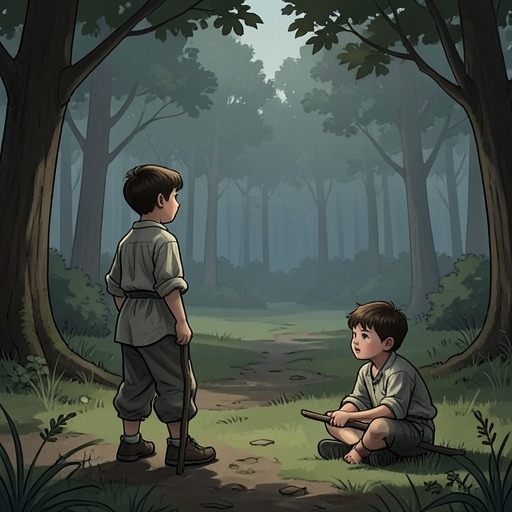
Matt sees Birk and calls him over. Birk approaches reluctantly, keeping his distance and asking what Matt wants. Matt admits that he would like to give him a beating, but instead asks him to return with them to Matt’s Fort. He does not pretend sudden affection: he says he is asking because Ronia loves Birk, and that perhaps he himself can learn to do so. He has had months to think.
This change in Matt’s terms is the decisive turn. He does not ask Ronia to choose him over Birk; he asks Birk to come too, while acknowledging the bond that matters to his daughter. Ronia feels the inner “lump of ice” she has carried break and melt: she no longer has to choose between the two people she loves. The reconciliation restores the possibility of a family gathering around her without demanding that her brotherly bond with Birk be sacrificed to it.
Birk does not accept immediately. Ronia takes him aside and argues that wintering in Bear’s Cave would endanger them both. When he says he would rather stay, she grows desperate and insists that she would remain beside him whether he liked it or not. Birk finally tells his “sister mine” that he does not want to throw away her life and will go wherever she goes, even if living among Matt’s robbers chokes him. His agreement is an act of care, not a sudden endorsement of Matt’s way of life.
Return and Continuing Bonds
Ronia and Birk put out the fire, pack their belongings, and leave Bear’s Cave. She whispers that they will move back there the next spring; Birk answers that they will still be alive then. Matt walks ahead through the forest singing, startling the wild horses into flight, though Villain and Savage stay where they are. The journey home therefore carries a promise of return to the cave as well as a return to the fort: Ronia and Birk are not renouncing their life together in the wilderness.
At Wolf’s Neck, Birk pauses to say that he wants to visit Borka’s Keep first and see how Borka and Undis are doing. He thanks Matt for allowing him to come to Matt’s Fort and see Ronia whenever he likes. Matt agrees, though he admits that it will not be easy for him. Their exchange makes the new accommodation concrete: the return does not absorb Birk into Matt’s household or sever him from his parents. At the place where Ronia and Birk have always said goodbye, he gives her his hand and promises to see her every day; she answers by naming him, and he calls her the robber’s daughter and his sister.
When Matt and Ronia enter Matt’s Fort, the robbers fall silent. No one dares cheer, because Matt has long forbidden cheering there. Noddle-Pete alone makes an unusually high leap of joy, remarking that people who come home ought to be greeted. Matt then laughs heartily—the first laughter the robbers have heard from him since the miserable morning at Hell’s Gap—and they join him until their eyes fill with tears. Their response shows how far the separation’s sorrow has spread through the household.
Lovis’s arrival turns the room quiet again. The robbers watch her greet the child who has been lost to her and has now come home; this time their tears reflect a mother-daughter reunion as well as Matt and Ronia’s. The return is therefore both an intimate reconciliation and a communal homecoming, but it does not settle the larger ethical conflict: Ronia continues to believe that the most cunning idea would be to stop robbing. What changes is that her father can welcome her without first making her surrender that conviction or her bond with Birk.