The united robber band
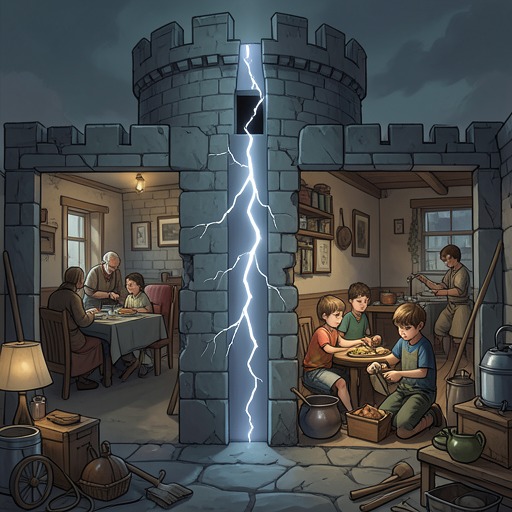
Ronja, the Robber's DaughterThe united robber band is the settlement that brings Matt’s and Borka’s robbers together under one paramount chief without erasing Borka’s position or his separate following. Its creation turns a long feud into a working alliance, but the reunion is also shadowed by the younger generation’s refusal to inherit the life on which the band depends.
From Feud to Settlement
Before the agreement, the two groups’ conflict shaped the movement of people through the surrounding country. While the robbers were preoccupied with their struggle, little robbery took place: travelers found Robbers’ Walk unusually peaceful, and the sheriff’s men discovered that Borka’s former den was deserted and empty of loot. They could find no trace of Borka. Matt, meanwhile, rode out scouting for a way to reach the robbers occupying the North Fort. Their position seemed silent, but they had built a long rope ladder to move up and down the rock face. When Matt saw it lowered, he charged toward it with his men; arrows from the loopholes of Borka’s Keep drove them back, and Little-Snip was injured. The failed rush showed that the division between the bands was still an armed contest, not a settled arrangement.
The feud’s personal stakes were equally stark. During a confrontation over the North Fort, Matt held Birk by a rope around his neck and demanded that Borka leave. Borka condemned Matt for using his son to get what he wanted, and said he would need to find a safe place for his people before he could go. The eventual union therefore follows a period in which family ties and political power are entangled: Birk is both Borka’s child and a means by which Matt tries to force a decision.
Matt’s Supremacy and Borka’s Place
The settlement is made explicit after Matt and Borka fight in a wild beasts’ match, whose rules permit almost every kind of hold and attack but forbid a blow between the legs. When the contest ends, Matt stands as chief, and the robbers acknowledge his victory, though the result is painful for Borka and some of his followers. The new unity does not mean equal command. Matt calls Borka his brother and promises that Borka may retain a chief’s name and reputation and continue with his own men, but he makes clear that Matt is the mightier chief and that his word now carries greater authority.
That division of status gives the band a practical structure: common allegiance at the top, with Borka still leading his own followers. The outcome converts a contest of force into an acknowledged hierarchy rather than dissolving Borka’s group. Their bond is described in kinship language, but it rests on a public defeat and an explicit difference in power.
Reunion in the Stone Hall
On the evening of the match, Matt holds a feast in the stone hall for the robbers of both forts. The meal and beer bring the two groups into one gathering, while the defeated rivals begin to recover an older intimacy. Matt and Borka sit side by side, alternately laughing and crying as they recall hunting rats together in an old pigsty and recount other childhood exploits. The robbers listen and laugh with them. For Ronia and Birk, seated at the far end of the table, the shared stories make the fathers’ friendship part of the present rather than merely a claim of alliance.
Their laughter matters especially because the children have been absent from Matt’s Fort for a long time. Matt and Borka have scarcely grown used to the happiness of having Ronia and Birk home again, and the children’s laughter delights them. The feast thus joins two kinds of reconciliation: the chiefs’ renewed companionship and the families’ return to a shared home. Songs and vigorous dancing continue the celebration, and Ronia teaches Birk some of the robbers’ leaps. The band can still enact its customs together, even as the future of those customs comes into question.
The Children and the Future of the Band
At the feast, Matt tries to console Borka for losing the contest by predicting that Birk will become chief after them. Matt acknowledges that Ronia does not want the role and will not be persuaded, but assumes that Birk will carry on the robber tradition. Ronia challenges that assumption by asking whether Birk actually wants to be a robber chieftain. Birk answers not with a negotiation over rank but with a solemn oath: whatever happens, he will never become a robber.
His declaration interrupts the feast. Silence falls; Borka mourns the son he believes has let the family down, while Matt tells him that children now do as they please and that parents must learn to accept it. The remark connects Birk’s choice to Ronia’s earlier refusal to inherit her father’s calling: neither chief can simply pass his way of life to a child who rejects it. The alliance secures the robbers’ present order, but cannot guarantee its continuation.
Matt and Borka eventually return to their childhood memories and choose to enjoy the feast despite their children’s defiance. The robbers answer the gloom with songs and dancing, and Ronia and Birk join them. Still, the chiefs sit for a long time looking toward a future in which their proud robber life may survive only as a legend. The united band is therefore both a resolution and a limit: it reconciles the two older leaders, yet its own celebration contains the clearest sign that their tradition may end with them.