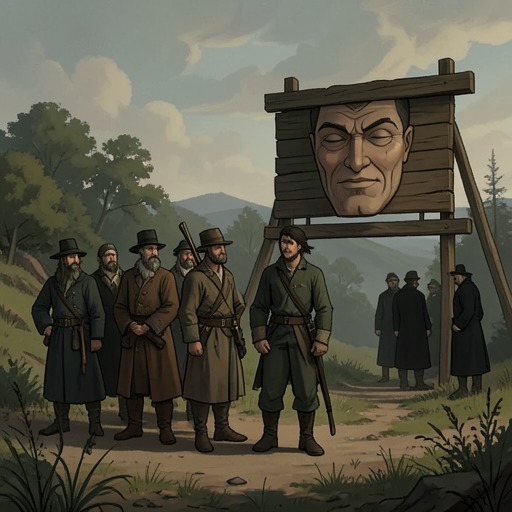
“As safe as the fox in its lair and the eagle in its nest”
Ronja, the Robber's DaughterThe expression “As safe as the fox in its lair and the eagle in its nest” gives Matt’s Fort the language of natural refuge: protected not merely by stone and height, but by the confidence of those who live within it. Its return at a moment of Matt’s distress turns the boast into an ironic refrain, setting the fortress’s apparent security against the vulnerability of its inhabitants.
Matt’s Boast of Safety
Matt uses the expression while declaring his gladness to be in Matt’s Fort. He imagines its residents as secure as a fox in its lair or an eagle in its nest, and warns that soldiers foolish enough to come seeking trouble will regret it. The paired images suggest shelter and command at once: the lair is a defended home, while the eagle’s nest occupies a height that is difficult to reach.
The confidence has a physical basis. Matt’s Fort stands atop a cliff and is inaccessible from three sides. A narrow bridle path zigzags down the southern side toward the forest, but anyone approaching that route would encounter Wolf’s Neck, where Matt says his robbers could stop an advance by rolling rocks and using other means. The saying therefore does more than express comfort: it compresses the stronghold’s terrain and defensive strategy into a memorable comparison.
A Community’s Confidence
The saying belongs to a shared sense of belonging as well as to Matt’s leadership. Around the long table, Ronia hears Noddle-Pete condemn Borka’s robbers as dirty devils, but regards Matt’s own rough, noisy, unwashed band as her friends, people who would face any danger for her. The fortress’s safety is thus imagined as collective: its cliffs and defenses matter, but so does the loyalty of the people gathered inside.
That assurance also has a blind spot. The robbers jeer at the thought that anyone could climb the sheer sides, unaware of where Ronia goes to practice not being frightened. Their confidence treats the cliff as an absolute barrier, while the narrative quietly signals that its danger and difficulty are not the same for everyone. The expression gives voice to the band’s conviction, not an objective guarantee that every threat has been mastered.
Repetition and Reversal
Later, Matt repeats the fox-and-eagle comparison after Lovis brings him a basket of freshly gathered eggs. He hurls the eggs one by one against the wall, then throws himself on the floor, crying, shouting, and cursing. In that disorder, he recalls having said that the fort was safe and breaks off with an anguished “and now…” The unfinished thought makes the old assurance sound less like a settled truth than a claim suddenly overtaken by events.
Lovis answers not by affirming the fortress’s defenses but by telling Matt to get up and do something about his troubles. The expression’s meaning consequently shifts between its two uses: first a public declaration of protection, spoken amid the robbers’ confidence in their stronghold; later a painful echo as Matt’s composure gives way. The cliff may still shelter the fort, but the refrain reveals that security of place cannot by itself secure peace of mind.