Birk’s knife
Ronja, the Robber's DaughterBirk’s knife is the essential implement of Ronia and Birk’s makeshift household in Bear’s Cave, where the absence of ordinary supplies makes its usefulness visible. It is not merely a possession to be kept safe: the pair depend on it to manage in the woods, and its temporary disappearance turns shared hardship into an argument. Its return, found beneath moss after they have searched for it, lets the knife become a quiet measure of what has been endangered by their quarrel—and of what they value more than any tool.
A Necessary Tool in the Woods
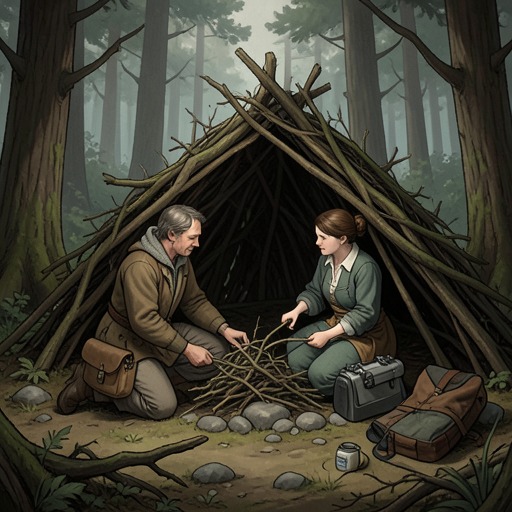
Birk explains that he left belongings in a hiding place inside a hollow tree in the woods outside Borka’s Keep because he could not carry everything at once. Among the things he hopes to retrieve is a crossbow. Ronia, who says Matt had not wanted her to have a crossbow yet, instead proposes making an ordinary bow if Birk will lend her his knife. He agrees on one condition: she must take care of it, because it is the most precious thing they have and without it they cannot manage in the woods.
Their exchange establishes the knife’s practical importance within a life short of equipment. Ronia points out that they also need buckets to carry water; Birk answers that thinking about buckets does not carry any water. The joke draws a line between imagining a workable household and possessing the things needed to make one. The knife is one such necessary object, but it cannot supply everything their new circumstances demand.
Work, Scarcity, and the Missing Knife
The tool’s value becomes still clearer when the pair try to make a bowl. By the third day, Ronia is comparing the discomfort of blisters on her hands with that of grilled salmon. Birk says they should have had a chisel: working with only a knife is sheer slavery. With no other tools, they take turns hacking and scratching until they produce something resembling a bowl. Birk then insists he will never make another and asks for the knife so he can sharpen it.
The request exposes an immediate problem: each thinks the other has the knife. Ronia says Birk has it; he insists she had it last. Their exchange becomes an accusation rather than a shared search, and when Ronia asks what he has done with it, Birk calls her claim a lie. They look everywhere, inside the cave and outside on the platform, then search those places again. The knife is nowhere they can find it. Birk’s warning that they cannot manage in the woods without it now lands as blame, and Ronia counters that he should have taken better care of it instead of accusing others.
Under the Moss
Ronia leaves, and Birk, already angry, calls after her, wishing the harpies would take her and saying she would be at home with them. He notices moss lying in a mess and kicks it away, blaming her for that too. Beneath it lies the knife. The discovery does not settle the argument at once: Birk stares at the object and wonders how it could be there when they had searched through the moss so carefully, and whose fault it was that it was there. He still assigns responsibility to Ronia, using the moss as another reason to condemn her.
Birk sharpens the knife and feels how well it lies in his hand. The familiar tool has returned, and the work of whetting it drains away his anger. Yet possession does not restore what has gone missing: Ronia is gone. He feels an odd gnawing in his chest and imagines that she may not come back, even as he tells himself the cave can remain closed against her and that she will eventually return asking to be let in. The passage makes the knife’s recovery materially complete but emotionally insufficient. It is available again; the person with whom Birk shared it is absent.
Return and Recognition
Later, Ronia remarks that it was a pity the knife had been lost. Birk takes it out and places it in her hand, saying it was fortunate that it came back and had only been waiting beneath the moss while they squabbled. The gesture gives the object a different place between them: earlier, sharing it meant negotiating practical need; now, handing it back acknowledges both the needless quarrel and their restored closeness.
Ronia reflects that everything can be ruined very easily and quite unnecessarily. Birk answers that from then on they will watch out for those unnecessary things, then tells her she is worth more than a thousand knives. The contrast completes the knife’s significance. Its scarcity made it precious because their survival in the woods depended on it, but the fight over it revealed the greater danger of letting a small loss and mutual suspicion damage their relationship. Recovered from under the moss and returned to Ronia’s hand, the knife remains indispensable; it is no longer mistaken for the most valuable thing they have.