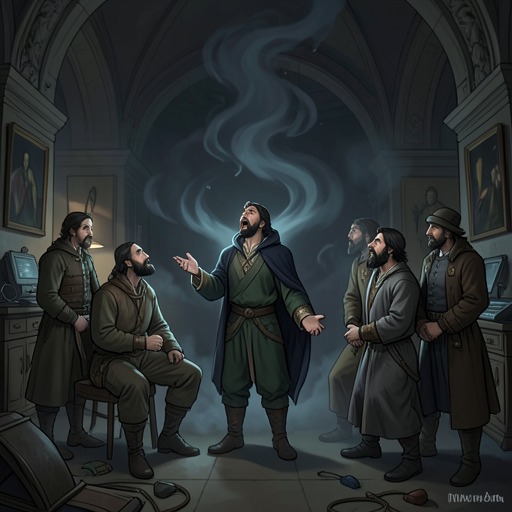
Bourke stops Ronya from following the Otherworldly People
Ronja, the Robber's DaughterBirk’s intervention keeps Ronia from following the Unearthly Ones into the darkness beneath the forest. The episode transforms a familiar walk home into a struggle for her freedom and safety: the song offers comfort before it becomes irresistible, while Birk’s grip on her and the leather rope prevents her from stepping beyond the path. When the fog lifts, Ronia returns to herself and finds Birk still beside her.
The forest and the journey
The danger takes shape against Ronia’s conviction that she knows the woods. Earlier, when she insists that the fox cubs are hers and that Birk should leave her woods, he answers that foxes belong to themselves and that the forest belongs to all its inhabitants: wolves, bears, elk, wild horses, birds, insects, and other living creatures. He includes the Wild harpies, Gray dwarfs, Rumphobs, and Murktrolls in that shared woodland. The exchange makes ownership itself a point of conflict: knowing the forest does not mean that Ronia can claim it or control everything in it.
That idea becomes newly urgent in the fog. Ronia and Birk set out a rope’s length apart, as she has decreed, and keep to the path because one wrong step could lead them astray. At first Ronia is confident. She feels her way by touching stones, trees, and bushes, and expects to be home before Lovis sings the Wolf Song. But the forest she knows seems to have fallen silent. The mist hides an unknown danger, and her confidence gives way to a fear she has never experienced so strongly.
The song and the temptation
A plaintive, beautiful song rises from deep in the mist. It soothes Ronia and seems to fill the forest with beauty, but its comfort carries a lure: the singers want her to leave the path and follow them into the darkness. As the song grows louder, she forgets the Wolf Song awaiting her at home and the safety it represents. Her attention narrows until she wants only to join the voices underground, even if that means living there for the rest of her life.
Ronia answers the song and takes several steps away from the path. The leather rope checks her with such force that she falls headlong. Birk calls out that she is being tempted away by the Unearthly Ones and will be lost if she follows them. Ronia knows of these beings: they come up from their dark places underground when fog closes over the woods, though she has never met them before. Recognition does not protect her. She calls to the singers again and tries to go, now struggling against Birk as well as the rope.
Birk holds her fast
Birk reaches Ronia and holds her while she demands to be released. He tells her not to upset herself, but the song is so powerful that she cannot hear him. Its pull becomes physical and consuming: Ronia strikes, scratches, screams, cries, and bites Birk’s cheek, yet he does not let go. The scene’s central reversal is stark: what sounds to Ronia like a welcome becomes a threat, while Birk’s restraint, which she fights, is what keeps her safe.
He holds her for a long time. Then the fog lifts as swiftly as it came, and the song dies at the same moment. Ronia looks around as if waking from a dream. She sees the path home and the red sun sinking behind the wooded ridges; Birk is still standing beside her. The danger ends not through Ronia’s strength of will but because Birk has kept her from acting on the enchantment until it passes.
Aftermath and significance
Returning to ordinary awareness, Ronia recalls her earlier rule and tells Birk that they were supposed to remain a rope’s length apart. Then she sees his bloody cheek and asks whether the fox bit him. Her mistaken question briefly connects the frightening encounter to the playful fox cubs they had been watching, but Birk does not explain the wound. He rolls up the leather rope and gives it back to her. Their exchange leaves the cost of his intervention visible without turning it into a speech or a claim on her gratitude.
The episode also gives the forest’s shared life a darker counterpoint. In the spring, Ronia and Birk sit quietly among birds, fox cubs, squirrels, hares, and a pregnant snake; they leave the animals undisturbed, and the scene affirms that spring belongs to everyone. The fog journey tests that principle in a more threatening register. The forest is not simply Ronia’s familiar refuge: it contains other beings, including those whose music can draw her away from home. Birk’s rescue depends on recognizing the danger and keeping her connected to the path and to the living world she knows.
The moment belongs to the larger development of Ronia and Birk’s relationship. They begin at a rope’s length apart under Ronia’s rule, but when the lure makes that distance dangerous, Birk closes it and refuses to release her. The rope first marks the separation she wants; in the crisis, it becomes the means by which he can stop her from disappearing into the mist. When the fog clears, the earlier boundary returns, but the scene has shown what their connection can require: Birk must hold on even when Ronia, under the song’s influence, fights him.