Lovis’s Wolf Song
Ronja, the Robber's DaughterLovis’s Wolf Song is the bedtime song Lovis sings to Ronia, a recurring ritual that gives shape to the child’s earliest sense of home and later measures the distance from it. Sung as the robbers leave the fire for their bedrooms, it first signals safety and the promise of another day; after Ronia leaves Matt’s Fort, the same song carries longing she cannot immediately sing through, and eventually becomes a comfort she can offer Birk.
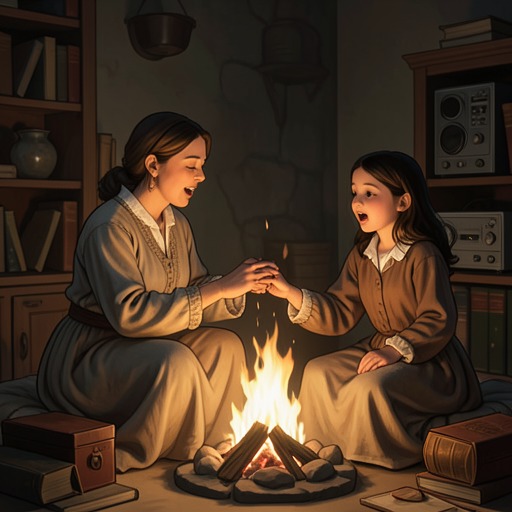
The nightly ritual
Every evening, Lovis sings when it is time for the robbers to leave the fire and go to their bedrooms. Only Lovis, Matt, and Ronia sleep in the stone hall. From her bed, Ronia watches the fire flare and die through a gap in the curtains as the song continues. She has heard her mother sing it for as long as she can remember, and associates it with the ordinary passage from wakefulness to sleep. Its reassurance is also bound to the next morning: before closing her eyes, Ronia thinks happily that she will get up again tomorrow.
The song belongs to a household routine, but its reach is more intimate than a signal to end the day. It joins Lovis’s presence, the fire in the hall, and Ronia’s confidence that sleep is temporary. At a time when the child is eager to go out into the forest whatever the weather, the song closes the day without making the outside world feel forbidden; its promise is not withdrawal from adventure but a safe return to rest.
Home and separation
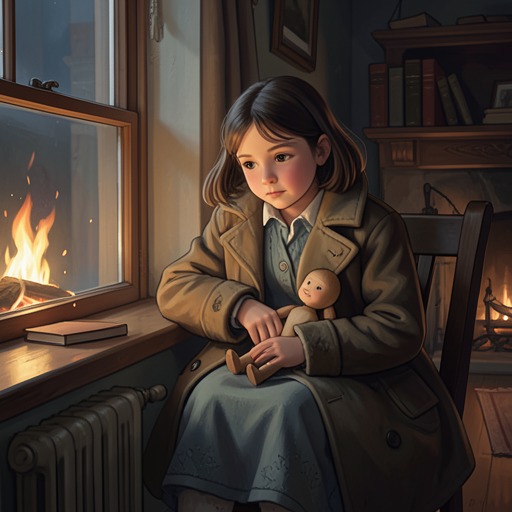
After Ronia leaves Matt’s Fort to live with Birk in Bear’s Cave, the Wolf Song returns as a sound of separation. On their first night there, she tries to sing it for Birk as they lie on beds of fir branches. Remembering how Lovis used to sing it for her and Matt when life in the fort was as it had always been, Ronia feels such a strong pull of yearning that she cannot continue. Birk, tired from cleaning the cave and gathering firewood and bedding, soon falls asleep; Ronia remains awake in the dark, cold cave, wrapped in a goatskin he lent her and the squirrelskin coverlet brought from home.
The scene makes the song’s changed meaning concrete. Its notes have not changed, but the setting that once made them part of an unbroken evening routine is gone. In the cave, the attempted lullaby opens a memory of family life instead of carrying Ronia smoothly into sleep. The song becomes a measure of what she has left behind, and her inability to finish it registers the cost of choosing a life apart from her parents.
A ritual shared with Birk
On another evening in the cave, after the pair have spent the day walking, running, carrying, and organizing, they eat bread, sheep’s cheese, and mutton, washing the meal down with clear spring water. When they are ready to sleep, Ronia sings the Wolf Song for Birk again. This time it goes better, though it still makes her sad. She asks whether their parents are thinking about them in Matt’s Fort and whether they will be sorry.
The song thus becomes a way for Ronia to bring the absent household into the refuge she shares with Birk. It does not erase the separation or answer her questions about how her parents feel. Instead, it gives her a familiar form in which to voice that uncertainty. Its movement from failed attempt to a more successful singing mirrors her gradual creation of a home in the cave: the old ritual can be carried into a new relationship, but its first associations remain present.
The song within Ronia’s changing life
The Wolf Song’s recurrence connects two kinds of security. In the stone hall, security comes from being a child at home with Lovis and Matt; in Bear’s Cave, it must be made anew through the companionship of Birk and the work of daily life. The song crosses that boundary without making the two homes equivalent. Ronia can sing it for Birk, but sadness accompanies it, because the melody recalls a family and a routine she has chosen to leave.
That tension gives the song its narrative significance. It is at once a dependable bedtime marker and an emotional record of change: its first appearance closes a day with eager expectation, while its later appearances disclose homesickness and the effort to sustain closeness in exile. The song offers continuity, not a return to the past. Ronia’s relationship to it changes as her life does—from a familiar sound received from her mother to a fragile practice she tries to carry forward.