Matt and Borka’s feud
Ronja, the Robber's DaughterMatt and Borka’s feud is the struggle between rival robber chiefs whose separate bands compete for plunder and power even as the sheriff’s soldiers close in. Its decisive turn comes when the danger of remaining divided forces Matt to acknowledge a shared interest: after a single combat, the two bands unite under Matt’s authority, and he names Borka his brother without surrendering the chief’s precedence.
Origins and Costs of the Feud
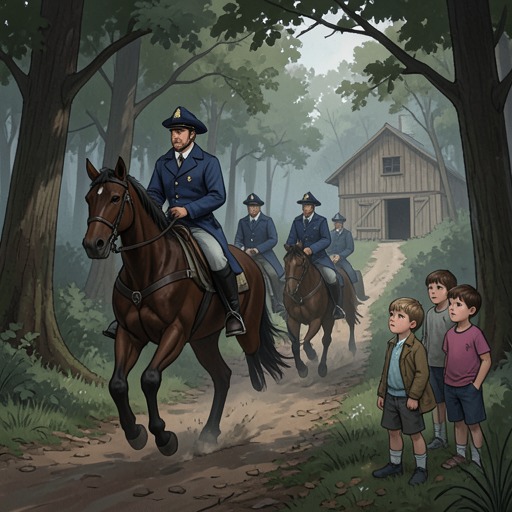
The rivalry shapes life on both sides of the forest. While Borka’s robbers occupy the North Fort, their old den in Borka’s Wood stands deserted, and the sheriff’s men, having searched it, are glad to leave the dark, cold, rainy wood. Travelers on Robbers’ Walk find the route unusually peaceful, not because the region has become safe, but because the Borka band has other concerns. Farther away, Matt’s robbers remain in Matt’s Forest, where the sheriff would rather not pursue their chieftain. The quiet on one road and the feared reputation of another reveal how the conflict has scattered the threat rather than ended it.
For Matt, the feud is not merely a question of territory. He repeatedly tries to work out what Borka’s people are doing in the North Fort and how to get at them. His daily scouting turns up little: the north wood seems silent, with no visible sign of the invaders. Yet Borka’s band has made a long rope ladder to climb the rock face. When Matt sees it lowered, he rushes to storm the stronghold, and his men follow, eager for battle. Arrows from the loopholes of Borka’s Keep drive them back; Little-Snip is struck in the thigh and spends two days in bed. The failed assault makes the practical cost of the feud plain: a guarded route into the fort turns Matt’s impatience into an injury for one of his men.
The rivalry also reaches into family ties. When Matt holds Birk as leverage against Borka, Ronia witnesses the confrontation from behind her father. Birk is no longer bound hand and foot, but a rope around his neck is in Matt’s hand, making him look as though he is being led like a dog. Borka condemns Matt for using his child to force him out. The dispute over the North Fort has become a threat to a son, and a contest between chiefs now carries a painful domestic consequence for Ronia, who sees what her father’s struggle demands of Birk and Borka.
The Case for Reconciliation
Noddle-Pete repeatedly argues that the feud is weakening both bands. In his view, one strong company might be able to contend with the sheriff and his men, whereas two separate companies waste their strength cheating one another and fighting over plunder. Matt dislikes hearing the argument, but admits privately that it is right in part. What keeps him from acting on it is the question of rank: he insists that he is the mightiest robber chieftain in the mountains and forests, and he is unwilling to assume Borka will accept that claim.
Noddle-Pete’s proposed answer is a single combat. If Matt defeats Borka, he reasons, Borka might accept his place and the two groups could become one band, helping to mislead the sheriff’s soldiers instead of fighting among themselves. The proposal makes the feud’s central issue explicit. The men have common enemies and a possible common purpose, but neither chief is willing simply to yield the title. Reconciliation must be made legible as a victory, not offered as an untested compromise.
The sheriff’s pressure gives that plan new urgency. One morning Borka rides to Wolf’s Neck with news that soldiers have been lying in ambush on Robbers’ Walk. Two of his men have been captured and a third has been badly wounded by an arrow while trying to escape. Borka warns Matt that no robber who values his life should enter the woods that day. He also explains that he has come in return for Matt’s recent rescue of two Borka men from the sheriff’s dungeon. The old enemies are already capable of reciprocal aid: Borka’s warning answers Matt’s earlier service, even before either man openly agrees to join forces.
From Rivalry to Single Combat
Matt’s response gives the feud its turning point. He declares that the soldiers must be taught to behave and says, almost without thinking, that “we” cannot allow this to continue. Only afterward does he notice the pronoun and understand what it implies. The shared danger has briefly made the two bands a single concern in his own speech. After a pause, he suggests joining forces, though the idea makes him shudder because it means speaking of alliance with a Borka.
Borka welcomes the prospect, but immediately frames it around the same question of leadership. He agrees that one strong band would be good, provided it had one strong chief, and presents himself as the obvious candidate. Matt answers with a terrible laugh and challenges him to prove who should lead. The alliance is therefore neither effortless nor based on the disappearance of their antagonism. Their common threat opens the door; the old rivalry decides how they will pass through it.
The announcement sends excitement through both groups. On the morning of the fight, Matt’s robbers make such a din in the stone hall that Lovis drives them outside. The combat is governed by the rules of a wild beasts’ match, in which nearly every kind of trick and hold is allowed: the fighters may break, rip, bite, scratch, and kick with bare feet. One limit is explicit: a blow between the legs is an outrage, and whoever strikes it loses immediately. The contest turns leadership into a bodily test under a shared custom, with an enforceable boundary even amid the deliberately rough tactics.
Settlement and Significance
When the fight is over, Matt stands bloody-faced, his remaining shirt hanging in rags, but recognized as chief by the robbers. Borka is badly beaten and close to tears. Rather than stripping him of standing altogether, Matt tells him that they are brothers from then on: Borka may keep a chieftain’s name and fame throughout his life and continue with his own men. Matt nevertheless makes the hierarchy unmistakable. He remains the mightiest chief in the mountains and woods, and his word will count for more than Borka’s. Borka nods, too battered to say much.
That evening, Matt holds a feast in the stone hall for the robbers of both bands, with plenty of food and beer. The change is concrete: men who had competed, evaded one another, and fought over plunder now share a banquet under one chief. Yet the settlement preserves rather than erases difference. Borka retains his name and his followers, but accepts Matt’s superior authority; Matt offers brotherhood, but couples it with an explicit statement of rank. The feud ends through a negotiated victory, in which the old contest is redirected into a united band capable of facing the sheriff together.