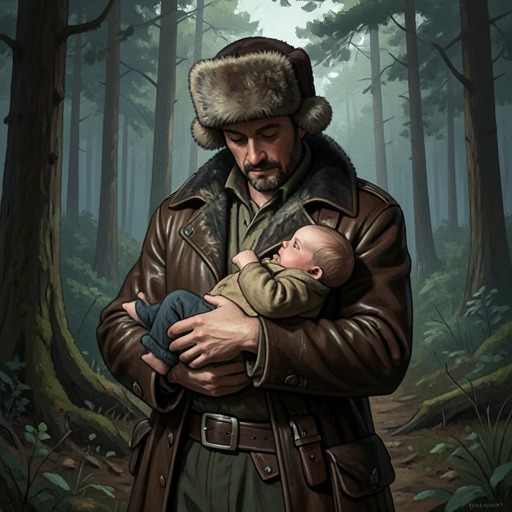
Matt detains Birk, and Ronia crosses the gorge to join Borka’s side
Ronja, the Robber's DaughterMatt detains Birk, and Ronia crosses the gorge to join Borka’s side in a decisive break between a father and daughter: Matt treats Birk as leverage in his feud with Borka, while Ronia refuses to let her father’s authority excuse harm to someone she regards as her brother. Her leap across Hell’s Gap changes the terms of the confrontation, and Matt eventually agrees to return Birk immediately, even as Ronia’s choice exposes the depth of their estrangement.
Causes and Background
Ronia’s refusal begins with a moral question about the robbers’ livelihood. When she hears that the goods brought home by Matt’s robbers have been taken from other people, she asks whether those people become angry. Noddle-Pete confirms that they do, and Matt responds not by abandoning the practice but by invoking family tradition: his father and grandfather were robber chiefs, and he expects Ronia to become one too. She rejects that inheritance, saying she will never take the role, even if the people whose property is stolen cry and grow angry.
Matt tries to justify robbery by saying that he takes only from the rich. But the encounter with Birk shows how easily his distinction between goods and people can collapse. When Matt catches Birk, he presents him as a means of making Borka leave the North Fort and recover his son only on Matt’s timetable. Ronia sees instead a person being held against his will, and that difference in judgment becomes the immediate cause of her break with Matt.
The conflict also reflects a broader disagreement about possession and belonging. Earlier, Ronia had claimed the fox cubs and the woods around them as hers. Birk challenged that claim: foxes belong to themselves, and the woods are shared by animals and other inhabitants rather than owned by human beings. In spring, Ronia and Birk sit among the birds and animals without disturbing them, and she accepts that she should not take a horse away from the woods simply because she wants to ride. That attention to the independence of other beings informs her later refusal to treat Birk as an object her father can use.
Matt Takes Birk
Matt points out that he has caught Birk and explains his intended bargain: Borka must decide whether to leave, with the return of his son hanging over that decision. Ronia then sees Birk bound in a corner of the stone hall, surrounded by Matt’s celebrating robbers. She reacts with tears of rage and tells Matt that he may rob money and goods, but he cannot rob people without losing her as his daughter.
Matt rejects the distinction she is making. He calls Birk a snake fry, a louse, and a thieving hound, and says that he intends to clear his father’s fortress. The insults recast a captured boy as an extension of the feud rather than as someone with claims of his own. Matt then sends Fooloks to Hell’s Gap with a message for Borka: he must come the next morning, and it would be safer for him to do so.
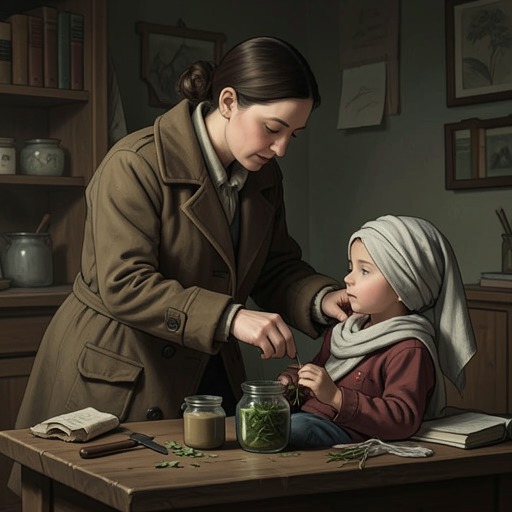
Lovis responds to Birk’s injury by bringing healing herbs to wash it, but Matt orders her not to touch him. Lovis insists that the wound must be cleaned regardless of what Matt calls the boy. Her intervention draws a line between Matt’s retaliatory language and the ordinary care Birk needs, while Ronia’s protest makes clear that Matt’s conduct now threatens his relationship with his daughter as well as his opponent.
The Crossing at Hell’s Gap
At Hell’s Gap, Borka condemns Matt for using his child as a means to get what he wants. He says that he must first find a safe place for his band to settle, but promises they will be gone before summer ends if Matt returns Birk. Matt agrees that Birk will be released by then. Ronia understands the cost of this arrangement: Birk cannot endure being held until the end of summer, and if he dies, she will lose her brother. She also recognizes that she can no longer love Matt as she did.
Ronia acts on that recognition by running and leaping across Hell’s Gap to Borka’s side. The crossing reverses her father’s leverage: Matt had treated Birk as the captive whose fate could compel Borka, but Ronia now places herself in the opposing camp. Borka, startled by her arrival, quickly puts a rope around her neck and calls across to Matt that his side has dungeons too. The exchange makes the cost of the leap visible without erasing its purpose: Ronia has accepted her own captivity rather than allow Birk to remain Matt’s bargaining piece.
Matt is devastated. He drops the rope that had held Birk, but Birk still stands across the gap from Ronia, pale and distressed. When Borka asks whether Matt will return his son, Matt says he will, and Borka demands that it happen now rather than at the end of summer. Matt agrees. Ronia’s intervention has not reconciled the two robber chiefs or ended their feud, but it has brought forward Birk’s release.
Exchange and Aftermath
Matt says that Borka may take his son, but that Matt has no child to give back. Lovis sharply rejects that claim: she says that she has a child and demands Ronia back. Matt walks away. In the days that follow, he is absent from the stone hall and from Wolf’s Neck when the children are exchanged; Lovis goes in his place, supported by Fooloks and Jep, with Birk beside them.
Borka and Undis wait beyond Wolf’s Neck with their robbers. Undis insults Matt for failing to appear, but Lovis does not answer her. She draws Ronia toward her and prepares to leave. At the exchange, Ronia and Birk look at one another as if they are alone, and the narration makes their bond unmistakable. Their connection has outlasted the attempt to turn Birk into a tool of the feud, but the scene does not restore Ronia’s relationship with Matt.
Significance
The episode is a reversal of Matt’s attempt to control the conflict through captivity. He expects Birk’s confinement to make Borka leave; instead, it makes Ronia choose Borka’s side, and the threat of losing his daughter moves Matt to release Birk at once. The consequence is immediate but limited: the children are exchanged, while the underlying dispute remains unresolved.
Ronia’s choice also gives practical force to her earlier rejection of the robber’s inheritance. Matt had appealed to family tradition and tried to distinguish taking property from robbing people, but Ronia’s response is grounded in the person before her: Birk is not a bargaining object. Her crossing of Hell’s Gap makes that judgment an action, not merely a refusal. The episode thus places chosen kinship against inherited allegiance, and shows that Matt’s claim to be Ronia’s father cannot by itself compel her loyalty when his actions violate her sense of what that relationship should mean.