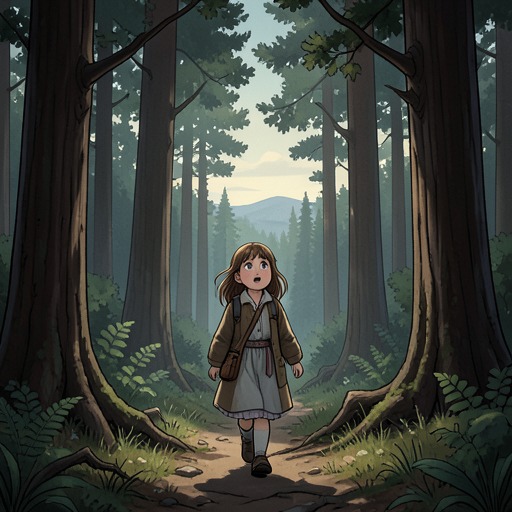
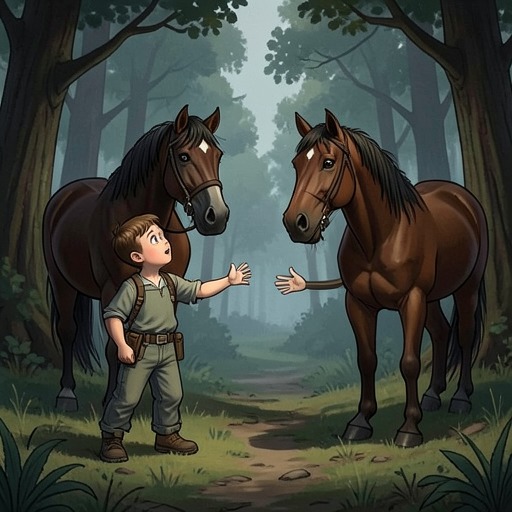
Ronia and Birk capture and tame wild horses to ride
Ronja, the Robber's DaughterRonia and Birk capture and tame wild horses to ride, turning a daring attempt to catch two young stallions into a hard-won partnership. Their riding brings them freedom and pleasure in the forest, but the horses never become mere possessions: their resistance must be met on its own terms, and Lia’s return to the herd makes the limits of human claim unmistakable.
A Forest Shared with Its Inhabitants
The episode grows out of a question of belonging. When Ronia finds Birk watching fox cubs outside their den, she insists that they are her foxes and demands that he leave her woods. Birk rejects both claims. The cubs belong to themselves, he tells her, and the woodland belongs not only to people but to foxes, wolves, bears, elk, wild horses, birds, insects, and other creatures. He adds that even the harpies, gray dwarfs, Rumphobs, and Murktrolls are part of the forest. Ronia says she already knows its living things, but Birk’s rebuke gives that knowledge a practical consequence: seeing animals is not the same as owning them.
Their later decision to catch horses does not simply erase this disagreement. Ronia wants to ride, and the children eventually act on that desire, but they first spend time watching the life around them. In spring they sit quietly as blackbirds and cuckoos call, fox cubs play nearby, squirrels dash through the treetops, hares pass across the moss, and a snake rests in the sun. Neither child disturbs the snake, and it leaves them undisturbed. Ronia accepts Birk’s point that she should not take a horse away from the woods where it belongs; wanting to ride, she says, has become urgent all the same. The capture that follows holds these positions in tension rather than resolving them by declaring the wilderness theirs.
The Capture of Villain and Savage
The opportunity comes when Ronia hears horses galloping somewhere near the river. She hurries Birk along because she wants to catch one, and the children soon see hundreds charging through the forest, their hooves making the ground ring. Later, when a glade fills with grazing horses, Birk points out two fine young chestnuts standing somewhat apart from the herd. They prepare their ropes and approach softly from behind, moving slowly so as not to alarm the animals.
A twig snaps beneath Ronia’s foot. The herd becomes alert and ready to flee, then settles again when no predator appears. The two chosen horses settle too, bringing the children within touching distance. Ronia and Birk exchange a nod and throw their lassos at once. The scene changes in an instant: the two young stallions neigh wildly and struggle, while the rest of the herd thunders away through the forest. The children manage to tether the captives to trees, then jump clear of their flying hooves. The horses kick, rear, bite, and strain against the leather thongs until they are drenched in foam. Catching them is only the start of the work.
The children make names out of the horses’ defiance. After one stallion snaps at Ronia when she offers him bread, she calls him Villain; the equally unruly second becomes Savage. Birk announces that the horses belong to them whether they like it or not, but the animals’ conduct immediately puts that boast under pressure. They tear and bite at their restraints, keep kicking, and frighten animals and birds for miles with their wild cries. The names mark the children’s familiarity with the horses, not the end of their resistance.
Learning to Ride
Ronia and Birk return to the task evening after evening, trying to teach Villain and Savage better manners. At first the effort means repeated falls, bruises, and pain. Ronia complains that no part of her body is free of aches, yet keeps coming back to Villain. Her persistence is not instant mastery: when she first springs onto his back, he throws her, and she lands in the brook, sore but relatively unhurt. She tells him she will return, and she does.
The balance shifts when Ronia comes back prepared for Villain’s attempt to unseat her. This time she grips his mane, holds fast with her knees, and stays on as he bolts into the woods. His speed frightens her; she fears falling and breaking her neck. Birk races after them on Savage, catches up, then brings his horse to a sharp stop. Villain has to halt too, and Ronia is flung forward, but she clings on and regains her seat. Once Villain has run himself out, Ronia praises his running and pats him until he calms. The breakthrough is not simply that she can overpower him: she survives the ride, responds to the horse afterward, and wins enough control for the two of them to return safely.
Birk observes that the horses have at last learned what they are supposed to do and who decides. His words describe a real change in their relationship: Villain and Savage can now carry riders, and the children can ride them through the forest. But control remains negotiated through danger and effort, not granted by the names or the children’s earlier declaration of ownership. Ronia’s resolve, Birk’s intervention, and the horses’ strength all shape the result.
Lia and the Limits of Possession
The children’s connection to a third horse, the mare Lia, develops on a different course. As Lia gives less milk, Birk recognizes that she is expecting another foal and will soon dry up. The flour Ronia brought from home is already gone, and the children have baked their last hard loaves on heated hearthstones. They expect that they can find fish in the forest’s lakes, snare a grouse if needed, and gather edible leaves and herbs; ripe wild strawberries are already plentiful, with blueberries soon to follow. Even so, Ronia does not welcome the prospect of the first day without bread or milk.
That day arrives sooner than expected. Lia still answers when the children call in the evening, but no longer wants to be milked; at last Ronia can draw only a few drops. Instead of pressing her for more, Ronia holds the mare’s head and thanks her for the milk, acknowledging that the next summer’s supply will belong to Lia’s foal, not to the children. Birk thanks her too. Lia stays with them for a while, follows them a little way when they leave, and then returns to her herd. The narrative presents the parting as the close of an unusual interval in the mare’s life, not a transfer of her to human keeping.
Lia later answers when Ronia and Birk call her name, but she does not leave the herd to join them. She remains a wild horse, not a domestic animal. Villain and Savage, by contrast, run eagerly to meet the children and now enjoy racing each other with a rider on each back. Ronia and Birk take pleasure in long rides through the forest. The distinction matters: the children do form a lasting riding partnership with the two stallions, while Lia’s return to the herd sets a clear boundary on what affection and gratitude entitle them to keep.
Freedom, Risk, and Seasonal Change
Riding provides the children with freedom and delight, but it does not make the forest safe or fully governable. On one evening a wild harpy pursues them. The horses panic and become impossible to guide, so Ronia and Birk throw themselves off and let the animals run. Without riders the horses have nothing to fear from the harpy, whose hostility is directed at human beings. In the face of danger, the children’s practical achievement is not to hold the horses at any cost but to release them.
The riders’ forest life also depends on changing seasons and modest stores. Their flour runs out; Lia stops providing milk; and the children look to fish, birds, edible plants, and fruit for food. Later, when autumn arrives, the Unearthly Ones’ laments announce the season’s turn. Summer has faded, and persistent rain leaves Ronia and Birk cold and confined to their cave, unable to keep a fire going. The horses’ story belongs to this wider cycle of wanting, taking, letting go, and adapting. Their capture opens a new kind of movement through the forest, but it does not cancel the children’s dependence on other living things, the weather, or the boundaries those lives impose.