Ronia clears the tunnel and secretly provides for Birk
Ronja, the Robber's DaughterRonia clears the tunnel and secretly provides for Birk in a sequence that transforms a blocked passage beneath Matt’s Fort into a concealed meeting place. Searching for a way to reach Birk across the fortress divide, she labors alone to remove the rubble and then risks crossing into Borka’s Keep. Their reunion leads to a sustained, clandestine effort: she brings him food and helps keep Borka’s family supplied through winter. The action joins physical persistence to a moral choice, as Ronia uses the knowledge and habits of her robber household to protect people on the other side of its feud.
Background: A winter divided by the fortress
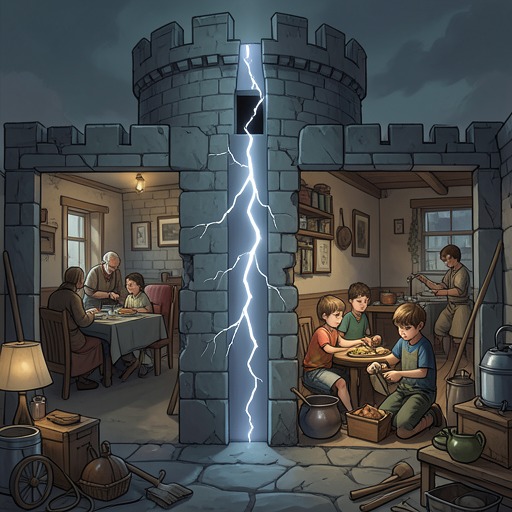
The tunnel ran underground beneath the fortress, past old dungeons, and had been blocked where the storm that marked Ronia’s birth had crushed the rock beneath Hell’s Gap. During winter, the two robber families occupied opposing sides of the divide. Ronia, meanwhile, had reason to miss Birk: in the snowstorm he had promised to be her brother, and she wanted to learn whether he meant it. As spring drew nearer, the separation felt less like a boundary she could accept and more like an obstacle she might remove.
Ronia’s journey through the vaults begins with a different response to the fortress’s past. The underground dungeons make her think of the prisoners once held there, and she pauses over the cruelty associated with their history. Beyond them, she finds the collapsed passage and studies the heaps of stone. Her attention shifts from contemplating the blockage to deciding what to do about it: clearing a route to the other side might bring her to Birk.
Clearing the passage
Ronia returns to the tunnel each morning without telling Matt or Lovis what she is doing. They assume she is outside shoveling snow with the others; instead, she moves the rubble bucket by bucket, dumping the stones into the nearest dungeon. The work leaves her arms and back aching. At night she is exhausted and resolves not to move another stone, but by dawn she is back at the passage, continuing the labor that she has privately chosen for herself.
As the dungeon fills and the heap sinks, the gap becomes just passable with difficulty. The physical task then becomes a decision with uncertain consequences: Ronia does not know what will happen if she enters Borka’s Keep, but she knows that doing so means stepping onto dangerous ground. Her longing to find Birk outweighs that uncertainty. The tunnel-clearing is therefore not only practical preparation; it brings her to the threshold of a choice she must make without knowing how she will be received.
Reunion across the rubble
Before Ronia can cross, she hears footsteps on the far side and fears that a Borka robber may discover her. Then the person whistles a tune she remembers Birk using when he struggled to free her from the rumphobs’ hole. Unable to be sure who is there, she answers with the same tune, softly. After a long silence, Birk calls her name. Ronia recognizes him and answers with joy, then asks whether he truly wants her as his sister.
That exchange gives the meeting its emotional and practical significance. Ronia has not merely reopened a route through the fortress: she has found the person whose promise drew her there. Their reunion turns the passage into a private connection between the divided households, one that allows her to act for Birk without crossing openly through the robbers’ occupied territory.
Food, scarcity, and secrecy
When Ronia meets Birk in the cellar vaults, he is hungry. She opens her leather bag and gives him bread; he eats it all, then drinks the milk she offers. His response makes clear how serious the shortage is, and he asks whether she should not have kept the food for herself. Ronia knows that Matt’s household has plentiful stores, while Birk’s family is struggling to get through the winter.
Birk explains the circumstances behind the shortage. His family had owned goats and sheep before moving to Matt’s Fort, but now their only animals are horses, which they left with a farmer beyond Borka’s Forest rather than risk eating them. Their remaining flour, turnips, peas, and salt fish are running low. Even getting water has become difficult: snow must sometimes be melted because the stream is buried, and bringing water up by the rope ladder is a burden in the stormy winter. The difference between the households is stark: Ronia sees the abundance of Lovis’s larder, while Birk describes a family running short of basic supplies.
Ronia returns early every morning for as long as winter lasts, meeting Birk in the vaults and bringing food from Lovis’s stores. She also gives him a bag of flour and a bag of peas each day, so that he can secretly add them to Undis’s supplies. Her help thus extends beyond a meal for Birk: it supports the household whose hardship he has described, while its repeated, hidden form keeps the assistance from becoming a public challenge to the division between the robber bands.
Moral choice and significance
The secret food-sharing reverses the logic of the feud without resolving it. Ronia’s own side has enough food, while Birk’s family is short; instead of treating that difference as a reason to stand apart, she shares what she can. The passage she clears makes the aid possible, but the daily return gives the act its force: meeting Birk and supplying his family become a sustained commitment rather than a single impulsive gesture.
The action also places Ronia’s developing judgment about robbery in a revealing context. She has already rejected Matt’s expectation that she become a robber chief, and when he frames theft as compatible with being her father, she insists that he cannot rob people if he wants her to remain his daughter. Her secret assistance is distinct from the robbers’ taking: she gives food to people in need rather than claiming a right to take from them. Later, when Noddle-Pete proposes a single robber band, Ronia states that the most cunning solution would be to stop robbing. In this winter episode, care for Birk and his family offers a concrete alternative to inherited loyalty and the logic of the robber life: the sides may be divided by a wall of stone, but their dependence on one another can be answered with practical solidarity.