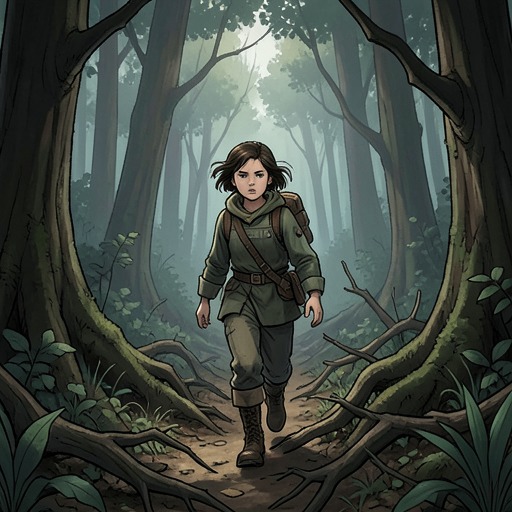
Ronia explores the forest alone for the first time and encounters gray dwarfs
Ronja, the Robber's DaughterRonia explores the forest alone for the first time and encounters gray dwarfs, an episode that turns childhood curiosity into a trial of fear and begins her independent understanding of the world beyond Matt’s Fort. The lake, the darkness, and the creatures Matt warned her about are not abstractions anymore: they are things Ronia experiences for herself. Her father can rescue her from danger, but he cannot dictate what she will learn from it or what she will later believe is right.
The forest becomes a world
Ronia has been told about the river and the forest, but descriptions have not prepared her for their scale. Seeing the river rush in wild rapids from deep under Matt’s Mountain, and the dark, rustling forest stretching beyond the huge fortress, she realizes that neither Matt’s Fort nor Matt’s Mountain is the whole world. The discovery is exhilarating precisely because it exceeds what she had imagined; she laughs silently at the fact that rivers and forests exist.
She follows the path into the wildest woods and reaches the lake, the point Matt has told her not to pass. Black water lies among dark pines, with white water lilies floating on its surface. Ronia does not know their name, but stays to look at them. The day becomes an unhurried sequence of first experiences: she throws pinecones into the water and tries to make them bob by splashing with her feet, climbs mossy boulders, and clambers among pine and fir trees. Her body’s delight in splashing and climbing makes the forest a place to explore, not merely a landscape described by adults.
As the sun sinks behind the wooded ridges, Ronia eats the bread and drinks the milk she brought, then rests on the moss beneath the rustling trees and falls asleep. When she wakes, stars are reflected in the lake and the woods are almost entirely dark. Darkness itself does not frighten her; she remembers that winter nights in Matt’s Fort, after the fire has gone out, are darker still. She climbs back up the boulder for her forgotten leather food bag and briefly imagines reaching for stars to carry home in it. Her confidence is rooted in a child’s direct familiarity with darkness, but it has not yet prepared her for what is waiting in the trees.
The gray dwarfs close in
Only as she is about to leave does Ronia notice a ring of gleaming eyes among the trees. They move closer while strange, gray voices murmur together. The gray dwarfs identify her as a human in their wood and chant, “Gray dwarfs all, bite and strike, gray dwarfs all, bite and strike!” Matt has warned her to watch for them, but now the warning has become an immediate threat: the creatures are below her on the boulder, unseen yet frighteningly near.
The gray dwarfs strike the stone with sticks and clubs, filling the forest’s silence with a horrible hammering. Ronia screams. The banging stops, only for the danger to intensify: she hears the dwarfs scraping up the boulder from every side. She swings the leather bag wildly, convinced they will soon bite her to death and that her first day in the forest will be her last. The bag that held her food and seemed a possible container for stars is reduced to an improvised defense against creatures she cannot see.
Matt’s roar breaks into the scene, followed by the flare of torches among the trees and the arrival of his robbers. He orders the gray dwarfs to leave or be slaughtered. Small bodies thud down from the boulder; in the torchlight Ronia sees them flee into the darkness. The reversal is immediate: a solitary child surrounded on all sides is no longer alone. Matt catches her as she slides down the steep rock, and she weeps into his beard while he carries her home to Matt’s Fort.
Rescue, knowledge, and fear
By the fire, Matt tells Ronia that she now knows what gray dwarfs are. She agrees, but he distinguishes knowing what they are from knowing how to deal with them: if a person is frightened, the gray dwarfs can sense it from far away, and that is when they become dangerous. The encounter thus gives Ronia knowledge through peril, while Matt’s explanation supplies a rule for future encounters. The forest’s dangers are real, but meeting them also requires a kind of composure she has not yet acquired.
The episode establishes a pattern in Ronia’s growing independence. Matt has set a boundary at the lake and warned her about the gray dwarfs, but she encounters the world by going out into it, looking, climbing, and testing what her body can do. Her exploration is not simply a disobedient excursion: it is her first firsthand apprehension of how much lies beyond the fortress. The gray dwarfs make that freedom costly, and Matt’s rescue shows that independence does not mean being beyond the reach of family protection.
From discovery to moral independence
Ronia’s first day in the woods belongs to the larger education that follows. Later, when she hears the robbers discussing what they bring home, she understands that their goods do not grow in the forest: Matt takes them from other people. She asks whether those people become terribly angry, and Noddle-Pete confirms that they do. Matt then presents robbery as an inherited calling, recalling that his father and grandfather were robber chiefs and declaring that Ronia will be one too. She refuses: she will never become a robber chief, even if the victims become angry and cry.
Matt tries to justify taking from the rich, but the defense does not settle the matter for Ronia. When he threatens to rob people, she tells him that he may take money and goods, but not people, or she will no longer want to be his daughter. Her judgment rests on the harm done to actual people, not on the family tradition Matt invokes to make robbery seem honorable. By the time Noddle-Pete proposes a plan to unite the robber bands, Ronia’s answer is more sweeping: the cleverest idea would be to stop robbing altogether.
That ethical independence develops alongside a widening sense of belonging in the forest. When Ronia claims the fox cubs and the woods as hers, Birk answers that fox cubs belong to themselves and that the woods belong to foxes, wolves, bears, elk, wild horses, birds, insects, and other creatures. Ronia insists that she knows the living things there; his reply adds that the forest is also home to the gray dwarfs and other beings she fears or resents. The first encounter with the gray dwarfs therefore gains significance beyond the night’s danger: the woods are not a human possession, and knowing them entails recognizing their inhabitants.
In spring, Ronia and Birk sit quietly among birds, newborn fox cubs, squirrels, hares, and a snake about to have young. They leave one another undisturbed, and Ronia accepts Birk’s understanding that spring is for everyone. The contrast with the night at the lake is sharp. There, unknown inhabitants surround her and fear narrows her attention to survival; later, she can share the woods without claiming its creatures as property. Her first solitary exploration begins with wonder, turns to terror, and opens onto a lasting recognition that the forest is a common home, not an extension of Matt’s authority.