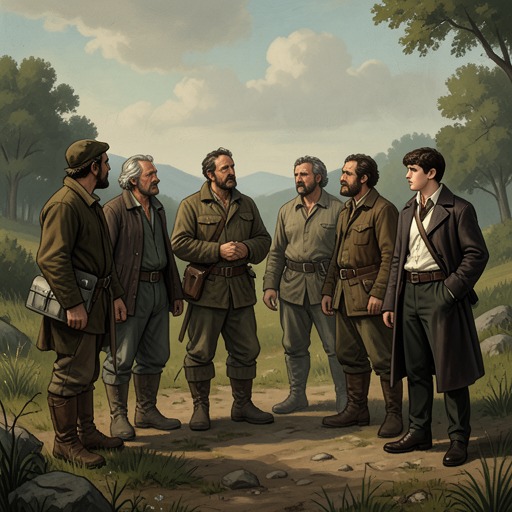
Ronia refuses to inherit the robber chief’s life
Ronja, the Robber's DaughterRonia refuses to inherit the robber chief’s life after discovering what Matt’s calling actually entails: taking other people’s possessions without permission. Her choice cuts across both a family tradition that Matt treats as an inheritance and the love she continues to feel for him. The episode makes the conflict more than a disagreement over a future title: Ronia judges the robber life by what it does to its victims, while Matt struggles to make his own conduct seem worthy of her admiration.
Discovery and Family Tradition
One evening, sitting by the fire with Matt, Ronia remembered the question Borka had raised: what had Matt taken without asking? Matt answered that he had been afraid she would not find her way home through the fog. His evasion shifted the conversation toward what he had concealed, and Noddle-Pete nearly answered for him before Matt insisted on explaining it himself.
With the other robbers already in their rooms and Lovis outside settling the animals for the night, Noddle-Pete was the only witness as Matt defined a robber as someone who took things without asking or permission. Ronia then understood where the goods came from: the sacks and bundles on the robbers’ horses, and the precious things in their chests and boxes, had not grown in the forest. Matt had taken them from other people. The realization replaced an indistinct sense of the robbers’ wealth with a plain account of its source.
Ronia’s first question was about the people on the other side of the theft: did they become terribly angry when their things were taken? Noddle-Pete confirmed that they howled, cried, and swore. His amusement at their distress sharpened the difference between the robbers’ celebration and the victims’ experience. The people who had lost their property were not an abstraction to Ronia; their anger was part of what robbery meant.
Matt framed the calling as a family inheritance. His father, grandfather, and great-grandfather had all been robber chiefs, he said, and he had lived up to their example as the mightiest chief in the woods and mountains. He expected Ronia to become one too. She answered with an emphatic refusal, saying she would never do it, even if the robbed people became angry and cried. The declaration directly joined her decision about her own future to her recognition of the victims’ pain.
Matt’s Justification and Ronia’s Judgment
Matt wanted Ronia to admire and love him as much as he loved and admired her. Her refusal therefore unsettled him: instead of accepting his authority and example, she rejected the occupation on which his pride rested. He tried to persuade her that he took only from the rich, presenting a limit on his targets as a defense of robbery. Noddle-Pete’s recollection undercut the claim: Matt had given to the poor only once, about ten years earlier. The distinction Matt relied on did not amount to the regular generosity his defense implied.
At this first confrontation, Ronia’s refusal of the robber’s life did not mean a refusal of her father. After Lovis returned and Noddle-Pete went to bed, Ronia listened to the Wolf Song and loved Matt as her Matt, whatever he did. The scene holds affection and judgment together: she could remain attached to him without accepting his account of what he did or agreeing to follow it.
That separation between love and consent becomes more severe when Matt later holds Birk captive. Ronia tells Matt that he may rob money, goods, and rubbish, but that he cannot rob people and still expect her to remain his daughter. Matt rejects her moral distinction, calling Birk a thief and treating his capture as a way to clear his father’s fortress. By making their relationship conditional on his right to take and control another person, he turns the earlier dispute over inheritance into an immediate family rupture. Ronia’s words now describe the consequence she is willing to accept: she will no longer be his daughter if he continues to rob people.
Separation, Loss, and the Life She Chooses
After leaving Matt’s Fort, Ronia tries to sing the Wolf Song to Birk as they lie on their fir-branch beds. Remembering how Lovis had sung it to her and Matt when life in the fort was still as it used to be, she feels such yearning that she cannot continue. Her refusal has not erased her attachment to home; the song carries the intimacy of that earlier family life into the cave and makes its absence audible.
The new refuge is materially different from her bed at home, though Birk has prepared it with care. He has cleaned the cave after a bear’s winter sleep, hauled up kindling, and gathered branches for beds. Ronia has her squirrelskin coverlet, and Birk lends her a goatskin to spread over the fir branches. She is not left freezing, but comfort does not dispel the longing. The episode’s quiet details show the cost of refusing Matt’s world without suggesting that Ronia regrets the principle behind her choice.
Ronia’s judgment reaches beyond the immediate quarrel with her father. When Noddle-Pete proposes that Matt and Borka settle their rivalry through single combat and then unite their robbers, she says the most cunning idea would be to stop robbing altogether. Noddle-Pete agrees that she is right, but says he is too old and feeble to drum the idea into Matt’s head. Her objection is not merely to which chief rules or how the rival bands cooperate: she challenges the occupation itself.
A Robber Order Reorganized
The world around Ronia’s refusal remains governed by robbery even while she is trying to leave it. During the period of conflict, little robbery takes place, and travelers using Robbers’ Walk are surprised by the unusual peace. The Sheriff’s men find Borka’s former den deserted and empty of loot; they know there are robbers in Matt’s Forest but prefer not to pursue its hard-to-catch chief. Matt, meanwhile, spends his days scouting the North Fort, trying to discover what Borka’s band is doing and how to attack it. The lull is not a conversion: it is the consequence of a feud occupying the robbers’ attention.
The final contest between Matt and Borka makes the code of that world explicit. In a wild beasts’ match, almost every trick and dirty hold is permitted: competitors may break, bore, rip, tear, bite, scratch, and kick, with a kick between the legs the one prohibited act. Matt wins the contest and stands bloody-faced, his shirt in rags, as the acknowledged chief. He then calls Borka his brother, allows him to retain a chieftain’s name and fame and to continue with his own men, but insists that his own word now counts for more. That evening Matt holds a feast for both bands in the stone hall.
The outcome resolves the leadership struggle but not the ethical question Ronia has raised. The two robber groups are brought together under Matt’s authority, and the old practice continues in a newly ordered band. Against that settlement, Ronia’s refusal remains distinct: family tradition, tactical compromise, and even a language of brotherhood do not answer her basic objection to taking from other people.