Ronia’s birth and the lightning split of Matt’s Fort
Ronja, the Robber's DaughterRonia’s birth and the lightning split of Matt’s Fort form a single charged beginning: amid a storm that drives the forest’s creatures into hiding, a newborn arrives as lightning cleaves the ancestral fortress. The damage is more than a dramatic backdrop. Its chasm divides the place where the rival robber families live, while the life born that night will eventually challenge the inheritance that gives the feud its force.
The birth in the storm
On the night Ronia is born, a thunderstorm rages over the mountains. The goblinfolk of Matt’s Forest retreat to their holes and hiding places, while the harpies wheel around the robbers’ stronghold on Matt’s Mountain, shrieking and hooting. Their noise disturbs Lovis as she prepares to give birth. She insists on singing through the labor, believing that singing makes the birth easier and that a baby arriving to music will be jollier. She sends Matt to drive the harpies away so she can hear her song.
The birth unfolds against a contrast between Lovis’s composure and Matt’s alarm. When the thunder cracks, Ronia gives a small cry, and the sound frightens Matt more than the thunder itself. Lovis calmly takes the baby from him and puts her to her breast; the crying stops. The storm has brought the child into the world, but the family’s immediate response is intimate and ordinary: a frightened father, a mother who knows what to do, and a newborn quieted in her arms.
The fortress is split
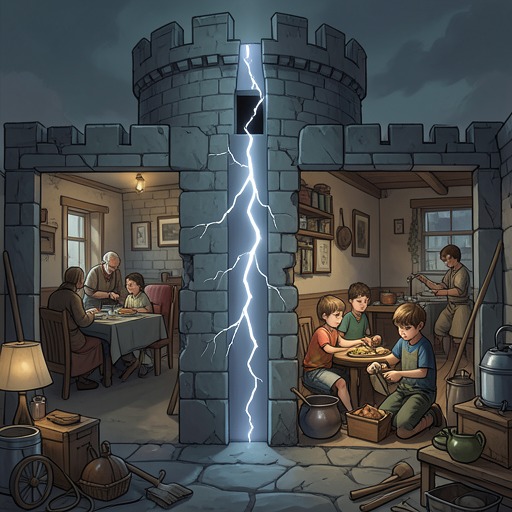
The strike’s full consequence becomes visible in the morning. Lightning has cleft the ancient fortress high on Matt’s Mountain from its highest battlements to the deepest dungeon vaults, leaving the structure in two halves with a chasm between them. Lovis stands beside the shattered wall with Ronia in her arms and tells her that her young life has begun grandly. Her remark makes the ruined fortress and the newborn inseparable in the story’s opening image.
Matt first rages that his forefathers’ old fortress has suffered such damage. His anger, however, does not last: he finds consolation in the possibility that the split might make the fortress easier to navigate, with fewer twists, cellar pits, and places to get lost. He recalls how Noddle-Pete once disappeared inside for four days. The response turns catastrophe into a practical joke, but it does not undo the new division. The chasm remains a material break in the stronghold and, later, the setting for a deeper division between its inhabitants.
A divided home becomes contested ground
The damaged fortress is subsequently occupied on both sides of its break. Birk tells Ronia that the northern part is no longer simply the north fort: since the previous night it has been called Borka’s Keep. The renaming makes clear that the lightning-created division has become a question of possession and identity. Ronia hears the claim as an insult to Matt and vows that he will scatter the Borka robbers, still seeing the two groups through the inherited hostility of their families.
The fortress’s history also exposes how long that hostility has been taught. Borka recalls that, when he and Matt were boys, a little door on the north side served as an exit for the maids to feed the pigs. Near the old pigsty, the boys had caught rats together until Matt’s father found them and boxed Borka’s ears. Borka says that this treatment taught him to regard every member of Matt’s clan as an enemy; before it, neither boy had fully understood that they belonged to opposing clans. The divided building thus holds an earlier, more intimate history beneath its later political boundary.
Openings, refuge, and changed loyalties
The split fortress contains a way in that Matt does not know. After Ronia has cleared a passage through the snow, she realizes she has opened a route into Borka’s Keep. She understands that Matt could use it to reach Borka, but she no longer wants the Borka robbers expelled, because Birk must be allowed to stay. She therefore resolves to keep the passage from becoming an attack route and to prevent Noddle-Pete from discovering what she has done. The old stronghold’s broken structure offers access, but Ronia’s changed loyalties determine whether that access becomes a weapon.
A different kind of shelter lies beyond the fortress. When Ronia and Birk plan to leave, she chooses Bear’s Cave, a place Matt had shown her and had sometimes lived in as a boy. It sits high above the river between two rocky cliffs, reached by a narrow, perilous ledge that widens into a broad stone platform outside the cave. From there, the two can watch morning rise over the mountains and forests. Against the fortress, whose divided rooms have become contested territory, the cave offers a place to live together by choice.
The inheritance Ronia refuses
The conflict rooted in the fortress is also a conflict over what Ronia is expected to inherit. As she begins to understand where the robbers’ evening loads of goods come from, she asks whether the people they rob become angry. Matt tells her that his father, grandfather, and great-grandfather were robber chiefs, declares himself the mightiest chief in the woods and mountains, and says that she is to become one too. Ronia refuses: she will not do it, even if the victims grow angry and cry.
Later, when Matt takes Birk prisoner and Ronia confronts him, she makes her refusal personal. Matt may rob money, goods, and other things, she says, but he cannot rob people without losing her as his daughter. Matt answers by describing Birk as a snake fry, a louse, and a thieving hound, and by insisting that he will clear his father’s fortress; he tells Ronia she may choose whether to remain his daughter. The quarrel brings the question of inheritance to its sharpest point: the fortress belongs to a robber lineage, but Ronia will not let that lineage define what she owes other people.
That judgment persists beyond her escape from Matt’s Fort. When Noddle-Pete proposes settling the conflict between Matt and Borka through single combat and then uniting their robber bands, Ronia says that the most cunning idea would be to stop robbing altogether, as she has always thought. The birth-and-lightning episode therefore stands at the beginning of a story in which a divided stronghold embodies inherited allegiance, while its first-born child comes to imagine a life beyond the robbers’ calling.
Event details
This is a main-narration event with an impersonal third-person narrator. The storm, birth, and lightning strike are presented in chronological sequence; the later conflicts show how the physical split acquires political and personal meaning. The event’s lasting significance lies in that double beginning: Ronia’s life starts as Matt’s ancestral home is broken open, and the fortress’s divided space becomes the setting for competing claims of family, refuge, and choice.