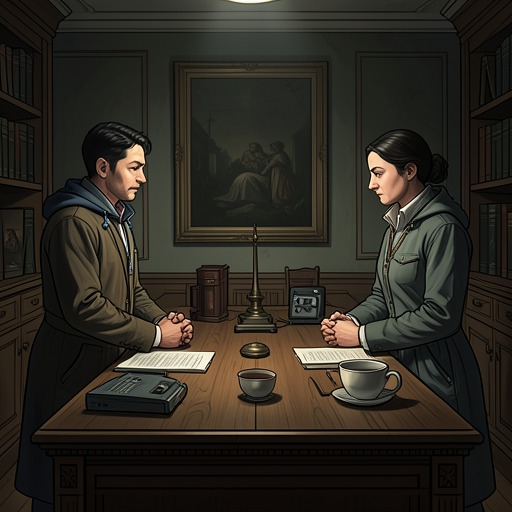
The Matt and Borka families’ age-old feud
Ronja, the Robber's DaughterThe Matt and Borka families’ age-old feud is an inherited rivalry that governs who controls the forest routes, defines the robbers’ competing loyalties, and threatens to carry violence into the next generation. Its decisive challenge comes from Ronia and Birk: their chosen sibling bond crosses the division between the families, while Ronia’s refusal to accept bloodshed as inevitable presses Matt toward a settlement that joins the bands rather than destroying one of them.
Origins and the Forest Rivalry
The feud reaches back through generations: Borka’s father and grandfather were enemies of Matt’s father and grandfather, and the two families have been at loggerheads for as long as anyone can remember. Both lines produced robber chiefs whose bands terrorized people travelling through the deep forests. The conflict is therefore not simply a private quarrel between two men; it is a family history that has become a social order, teaching each side to treat the other as an inherited enemy.
That order is concentrated on Robbers’ Walk, the narrow mountain pass between Borka’s Wood and Matt’s Wood. Travellers face the same danger whether the robbers who waylay them belong to Borka or Matt, but the distinction matters intensely to the rival chiefs. They fight over booty and, when there are too few merchants to rob, rob each other. The feud thus feeds on both inherited hostility and direct competition: territory and stolen goods give the old enmity immediate stakes.
Ronia initially knows none of this. She loves Matt as her kind, bearded father, who laughs, sings, and gives her porridge; she does not yet understand that he is a feared robber chief. The contrast between her intimate experience of Matt and the violence attached to his public identity makes the family conflict something she must eventually judge for herself, rather than simply inherit as a rule.
Inherited Enmity and Its Justifications
The past is kept alive through family stories. Matt and Borka recall childhood episodes in the fortress, including the old pigsty and their attempts to catch rats, but remember their fathers’ authority differently. Matt praises his father for keeping the Borkas in their place; Borka says that Matt’s father taught him to regard every member of Matt’s clan as an enemy, living or dead. Borka adds that, before this lesson, neither boy had scarcely understood that they belonged to different clans. The feud is shown not as an unavoidable instinct but as an identity imposed and reinforced by an older generation.
As a child, Ronia learns what her father’s inherited occupation means when she hears that the goods brought home by the robbers have been taken from other people. She asks whether those people become terribly angry. Matt insists that the robber chiefs before him were robbers and that he has not let them down; he expects Ronia to become a chief too. She rejects that future, refusing to become a robber even if the victims cry. Her response challenges both the occupation and the family logic that presents its continuation as loyalty to the past.
Matt tries to defend his practice by saying that he takes only from the rich, but his explanations do not resolve Ronia’s objection to taking people’s property. When the feud later threatens to turn into bloodshed, she asks why he and Borka must be out for each other’s blood. Matt blames Borka for shooting the first arrow and invokes Bumper as witness, while Lovis warns that the conflict can end only in bloodshed and misery. Ronia asks whether there is no other way. Matt angrily tells her to find one, insisting that driving Borka out of Matt’s Wood is the purpose of the fight; even as he resists her, he admits that sparing Borka could cost him standing among robbers.
Ronia and Birk Cross the Divide
The feud becomes personal for Ronia when she sees its effects on the people she loves. She worries each morning as Matt rides out with his robbers and is not at ease until they return to the long table at night. Her anxiety makes the old rivalry more than a dispute over territory: it is a continuing threat to the lives of both bands and a source of fear in the family home.
At the same time, Ronia and Birk form a bond that the inherited division cannot contain. In the falling snow, near Wolf’s Neck, they must part because Birk has to take a secret route back to Borka’s Keep. Ronia tells him that she wishes he were her brother. He accepts, and she agrees on the condition that he call her Ronia. Their chosen kinship does not erase their families’ conflict, but it gives them a loyalty that runs across it.
That bond acquires public and political force when Matt holds Birk as leverage against Borka. Borka calls Matt vile for using his son to compel him to leave, and says that finding a safe place for his band may be difficult. Ronia then crosses over to Borka’s side and offers herself in exchange for Birk. Borka, startled by her intervention, puts a rope around her neck in response; Matt drops the rope he had held over Birk, but the exchange leaves the two children separated across Hell’s Gap. Each has put the other’s safety ahead of allegiance to a parent’s side.
Birk makes the meaning of that choice explicit when Undis challenges what is between them: he says Ronia is his sister and that she saved his life. Ronia, leaning against Lovis, answers that Birk saved hers too. Their mutual account of rescue gives the sibling bond substance beyond a declaration: it is founded on reciprocal action, and it directly contradicts the feud’s demand that each family regard the other as an enemy.
A Rivalry That Changes Shape
Even after the children’s separation from the old household, the feud persists in memory and daily life. In Bear’s Cave, Ronia tries to sing the Wolf Song for Birk, but remembers Lovis singing it to her and Matt when life in Matt’s Fort was still as it had been. The song’s interrupted return connects her chosen life with Birk to the family home she has left behind; the conflict has divided households as well as bands.
Meanwhile, the feud’s disruption alters the robbers’ activity beyond the families themselves. While Matt concentrates on what Borka’s band is doing in the North Fort and how to reach them, little robbery takes place. Travellers find Robbers’ Walk unusually peaceful, and the sheriff’s men discover that Borka’s former den is empty of both robbers and loot. The men know that Matt’s band remains farther away in Matt’s Forest, but avoid pursuing its difficult-to-catch chief. The rivalry temporarily checks one band’s robberies without ending the wider robber threat.
Matt eventually recognizes that the struggle cannot simply continue as before. After saying that he cannot accept the situation, he notices that he has spoken of the problem as something shared and proposes that the two sides join forces. Borka welcomes the idea of one strong band, but immediately asserts that he should lead it. The old contest over supremacy therefore survives even at the point of reconciliation; the change is that it can now be settled within a proposed alliance rather than through a campaign to expel or destroy the other family.
Settlement and Significance
The leadership dispute is decided through a wild beasts’ match, a formal contest in which a wide range of holds and tactics is permitted, with a specific prohibition against striking between the legs. Matt and Borka fight before the robbers, and Matt wins. The contest translates their rivalry into a bounded test with an outcome the bands can recognize, replacing an open-ended feud over who has the right to rule.
Matt names himself chief but does not strip Borka of his identity or his men. He calls Borka his brother, says that Borka may keep a chieftain’s name and fame and continue with his own band, while making clear that Matt’s word will carry greater weight. That evening he holds a feast in the stone hall for both groups. The ending transforms inherited enmity into an unequal but shared organization: the clans remain distinguishable, yet the robbers gather under one leadership instead of continuing their fight.
The resolution does not make the earlier harm disappear or establish that the families have forgotten their history. Rather, it changes what that history requires of them. The fathers’ feud taught Borka and Matt to interpret clan membership as an obligation to hostility; Ronia and Birk’s self-chosen siblinghood demonstrates a competing loyalty, and Ronia’s insistence that there must be another way makes the adults confront the consequences of their inherited code. The merger offers a concrete alternative to perpetual retaliation without pretending that the rivalry’s roots were shallow or its settlement effortless.