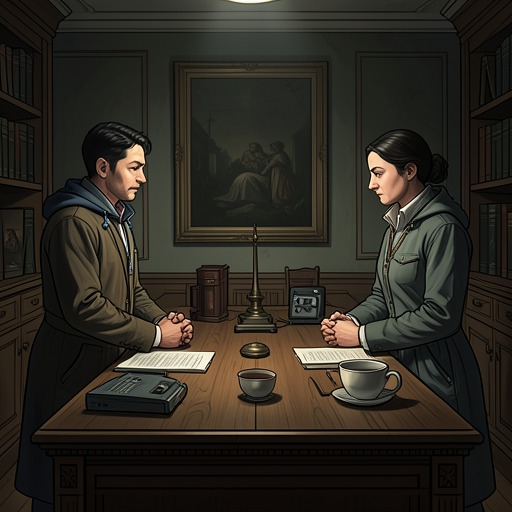
Borka–Birk father-son relationship
Ronja, the Robber's DaughterBorka–Birk father-son relationship gives the feud between Borka and Matt a vulnerable human dimension. Birk is not only one of Borka’s robbers but his child, and that distinction becomes decisive when Matt turns the struggle over the North Fort into a contest over the children. Borka’s affection and concern are visible in his praise of Birk’s daring, his anger at Matt’s treatment of him, and his willingness to bargain for his son’s release; Birk, meanwhile, acts with an independence that neither his father nor the feud can contain.
Family and the North Fort
When Ronia first meets Birk, he identifies himself as Birk Borkason and explains that he lives in the North Fort with Borka, Undis, and twelve robbers. The family has moved in together, and Birk presents the occupation as an accomplished fact: they arrived the previous night. His place in the group is therefore at once familial and practical, but the story first introduces him through a dispute between children over who belongs in the forest and who counts as a robber.
Borka makes Birk’s role in the takeover explicit when Matt demands to know how the band entered the fort. He calls his son a little monkey and describes how Birk climbed the steep wall with a long, strong rope trailing behind him, then tied it securely so the others could follow. Borka pats Birk’s red topknot as he recounts the feat, while Birk smiles. The gesture turns a military advantage into a father’s open pride: Birk’s daring has helped his family establish itself in the keep, and Borka celebrates him in front of their enemies.
Inherited Feud and Moral Choice
The adults’ inherited hostility threatens to define Birk’s relationships before he can choose them. Matt says that his father kept Borka’s people in their place, while Borka recalls being taught to regard every member of Matt’s clan as an enemy. Borka also admits that, before that teaching, he had scarcely understood that the two men belonged to different clans. Matt now declares that either a Borka robber will die or Borka’s band will leave Matt’s Fort. Borka’s refusal to give up the keep makes clear that the old conflict has become a present struggle over home and security, not merely a family story handed down unchanged.
Birk’s friendship with Ronia brings that inherited division into direct conflict with personal attachment. When Matt holds Birk and demands that Borka leave, Borka condemns the tactic as vile: Matt is using Borka’s child to get what he wants. Borka does not pretend that leaving will be easy. He says he must first find a place where his family can settle safely, but promises they will be gone before summer ends if Matt returns his son. Matt gives his word that Birk will be returned within the same period. The bargain shows Borka’s priorities under pressure: the dispute over territory remains serious, but his son’s safety is the immediate stake.
Hostages and the Exchange
Ronia intervenes by putting herself in Birk’s place, and Borka quickly recognizes that her action has changed the situation. Though confused by the sight of Matt’s daughter helping him, he acts on the opening: he puts a rope around Ronia’s neck and tells Matt that Borka’s side has underground dungeons too. Across Hell’s Gap, Matt drops the rope that had held Birk, but Birk remains pale and crushed as he looks toward Ronia. The exchange gives Borka his son back, while making the children’s loyalty to each other impossible to dismiss as part of the adults’ clan enmity.
At the later exchange at Wolf’s Neck, Borka waits with Undis and the robbers beyond the pass. When he sees Ronia and Birk looking at one another, he asks whether his son has been keeping company behind his back with the enemy’s offspring. Birk answers that Ronia is his sister. The claim does not reconcile the adults: Undis responds with suspicion, and Borka is angry. But Birk’s declaration makes a chosen bond more important to him than the feud’s demand that he treat Ronia as an enemy.
Birk also refuses to be physically directed by his mother. When Undis grabs him and tries to pull him away, he tells her not to touch him, says he will go by himself, and walks off. The moment does not show him rejecting his family as a whole; rather, it marks a boundary within it. His relationship with Borka is entangled in a household and clan whose rules press against the attachment he has chosen for himself.
Leaving Borka’s Keep
After the children part, Ronia waits by the lake and finds that spring no longer gives her the same pleasure without Birk. When he finally arrives, carrying a large bundle, he tells her that he is moving into the forest because he can no longer live in Borka’s Keep. He explains that he cannot endure nagging and hard words forever and that three days have been enough. The scene locates the separation in the daily atmosphere of the keep: Birk’s decision follows the hostility and pressure he experiences there, rather than a stated break with his father’s love.
Birk’s departure changes the practical shape of the father-son relationship. Borka’s household and the robber band have been the setting of Birk’s life, but he chooses to leave that setting and make a home in the forest with Ronia. His earlier willingness to help his father’s band and his later refusal to remain in the keep coexist: filial connection does not erase his need to act on his own judgment.
What the Relationship Reveals
The relationship develops against a story in which adults defend robbery through inheritance and custom. Matt tells Ronia that he comes from generations of robber chiefs and expects her to follow him; she rejects that future, asking whether the robbed people become terribly angry and declaring that she will never be a robber chief if they cry. Later, when Noddle-Pete proposes a single combat to settle the leadership dispute, Ronia says the most cunning solution would be to stop robbing. These choices illuminate Birk’s position without making him an advocate for his father’s calling: he can take part in Borka’s daring occupation of the keep and still choose companionship and a life beyond its continual quarrels.
The novel does not reduce Borka and Birk’s bond to either obedience or rupture. Borka takes pride in his son, fights to secure his return, and is unsettled when Birk names Ronia as his sister; Birk remains emotionally connected to the family while resisting its demands and leaving its home. The relationship thus turns the clan feud into a question of what inheritance can and cannot command. Borka can pass on a name, a household, and an enemy, but Birk’s most consequential loyalties are not fixed by those inheritances alone.