Borka’s robbers
Ronja, the Robber's DaughterBorka’s robbers begin as Matt’s feared rivals and become the other half of a single band at Matt’s Fort. Driven from Borka’s Wood by the Sheriff’s men, they occupy the fort’s north side, endure a winter of shortage, and clash with Matt’s men over stolen goods. Their eventual union ends the separation between the bands without erasing their distinct loyalties: Borka keeps his chieftain’s name and his own men, but Matt becomes chief. Through that change, the band’s history turns the inherited feud into a question of survival, authority, and whether robbery itself should continue.
Identity and Background
Borka’s robbers are the company led by Borka, Matt’s archenemy. The enmity predates the current chiefs: Borka’s father and grandfather had been enemies of Matt’s father and grandfather, and the two families had been at loggerheads “since time immemorial.” Both bands prey on travelers passing through the forests, especially along Robbers’ Walk, the narrow mountain pass between Borka’s Wood and Matt’s Wood. To the people being robbed, it scarcely matters which band takes their goods; to Matt and Borka, the distinction is bound up with rivalry, booty, and competing claims to power.
The feud shapes how the bands speak about one another. When Ronia grows up in Matt’s Fort, she hears the men condemn Borka’s robbers as “dirty devils” and assumes that Matt’s own company must be better. Matt’s boast that Ronia’s birth will torment Borka likewise treats the rival chief’s childlessness as a weapon in their contest. The words are not an impartial description of either band: they reveal how thoroughly each company inherits its leader’s hostility.
Arrival at Matt’s Fort
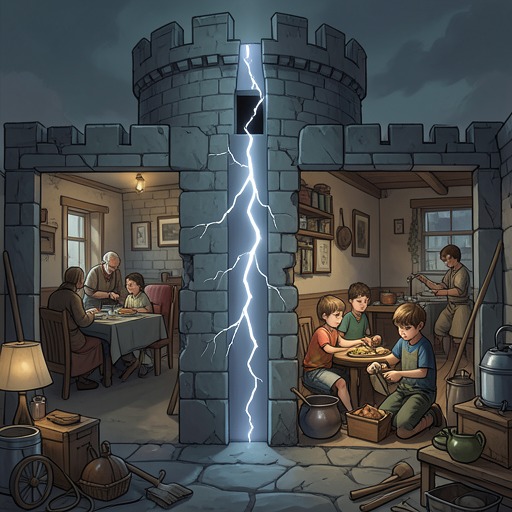
The band’s move begins when the Sheriff’s men make Borka’s Wood unsafe. Borka explains that soldiers are swarming through the forest and that he had to take his wife, child, and robbers somewhere else. He brings them into the north side of Matt’s Fort without permission, a seizure Matt condemns even as Borka points out the irony of a robber objecting to someone taking what he wants. Borka’s men have not merely wandered into the keep; they have organized themselves a new robber’s den there.
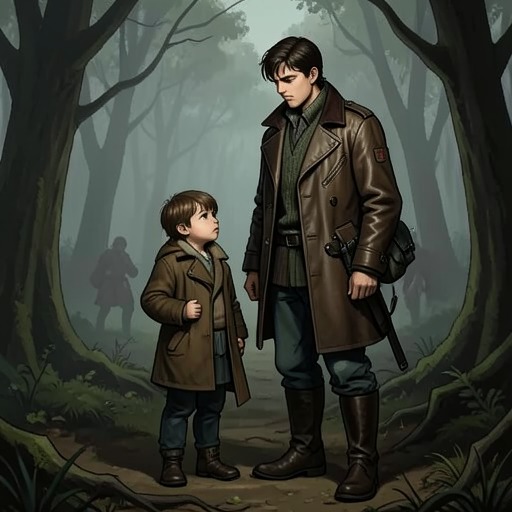
Their entrance depends on Birk’s daring climb. Borka describes his son as a little monkey who scaled the steep wall with a long, strong rope trailing behind him, then secured the rope so the rest of the company could follow. The new occupants settle in the north fort, turning Matt’s stronghold into shared ground divided between enemies. Ronia’s first response is to apply the language she has heard at home and ask whether the entire north fort is full of “dirty devils.” Birk answers by reversing the accusation: his family considers Matt’s side the dirty one. The exchange makes the feud’s mirrored judgments plain even as the rival children meet face to face.
Shortages, Raids, and the Cost of Rivalry
The move leaves Borka’s robbers materially weakened. Before leaving their former home, they had goats and sheep; at Matt’s Fort, they have only their horses, which they have stabled for the winter with a farmer beyond Borka’s Forest. Their remaining flour, turnips, peas, and salt fish are running out. They have so little water that they melt snow when deep snow makes it impossible to reach and dig out the stream. Carrying a bucket up the rope ladder in a snowstorm compounds the hardship of living in the exposed keep.
That deprivation is one reason Ronia begins secretly to help Birk’s family, though the band’s circumstances also make the conflict between the children’s households tangible. From Matt’s side, the great larder is stocked with bread, cheeses, eggs, salted food, smoked mutton, flour, grain, dried peas, honey, hazelnuts, and herbs. The contrast between abundance and near-starvation gives the rivalry an immediate domestic consequence: while the two bands occupy the same fortress, their children experience sharply unequal access to food and comfort.
The antagonism turns violent during a raid. After Matt’s men have loaded their booty onto their horses, Borka and his followers arrive demanding a share. Arrows fly on both sides; Bumper is struck in the throat, and two or three of Borka’s men are hit in return. Bumper survives, but the wound leaves his head tipped to one side. Matt interprets the attack as the opening of a larger campaign and vows to put an end to Borka’s robbers. Ronia, distressed by the escalating hatred and fearful each morning when Matt’s men ride out through Wolf’s Neck, sees the threat to both bands: if Matt’s men can be destroyed, his own company may perish too.
A Divided Band and a Shared Threat
The rivalry is sustained not only by old family hostility but by competition over plunder and the need to evade the law. Noddle-Pete argues that the two separate bands waste their strength cheating one another and fighting over booty, like wolves over scraps. The Sheriff’s men hunt them persistently; when Borka’s former den in Borka’s Wood is found, it has been abandoned and emptied of loot. For a time, Robbers’ Walk becomes unexpectedly peaceful, leaving travelers puzzled about the highwaymen’s disappearance. The quiet does not mean the danger has ended: Matt still scouts the north side, looking for a way to attack Borka’s men.
Matt’s failed attempt to storm the keep shows how guarded the division has become. When the rope ladder is lowered, he rushes toward it to climb up, and his men follow, eager for battle. Arrows from the loopholes of Borka’s Keep drive them back; Little-Snip is hit in the thigh and spends two days in bed. The ladder is thereafter lowered only under strict guard. The episode makes the fortress’s physical division a practical barrier as well as a symbol of the feud: each band has a foothold, but neither can take the other’s without risking injury.
Later, the Sheriff’s men make the shared danger impossible to ignore. Borka comes to warn Matt that soldiers are lying in ambush at Robbers’ Walk. Two of Borka’s men have been captured, and another has been badly wounded by an arrow while trying to escape. Borka offers the warning in return for Matt’s recent rescue of two of his men from the sheriff’s dungeon. Their exchange does not erase hostility, but it establishes a debt of assistance across the old divide. Matt hears himself speak of what “we” must do against the soldiers and recognizes that cooperation has already entered his thinking.
Settlement and Significance
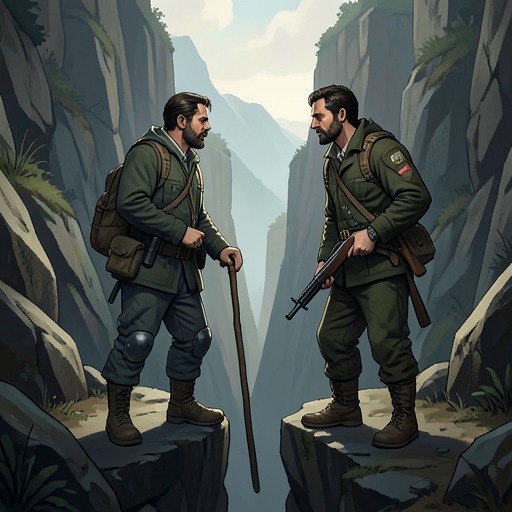
The bands’ merger is settled through a contest over leadership rather than an effortless reconciliation. Noddle-Pete has argued that one strong band could resist the Sheriff’s men more effectively than two companies busy fighting each other. Matt accepts the prospect of joining forces, but immediately raises the question of who will be chief. Borka also imagines himself as the strong and resourceful leader. Their rivalry thus survives inside the proposed alliance, and the men gather in suspense for a single combat to decide it.
The contest follows the rules of a wild beasts’ match: almost every trick and dirty hold is allowed, including breaking, biting, scratching, kicking, and tearing, while a kick between the legs means immediate defeat. Matt and Borka charge one another amid war cries. Matt wins and stands bloodied, with his shirt in rags, recognized by the robbers as chief. The result establishes a hierarchy, but not the expulsion or humiliation of Borka’s company.
Instead, Matt addresses Borka as his brother and grants him a continuing place in the new order. Borka may keep a chieftain’s name and fame and carry on with his own men, while Matt’s word takes precedence. That distinction is crucial: the united band retains Borka’s group as a recognizable company, but its overall authority belongs to Matt. The settlement replaces a contest between two separate leaders with a negotiated structure inside one band.
Matt celebrates that evening with a feast in the stone hall for both companies, with food and beer. As the night goes on, he and Borka sit side by side, laughing and crying over childhood memories, including hunting rats together in the old pigsty. Their shared recollections make the new kinship more than a public formula after the fight. At the far end of the table, Ronia and Birk laugh too, their presence a joy to both men after the long period when neither child was at Matt’s Fort. Matt acknowledges that Ronia refuses to inherit his calling and imagines that Borka’s son may one day be chief. The final gathering therefore joins the bands without requiring the children to repeat the old pattern: their laughter accompanies a settlement built on cooperation, while Ronia’s refusal to become a robber chief leaves open the possibility of a different future.