Matt–Borka longstanding feud
Ronja, the Robber's DaughterMatt–Borka longstanding feud is an inherited conflict between two robber families that turns a contest over territory and booty into a threat to both clans and their children. Its force comes not only from old grievances but from the way tradition presents enmity as a duty; the eventual alliance shows that this supposedly permanent inheritance can be challenged and remade.
Origins and Material Stakes
The rivalry reaches back through generations: Borka’s father and grandfather were enemies of Matt’s father and grandfather, and the families had been at loggerheads for as long as anyone could remember. Both clans robbed travelers moving through the forests, making them a danger to ordinary people who had to cross the region with horses and wagons. Their shared occupation did not unite them; it put them in direct competition.
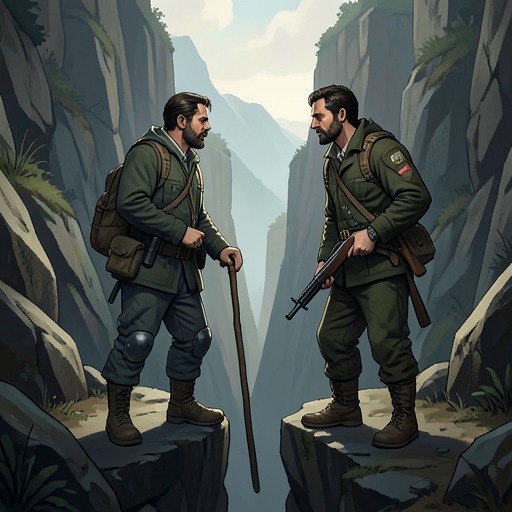
The narrow mountain pass between Borka’s Wood and Matt’s Wood, known as Robbers’ Walk, makes that competition concrete. Travelers feared the route, but, from the victims’ perspective, it mattered little whether Matt’s robbers or Borka’s robbers took their goods. To the chiefs, however, the distinction mattered enormously. The two bands fought over the proceeds and were willing to rob each other when too few merchants passed through. The feud was sustained by territory, rivalry, and the practical scarcity of targets, as well as by inherited hostility.
Territory and the Inheritance of Hostility
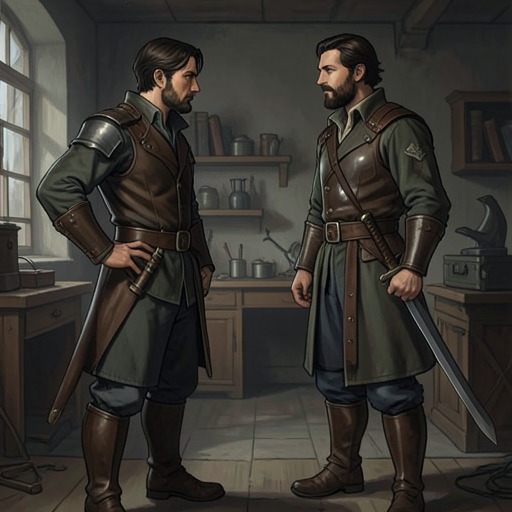
When Borka brought his family and band to Matt’s Fort, he explained that he could no longer remain in Borka’s Wood because the Sheriff’s men were swarming there. Matt objected that Borka had taken a place to live without asking. Borka answered by pointing out the hypocrisy: Matt himself had always taken what he wanted without permission. Matt could offer no reply. Their confrontation thus exposes a conflict between the rule Matt invokes against Borka and the robber practice that both men share.
The disagreement is also framed as a clan obligation. Matt says that his father kept the Borka clan in its place; Borka counters that Matt’s father taught him to regard every member of Matt’s clan as an enemy, living or dead. Borka says that, before this lesson, he had scarcely understood that the two men belonged to different clans. Matt now insists that either a Borka robber will be mourned or Borka’s band will leave Matt’s Fort. Borka refuses to go, declaring that he has made a home in Borka’s Keep. Each man treats the other’s presence as an intolerable challenge, while their language reveals how a previous generation’s teaching has hardened into present-day policy.
Ronia’s Recognition and Rejection
At first Ronia does not know that her father is a feared robber chief. She sees Matt as a kind, bearded father who laughs, sings, and gives her porridge. That affection makes her later discovery more consequential: when she understands that the goods the robbers bring home have been taken from other people, she asks whether the victims become terribly angry. Noddle-Pete confirms that they do, describing their anger as a source of amusement to the robbers.
Matt then presents robbery as a family inheritance. He tells Ronia that his father, grandfather, and great-grandfather were robber chiefs and declares that she too will become one, as the mightiest chief in the woods and mountains. Ronia refuses. Her response is tied directly to the victims’ distress: she will not take part, even if the people whose goods are taken grow angry and cry. Matt wants her admiration and love and tries to make his conduct appear right, including by saying that he takes only from the rich. But his defense does not undo what she has understood: the goods came from other people, and those people suffer their loss. Her refusal makes the inherited role a moral choice rather than an unquestioned destiny.
The conflict also becomes personal for Ronia because the two chiefs’ hostility threatens the people she loves on both sides. After Bumper is wounded in a clash between the bands, Matt vows to bring an end to all Borka robbers. Ronia asks whether Matt’s own robbers might also be destroyed, but Matt refuses to consider that possibility. She sees that the feud, which the chiefs describe as a fight against the other side, places both groups at risk. As Matt rides out each morning, she worries about how many will return unharmed and is not reassured until she sees them gathered again at the long table that night.
Kinship Across the Divide
Ronia asks Matt why he and Borka have to be out for each other’s blood. Matt blames Borka for shooting the first arrow, with Bumper as his witness. Lovis, too, argues against Matt’s course, telling him that the child has more sense and warning that the conflict can end only in bloodshed and misery. Matt insists that driving Borka out of Matt’s Wood would be worth the cost. Ronia presses the issue: must that happen through bloodshed, with everyone dead before Matt gives in? Her question refuses the feud’s premise that force is the only means of settling the dispute.
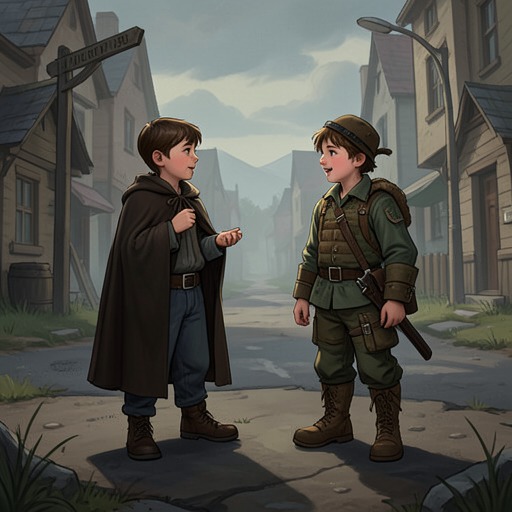
The bond between Ronia and Birk gives that refusal a living form. During the winter, as the two part near Wolf’s Neck, Ronia tells Birk that she wishes he were her brother. He readily agrees, provided she calls him Ronia. Later, when Ronia intervenes as Matt holds Birk and Borka’s family faces the threat of losing him, Borka recognizes that she has changed the situation and takes her as a counter-hostage. The exchange makes the children’s bond part of the adults’ struggle, but it also shows that Ronia’s allegiance cannot be reduced to her father’s clan. Birk calls her his sister and says she saved his life; Ronia adds that he saved hers. Their mutual rescue and chosen kinship cross the division that the older generation has treated as absolute.
From Feud to Alliance
Ronia’s challenge helps open a path away from the threatened violence. Matt eventually tells her that she was right: there need be no bloodshed. His immediate plan is still to make Borka leave, but the declaration marks a change in the means he is willing to consider. The feud’s established demand—defeat the rival and reclaim the disputed territory—begins to give way to a possibility that does not require the bands to destroy one another.
The final settlement emerges when Matt recognizes the force of a shared problem and proposes that the two bands join. His own use of the word “we” surprises him, and he hesitates before suggesting that they join forces. Borka welcomes the idea but assumes the united band should have one strong chief and presents himself for the role. Their old contest immediately reappears in a new form: the issue is no longer whether the bands will fight, but which man will lead them.
They settle that question through a wild beasts’ match, a contest whose rules permit nearly every kind of trick and hold but forbid a blow between the legs. Matt wins and is acknowledged as chief. He then calls Borka his brother, allows him to retain the name and standing of a chief and to continue leading his own men, but makes clear that Matt’s word will carry greater authority. That evening he holds a feast in the stone hall for both bands. The arrangement does not erase their history or make their leadership equal; it converts the old rivalry into a single organization with Matt in command and Borka still honored within it. The feud’s ending therefore comes not through the disappearance of difference, but through a negotiated structure that joins the former opponents.