Matt’s Forest
Ronja, the Robber's DaughterMatt’s Forest is both the territory of rival robber bands and a living world that refuses to belong to them. It is where Ronia learns to move freely beyond Matt’s Fort, where the forest’s animals and supernatural dangers set their own terms, and where the contrast between human possession and shared habitation becomes central to her understanding of home.
Territory and danger
Matt’s Forest lies within the wooded mountain country in which Matt and Borka’s families have long fought for control. Their feud stretches back through generations: both families are robber dynasties, and both prey on travellers passing along Robbers’ Walk, the narrow mountain pass between Borka’s Wood and Matt’s Wood. To the people being robbed, which gang controls the road makes little difference; to Matt and Borka, the distinction is worth fighting over, even when the available merchants are so few that the rival bands rob one another.
The forest is not made dangerous by human conflict alone. Wild harpies fly over it, while gray dwarfs and other uncanny beings inhabit its spaces. When Ronia is born during a thunderstorm, the goblinfolk retreat to their holes and hiding places, but the harpies relish the weather and circle the robbers’ stronghold, shrieking. Years later, as autumn comes, harpies chase Ronia through the trees. She escapes by diving into a pool, swimming underwater, and hiding beneath a thick fir while they search and cry out. The episode makes the forest’s dangers concrete: survival depends on knowing the ground and its hiding places, not on the authority of the people who claim the surrounding territory.
Ronia enters the forest
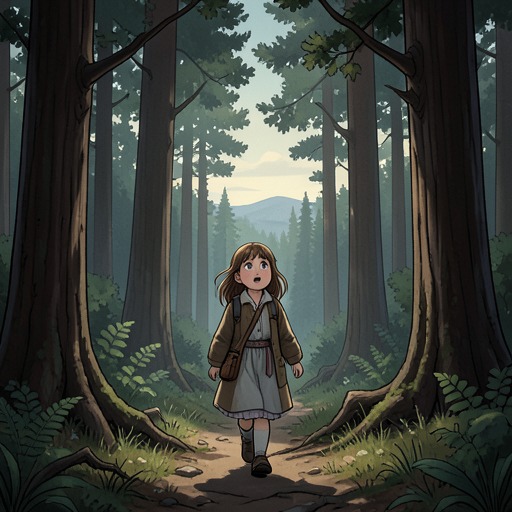
For much of her early life, Ronia knows little beyond Matt’s Fort. When Matt finally recognizes that she must learn what it is like to live in the forest, he lets her go out. The decision opens a world that had been kept from her partly because of the dangers, especially the harpies. Ronia responds by learning the landscape through movement and practice. She explores the fort’s deserted rooms, underground passages, dark pits, and cellar vaults, and discovers the fortress’s secret passages as well as the forest’s secret paths. Yet she loves the forest best, running there freely for as long as daylight lasts.
Her growing confidence is not a victory over nature so much as an education in living within it. She practices watching out, learns the places where she can hide, and becomes strong and agile. By the time autumn arrives, she is no longer frightened away from the paths and places where she lives her solitary forest life. The forest gives her pleasure and room to act independently, but it never becomes harmless: the harpies remain a real threat, and her freedom depends on attention to the risks around her.
A shared home, not private property
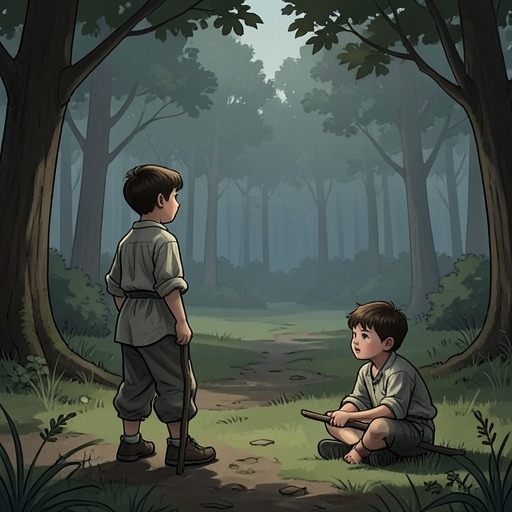
Ronia’s understanding of the forest is challenged when she finds Birk watching fox cubs near their den. She claims the cubs as hers and tells him to leave her woods. Birk answers by rejecting both claims. The fox cubs belong to themselves, he says, and the woods belong to foxes, wolves, bears, elk, wild horses, birds, insects, and many other living things. He includes even creatures Ronia dislikes, such as wild harpies and gray dwarfs. The exchange turns a quarrel over animals and territory into a disagreement about what it means to belong in the forest.
The book gives that principle a quiet, observable form in spring. Ronia and Birk sit without disturbing newborn fox cubs, squirrels, hares, or a snake resting in the sun. The animals continue their lives around them; the two children are present, but do not treat every creature as theirs to command. Their shared stillness contrasts with the rivalry of the robber families, whose claims to the woods and roads are backed by theft and force. The forest’s abundance does not erase hardship—Birk’s family can be short of food even while living near this natural world—but its inhabitants cannot be reduced to a storehouse for human use.
Living with animals
The forest’s animals shape the children’s lives through their own choices and limits. Ronia and Birk ride Villain and Savage, but riding is neither effortless nor proof of mastery. When Villain bolts with Ronia on his back, she holds onto his mane and grips with her knees while the horse races through the trees. Birk catches up on Savage and stops sharply, forcing Villain to halt; Ronia nearly flies over his head, then regains her seat. The horses’ speed and fear make the danger of the ride plain, while Ronia’s decision to stay mounted turns the encounter into a test of her nerve and skill.
The injured wild mare Lia offers a different kind of relationship. After the children have received milk from her, Ronia recognizes that Lia no longer wants to be milked. She thanks the mare and acknowledges that the milk to come will belong to her foal, not to the children. Birk thanks her too. Lia returns to her herd and, although she sometimes answers when they call, never leaves the other horses to join them. The children can remember and care for her without converting her into a domestic animal. Her return is a limit on human possession, not a rejection of the bond they formed.
That limit becomes urgent when a wild harpy pursues Ronia and Birk during an evening ride. The horses panic, and the children can no longer control or guide them; they throw themselves off and let the horses run. The harpies hate and pursue human beings, not the other animals, so the riders’ presence is what brings the immediate danger. Here, as elsewhere, safety depends on understanding the difference between the children’s vulnerability and the animals’ place in the forest.
Seasons and belonging
Matt’s Forest changes with the seasons, and the children’s experience of it changes with them. Ronia’s first years of wandering carry her from summer into autumn, when the harpies grow more ferocious. Later, spring brings new fox cubs, birdsong, squirrels, hares, and the grazing horses into view. Seasonal abundance is not merely scenery: it determines when animals have young, when Lia can give milk, and what kinds of risks the children face. Their attention to these patterns helps them live in the forest without assuming that every resource or creature exists for their use.
The robber conflict also alters the forest’s human traffic. During the period when Matt and Borka’s bands are preoccupied with their struggle, little robbery occurs on Robbers’ Walk. Travellers are surprised by the unusual peace, and the sheriff’s men find Borka’s former den deserted. Later, Matt explains that the sheriff’s pursuit has intensified because the united robbers rescued Peller from the dungeon and took two of Borka’s men with him. The forest remains a refuge and a contested domain, but its relative quiet is temporary: the outlaw life draws the state’s attention back into the woods.
Near the end of the story, Matt and Borka settle their leadership struggle through a wild-beast match, governed by rules that allow brutal holds and bites but forbid a blow between the legs. Matt wins and grants Borka a chieftain’s title and the right to continue with his own men, while insisting that his word carries greater authority. Their agreement changes the organization of the robber bands, not the deeper question of who the forest is for. Against the claims of chiefs, roads, and rival families, Matt’s Forest remains most fully itself as a habitat shared by human and nonhuman life.