Matt’s Fort
Ronja, the Robber's DaughterMatt’s Fort is an ancient mountain stronghold whose physical division gives the story a durable image of separation and eventual reunion. Lightning cleaves the fortress in two on the night Ronia is born, but the household continues in the familiar rooms on the southern side. The stronghold remains home, refuge, and the center of robber life even as its North Fort becomes contested ground and its stone hall witnesses the return of laughter and a newly united band.
Setting and Structure
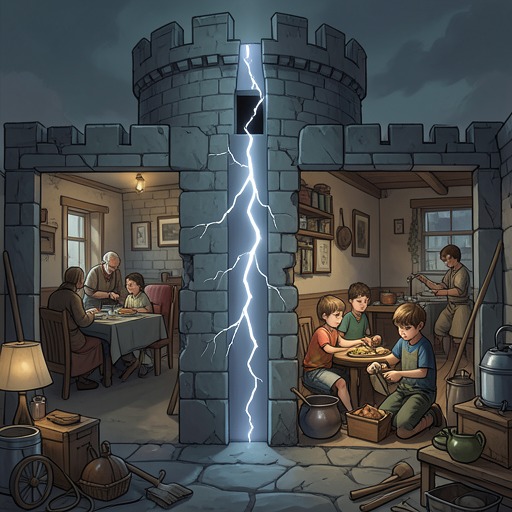
The fortress stands high on Matt’s Mountain. The lightning strike splits it from the highest battlements down to the deepest dungeon vaults, leaving a chasm between its two halves. The damage is not a small breach in a wall but a division through the whole ancient structure, separating parts of the stronghold that had belonged to one inherited home.
Matt’s first reaction is fury at the destruction of his forefathers’ fortress. He soon finds reasons to take a more practical view: the household had never used all of the sprawling building, and its remaining hall, bedrooms, and tower rooms can still serve as before. The split does, however, leave the outhouse on the far side of the chasm, a conspicuous inconvenience amid Matt’s attempt to make light of the disaster. He also recalls that Noddle-Pete once got lost in the fortress for four days while exploring its great size; the newly divided building seems to promise fewer cellar pits and confusing passages to keep track of.
Stronghold and Refuge
Matt’s Fort is difficult to approach. It stands atop a cliff, sheer on three sides, while a narrow bridle path zigzags down the mountain on the south side and vanishes into the forest. That path passes through Wolf’s Neck, where Matt’s men can guard the approach and, if necessary, roll rocks down on anyone trying to force a way through. The robbers boast that the fort is as safe as a fox in its lair and an eagle in its nest, confident that no enemy could climb the cliffs or get past the guarded neck.
The confidence has limits. When Borka’s robbers establish themselves in the North Fort without being spotted, Matt and his men cannot explain how they passed the night watch at Wolf’s Neck. Matt responds by placing guards both there and on the roof. His fear that Borka might suddenly rush across Hell’s Gap and drive the household out turns the old fortress’s divided plan into an immediate military problem: the chasm is not merely the visible scar of the lightning strike but a boundary around which the rival bands’ struggle is organized.
The fort’s stone hall is the household’s social center as well as its defensible interior. The robbers gather there to eat, and later it becomes the setting for a decisive homecoming. When Matt and Ronia enter together after their estrangement, the gathered men are so uncertain how to receive them that no one dares cheer. Noddle-Pete breaks the silence with an uncharacteristically high leap of joy and a remark that returning people should receive a greeting. Matt’s first great laugh since the misery at Hell’s Gap releases the robbers into shared laughter; when Lovis arrives from the sheep pen to greet her lost child, the laughter gives way to tears.
A Home Changed by Ronia
After the lightning strike, life in Matt’s Fort resumes much as before, but the presence of Ronia alters its emotional character. Lovis observes that the child gradually makes Matt and his twelve robbers gentler and milder, even as they become so absorbed in her that ordinary work is neglected. The men celebrate her first crawling, especially because she propels herself unusually fast by pushing off with her left foot. Lovis considers such noisy excitement excessive, but the scene establishes the fort as a place where a fierce robber household can be softened by attachment to a child.
The fort also gives Ronia her first direct understanding of what her father’s occupation means. She hears that the goods the robbers bring home in sacks, bundles, chests, and boxes are taken from other people, who become furious and cry out in anger. Matt describes himself as heir to a line of robber chiefs and expects Ronia to become one too. She rejects that inheritance, insisting that she will never take part in a life that makes people suffer. Their disagreement makes the home itself a site of moral conflict: Matt wants his daughter’s admiration and love, while Ronia’s sympathy for those robbed prevents her from accepting the family tradition as good.
The dispute becomes more painful when Matt threatens to clear the North Fort of Borka’s men and Ronia tells him he may take goods but must not rob people if he wants her to remain his daughter. Their quarrel turns the fort’s division into a family rupture as well as a conflict between robber groups. Later, even after she and Matt are reunited, Ronia voices her objection plainly to Noddle-Pete: the cleverest plan would be to stop robbing. The stone hall can again hold laughter, but her return does not erase the ethical disagreement that changed how she understood her home.
North Fort and the Rival Band
The fort’s division acquires a second meaning when Borka’s band takes hold of the North Fort. Matt and his men had believed that every approach to Matt’s Fort could be watched, yet the newcomers appear without passing the guard at Wolf’s Neck in any visible way. The occupation exposes a weakness in the stronghold’s defenses and forces Matt to consider how to remove men who have secured themselves inside its northern section.
For Ronia, the presence of Borka’s robbers is not simply an invasion by strangers. She has ties to Birk and wishes the conflict between the two families to end, but Matt sees Borka’s arrival as a direct challenge to his authority. His response—more guards at the neck and on the roof, and the expectation that Borka might charge across Hell’s Gap—shows how quickly the household’s refuge becomes a contested border. The physical split of the fortress supplies the setting for an old feud to become visible within the walls of one home.
Return, Feast, and Reunion
When Ronia returns with Matt, the stone hall registers how much has changed. The silence at their entrance reflects the long absence of easy celebration: Matt has not laughed since the painful events at Hell’s Gap, and no one knows whether they are permitted to cheer. Noddle-Pete’s impulsive welcome gives Matt an opening to laugh again. The robbers join him, and Ronia laughs with them; Lovis’s arrival then reveals the more intimate meaning of the return, as a mother welcomes the child she had lost.
Matt’s Fort later receives both robber groups for a feast in the stone hall. After Matt and Borka settle their contest, Matt formally grants Borka a chieftain’s name and standing while making clear that Matt’s word will count for more. Borka accepts the arrangement. Over food and beer, the former rivals sit together remembering their childhood, including the time they hunted rats in the old pigsty. Their stories draw laughter from the assembled robbers, while Ronia and Birk sit at the far end of the table, their laughter rising above the men’s rough voices. Matt and Borka are moved by hearing it: the sound marks the return of the children whose absence had shadowed the fort.
The fortress’s divided architecture is not repaired in these scenes, but its social division is altered. A place first marked by a chasm and later divided between hostile bands becomes the setting for shared recognition, a common feast, and renewed family bonds. Matt’s Fort remains a robber stronghold, and the danger from the sheriff’s men grows after the rescue of Peller and two of Borka’s men. Yet within its hall, the old feud has given way to cooperation, while Ronia’s refusal to become a robber chief remains part of the future Matt must accept.