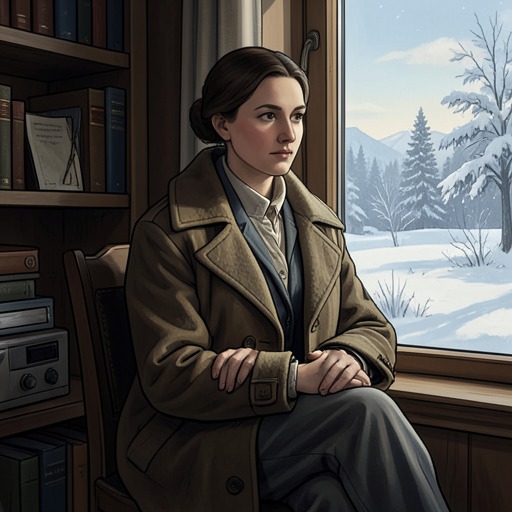
Matt’s Mountain
Ronja, the Robber's DaughterMatt’s Mountain is the setting that binds the divided fortress, the rushing river, and the surrounding wilderness into one contested landscape. Lightning cleaves its ancient stronghold in two, but the mountain is more than a backdrop to the feud: its heights, edges, and caves shape how Ronia learns courage, how the rival clans occupy space, and where she and Birk can imagine living together.
The split fortress and divided territory
The mountain’s fortress is already ancient when Ronia is born. During the night, lightning strikes it with extraordinary force; by morning the building has been cleft from its highest battlements to the deepest dungeon vaults, leaving a chasm between its two halves. The damage is at once physical and political. The robber families’ conflict acquires a permanent architectural shape, with the divided stronghold standing above the mountain as an emblem of their separation.
The northern half becomes the focus of a struggle over possession and naming. When Birk tells Ronia that it is no longer the North Fort but Borka’s Keep, she hears the new name as an assertion by the rival clan, not a neutral description. The fortress is also a place whose past contains forgotten ways in: Matt recalls that, when the stronghold was more of a gentleman’s home, the servants used a small door to reach the pigsty. Borka knows the old layout too, remembering childhood visits to the pigsty with Matt, before their fathers’ hostility taught them to regard one another as enemies. Thus the mountain’s built space carries both the history of their friendship and the later feud.
A landscape for learning courage
For much of her early life, Ronia knows little beyond the fortress. When Matt decides she must learn what it is like to live in Matt’s Forest, he lets her go out to explore. The mountain gives that freedom a demanding form: to reach the waterfalls, she climbs down its sheer face toward the river, where a fall would be dangerous. Matt’s warning to watch out becomes, in Ronia’s practice, an invitation to learn the ground closely rather than avoid it.
At first the descent frightens her so much that she shuts her eyes. With repetition, she learns where the crevices lie, where her feet can rest, and where she must cling with her toes to keep from pitching backward into the rushing water. The same slope is therefore both hazard and school: careful attention lets her turn a frightening route into a place where she can train herself not to be afraid. Her growing bodily confidence in the mountain’s terrain belongs to a larger change. She becomes strong and agile, and is no longer frightened of the forest’s dangers, including the prospect of getting lost or falling into the river.
The hidden way and the mountain refuge
The mountain’s divisions are not absolute. While clearing snow, Ronia realizes that she has opened a way into Borka’s Keep. The discovery could give Matt a route to attack the rival stronghold, but she does not want the Borka robbers expelled: Birk lives there, and she is determined to protect him and keep others from using the passage against the keep. The opening thus changes meaning according to who knows of it and what they intend to do. A potential military entrance becomes a secret she guards to preserve Birk’s home.
Beyond the fortress walls, the mountain also contains the Bear’s Cave, a place Ronia has known since she began wandering in the woods. Matt showed it to her and had himself lived there in summer as a boy. Noddle-Pete told him that bears slept in it during winter, giving the cave its enduring name. Its position makes access an adventure in itself: it lies high above the river between two rocky cliffs, reached by a ledge that begins narrow and perilous before widening into a broad stone platform outside the cave. From that platform, Ronia has often watched morning rise over the mountains and forests.
When Ronia and Birk choose the cave as a refuge, its height and separation offer space outside the conflict organized around the fortress. But the retreat has limits. Birk eventually recognizes that he must live with his parents in Borka’s Keep, because otherwise the hostility within the mountain stronghold would grow further. Ronia accepts that he must return until spring. The cave remains a shared refuge and a possibility for life beyond the fort, while the mountain’s divided homes continue to exert their claims.
A landscape that makes conflict tangible
Across these episodes, Matt’s Mountain is repeatedly remade by acts of occupation, movement, and concealment. Lightning divides the fortress; a new name claims its northern half; an old servants’ door recalls an earlier use of the building; Ronia’s snow-clearing exposes a possible route of attack; and the difficult ledge makes the Bear’s Cave both accessible and secluded. The terrain does not settle the families’ conflict, but it determines the routes through which that conflict can be pursued or resisted.
The mountain also links public struggle to private choice. Its fortress is inherited and contested, while its slopes teach Ronia a courage she develops for herself. Its hidden passage could serve Matt’s feud, yet she protects it for Birk’s sake. Its cave offers shelter, but not a permanent escape from family bonds or the danger of worsening enmity. In this way the mountain is both the material setting of the feud and a landscape in which Ronia and Birk discover ways—necessarily provisional—to make choices of their own.