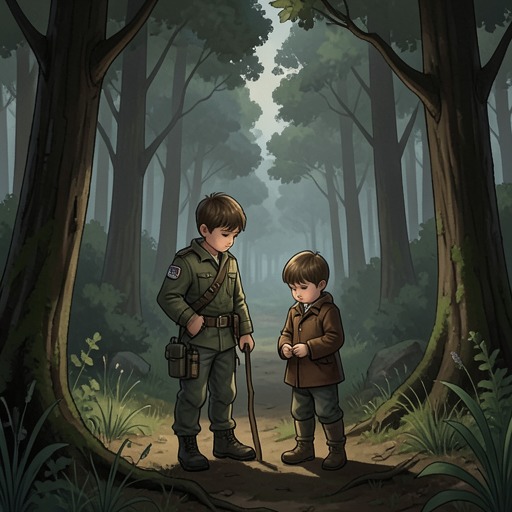
Ronia secretly brings food to Birk’s family
Ronja, the Robber's DaughterRonia secretly brings food to Birk’s family during the winter shortage in Borka’s Keep, turning the rubble-filled passage beneath Matt’s Fort into a concealed route between hostile households. Her daily deliveries are more than a rescue from hunger: by giving away provisions taken from a household built on robbery, she acts on a moral choice of her own and treats Birk as family before the adults have reconciled.
Causes and the hidden passage
Winter confines Ronia inside Matt’s Fort, where she longs for spring and for the chance to see Birk again. She begins clearing the collapsed underground passage beneath the fortress, moving rubble bucket by bucket and emptying it into an old dungeon. Though the work exhausts her, she persists until the heap has fallen enough for someone to cross. Her goal is not to create a military route: she wants to reach Birk. But she recognizes that the opened passage could also give Matt a way into Borka’s Keep, so she keeps the discovery secret and does not want the Borka robbers expelled for Birk’s sake.
When Ronia and Birk first find one another on opposite sides of the rubble, she asks whether he truly wants to be her brother. Their reunion gives the passage a private purpose, one that conflicts with the strategic advantage it could offer Matt. Ronia understands the danger of being discovered, but her wish to reach Birk outweighs it.
Food for Birk
The need becomes clear when Ronia asks whether Birk has enough to eat. He tells her that food in Borka’s Keep has been running out for a long time and that none of them has had enough. Ronia answers that circumstances have changed: she did not have a brother before, but now she does. She opens her leather bag and gives Birk bread. He eats the coarse pieces and drinks the milk she offers, then asks whether she should have kept the food for herself.
Ronia returns to him early every morning for the rest of the winter, meeting him in the cellar vaults and bringing food from Lovis’s larder. The regularity matters: this is not a single gift prompted by a moment of hunger, but a continuing commitment that helps keep Birk alive through the shortage. The cellar passage lets her cross the boundary between the two groups without making the aid public, while its concealed nature also means that discovery could expose both her disloyalty to Matt’s side and the route into Borka’s Keep.
Provisions for Birk’s family
Ronia’s help extends beyond Birk. Every day she also gives him a bag of flour and a bag of peas to add secretly to Undis’s store. The food is meant to sustain his household, not simply ease his immediate hunger. Birk is sometimes ashamed to accept the gifts, feeling as though he is stealing from her. Ronia counters that she is a robber’s daughter and invokes the lesson she has learned about taking without permission; in this case, she directs that practice toward keeping Birk’s family fed.
Her reasoning connects the deliveries to her earlier rejection of her father’s calling. When Matt explained that generations of his family had been robber chiefs and expected Ronia to follow him, she refused. She had already understood that robbers took their goods from other people, and she could not accept the harm hidden behind the household’s stores. Her secret use of those provisions does not erase their origin; instead, it shows her redirecting what is available to her toward people who need food. Ronia herself recognizes the contradiction and fears that Matt will discover that she is helping the Borka robbers.
Reciprocity and the divided household
The exchange is deliberately unequal in material terms: Ronia gives bread, milk, flour, and peas, while Birk can offer no comparable supply during the shortage. His gratitude and embarrassment acknowledge that imbalance, but Ronia does not make help conditional on repayment. She treats the food as an expression of kinship, grounded in the brotherhood they have chosen, rather than as a bargain or a payment for future allegiance.
That chosen family bond cuts across the feud. Ronia once wished the Borka robbers at the bottom of Hell’s Gap; now she risks being caught to keep them alive. Yet she does not thereby adopt their robbery or simply exchange one band’s loyalty for another. Her conduct distinguishes care for Birk and his family from approval of the rival robbers’ way of life. Later, Matt invites Birk to return to Matt’s Fort because he knows how much his daughter cares for him and says he may learn to care for him too. That invitation gives the relationship a public opening after the long period in which Ronia’s support had to remain hidden.
Significance
The secret food deliveries make Ronia’s moral independence concrete. Her refusal to inherit the robber chief’s role is not only a statement against taking from others; it becomes a practice of giving, sustained day after day under conditions of scarcity. The same stores associated with her family’s raids become the means by which she protects the people her family treats as enemies.
The reopened passage carries both threat and possibility. It could be used to attack Borka’s Keep, but Ronia keeps it from becoming a weapon because Birk must not be driven out. In her hands, the underground route enables contact across a division maintained by adult rivalry. The flour and peas secretly placed in Undis’s store extend that contact from two children to an entire household, while the later invitation from Matt points toward reconciliation. The episode thus links food, secrecy, and chosen kinship: a child’s repeated acts of maintenance begin to unsettle the feud that the adults have inherited.