Ronia–Lovis mother-daughter relationship
Ronja, the Robber's DaughterRonia and Lovis’s mother-daughter relationship is the novel’s durable source of care and belonging, persisting through illness, moral conflict, and Ronia’s self-imposed departure from Matt’s Fort. Lovis’s affection is expressed less through grand declarations than through a song at day’s end, attention to the needs of the household, and the bread and salt she sends to her daughter in the forest. Ronia’s leaving wounds that bond, but does not undo it: even far from home, she understands that her mother is thinking of what she needs to stay alive.
Birth and the household Lovis creates
On the night Ronia is born, a thunderstorm rages over the mountains and the harpies circle Matt’s Fort, shrieking around the stronghold. Their noise interrupts Lovis as she prepares to give birth. She wants quiet not because she has stopped singing, but because singing is part of how she intends to bring the baby into the world: she believes it makes labor easier and may make the child jollier. From the beginning, Lovis’s care is practical and self-possessed, while her song gives the birth its emotional frame.
After the storm and the birth, a child changes the rhythm of the fort. Ronia’s unusually quick crawling delights Matt and his twelve robbers so completely that they rush home early to see her eat her porridge before bedtime. Lovis recognizes their tenderness but also sees how it distracts Matt from his work. Her brisk reminder that Borka might take over all the robbing if Matt neglects it places maternal affection inside the ordinary pressures of the household: she is not merely watching Ronia grow, but managing a family whose men can be swept away by their own excitement.
Care, illness, and a difference in temperament
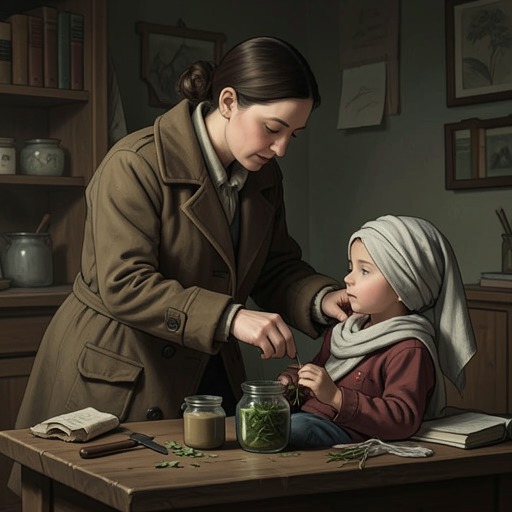
When Ronia falls ill with a high fever after a dangerous day in the winter forest, Matt panics at the sight of his daughter burning with fever. He fears she will die, yet tries not to frighten her and can manage only the advice that she should keep warm. Lovis is not immediately at her bedside because she is finishing her duties with the sheep, goats, and chickens. Matt finds her in the sheepfold, where his own desperate crying has frightened the animals, and orders her to go to Ronia while he takes over the chores.
The scene gives the parents contrasting forms of care without making Lovis’s steadiness a lack of love. Matt is overwhelmed by the possibility of losing Ronia; Lovis answers the immediate demands of the household and then goes to the sick child. Ronia, feverish herself, tries to reassure her father. The family’s care therefore moves in several directions at once: the child comforts the frightened parent, while the mother’s practical attention restores the household’s focus to the sickbed.
The Wolf Song and the pain of leaving
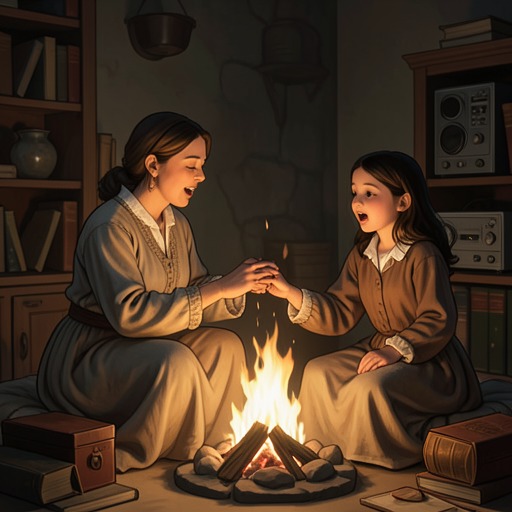
Lovis’s recurring Wolf Song marks the intimacy between mother and daughter through repetition. She sings it for Ronia at the end of every day, whether the day has been happy or sorrowful. When Ronia decides to leave Matt’s Fort, she knows that departure will cost her this familiar ending to the day. She thinks it will be hard to leave Lovis, but harder still to cease being Matt’s child; her choice to go into the woods thus separates her from her mother even though the two have not ceased to love one another.
Before leaving, Ronia waits until Lovis is asleep and stands for a long time looking at her in the firelight. She notices her mother’s unbound red-brown hair spread over the pillow and touches it with one finger. Lovis looks tired and lonely without Matt beside her, and Ronia recognizes that her departure will add another absence to the mother’s life. She murmurs an apology, then gathers her heavy pack from the costume chamber and slips out of the stone hall. The quietness of the farewell makes the separation more than a change of address: Ronia leaves with affection intact, but without knowing whether she will see her mother again.
Care across the distance
While Ronia and Birk live in Bear’s Cave, Lovis’s care reaches them through Little-Snip. He brings five large round loaves of bread, and Ronia’s immediate delight turns to tears as she realizes what the food means in their isolated life. Little-Snip also tells her that Matt’s Fort is melancholy and that everyone is waiting for her to return. Ronia asks whether Matt is waiting too, but Little-Snip cannot tell her what Matt thinks. The message makes clear that the household misses her, while leaving the central breach between father and daughter unresolved.
The practical gift continues when Little-Snip discovers that he has brought a bag of salt as well. Ronia recognizes the significance of this small provision: Lovis knows what they need to stay alive and has somehow understood that they have almost run out. Little-Snip suggests that a mother may feel when her child lacks something necessary. Ronia’s gratitude is directed specifically toward Lovis, whose attention crosses the distance without requiring Ronia to return or ask for help. The bread and salt do not erase the hardships of exile, but they show that the maternal bond can take material form even when mother and daughter are separated.
A bond that endures separation
Lovis’s role in Ronia’s life is defined by recurring acts rather than by control over her choices. She sings at the birth and at the close of ordinary days, tends the household, and sends supplies when Ronia is living elsewhere. Ronia, in turn, remembers the cost of leaving: she thinks of the Wolf Song she may never hear again, pauses beside her sleeping mother, and apologizes before going. Later, the food from home confirms that distance has not made her forgotten.
The relationship also helps distinguish belonging from obedience. Ronia can leave the fort and refuse the life her father expects without ceasing to be Lovis’s daughter. The separation is painful precisely because the bond remains strong: Ronia does not depart out of indifference, and Lovis’s care does not depend on her immediate return. The song and the provisions become two forms of the same enduring connection—one remembered from home, the other carried into the forest.