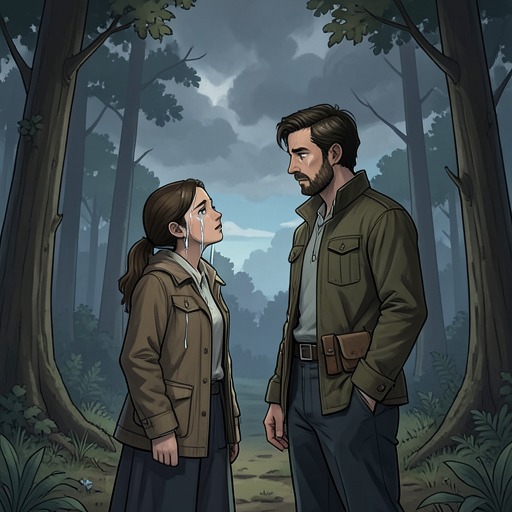
Ronia–Matt father-daughter relationship
Ronja, the Robber's DaughterRonia–Matt father-daughter relationship is both the deepest attachment in Matt’s life and the bond most sharply tested by his robber’s code. Matt greets Ronia’s birth with uncontained joy and trembles with love as he gazes at her; yet he also expects her to inherit his calling. Ronia’s refusal to treat robbery as right turns their intimacy into a struggle over whether being a daughter means accepting her father’s way of life. Their rupture reaches its starkest point when she crosses Hell’s Gap to stand with Birk, and the relationship’s later estrangement shows that love persists even when neither parent nor child can make it a simple reconciliation.
A bond formed in delight
Before Ronia is born, Matt longs to see a new robber chief arrive while he is still alive to welcome one. Her birth fulfills that hope in a form he had not anticipated: she is a daughter, and he celebrates her as a child of the robber family. His joy is physical and overwhelming; he races around the hall, leaping and shrieking, announcing that he has a child.
When Lovis asks whether she may take the baby, Matt cannot bring himself to hand her over at once. He studies Ronia’s eyes, mouth, hair, and helpless hands, and trembles with love. He tells the baby that she already holds his robber heart in her little hands. The image makes the relationship’s central tension present from its beginning: Matt loves her without reserve, but he understands that love through the identity of a robber chief and imagines her future within that inheritance.
Inheritance and moral disagreement
As Ronia grows old enough to understand where the robbers’ goods come from, she realizes that the sacks, bundles, chests, and boxes brought home on their horses are not products of the forest. Her father takes them from other people. She asks whether the victims become terribly angry, and Noddle-Pete confirms that they do, howling, crying, and swearing. The victims’ distress gives Ronia a concrete measure of what the family’s familiar way of life means to those outside it.
Matt answers her understanding with an appeal to ancestry and continuity. His father and grandfather were robber chiefs, he says, and he has not let them down; he is the mightiest in the woods and mountains, and Ronia is to become one too. She rejects the expectation outright, refusing the robber chief’s role even if the people whose property is taken become angry and cry. Matt wants her admiration and love, and her refusal makes him unhappy; he tries to persuade her that he takes only from the rich. His defense reveals how he separates the robber’s identity from its consequences, while Ronia’s judgment begins from the injured people themselves.
That difference turns into a direct contest when Matt detains Birk. Ronia strikes at her father with her fists and insists that he may rob money, goods, and possessions, but cannot rob people without losing her as his daughter. Matt answers in a fury, calling Birk a snake, a louse, and a little thieving hound, and says that he will clear his father’s fortress of the robbers there. In his account, the conflict is about the fortress and its occupants; for Ronia, it is about whether her father will treat a person she loves as property he can seize.
Birk and the breaking point
Matt’s threat to keep Birk in a dungeon turns the dispute into a life-or-death choice for Ronia. She understands that Birk cannot survive there until the end of summer. She also knows that losing him would mean losing her brother, while the prospect of losing a father she can love wounds her too. Her attachment to Matt does not disappear; in the same moment, anger makes her want him to suffer and to undo his plans.
Ronia acts on that conflict by running and leaping across Hell’s Gap to the side of Matt’s enemy. Matt sees her in midair and cries out in a sound compared to the death agony of a wild animal. His robbers have never heard anything like it. On the far side, she is not simply his daughter but his daughter standing with Borka, and the sight is incomprehensible to him. Ronia’s choice makes the cost of Matt’s detention unmistakable: his attempt to hold Birk has driven his own child across the divide.
The separation does not bring Ronia the clean emotional victory of disavowal. After she has called Matt a beast, she wishes she could comfort him for the suffering she has caused. The narrator makes the contradiction explicit: she has condemned him and still feels concern for him. Matt, meanwhile, is too overwhelmed to notice Lovis standing beside him or to respond to Borka’s demand for his son. When Borka invites him to take his son back, Matt says that Borka can have his son but that Matt has no child. Lovis rejects this erasure at once, insisting that she has a child and wants her child back. The exchange shows the rupture not as a loss of the underlying bond, but as Matt’s anguished attempt to deny it after Ronia has chosen Birk.
Estrangement and continuing attachment
After Ronia returns to Matt’s Fort, she lies down silently and draws the curtains around her bed. Noddle-Pete reports that Matt is in his bedroom, staring without speaking, refusing to get up or eat. Lovis expects hunger eventually to bring him out, but worries about him. The parallel withdrawals give the separation a domestic aftermath: Ronia retreats behind curtains, while Matt shuts himself away in his room, and Noddle-Pete describes the fort as full of misery.
Ronia later states the condition of her estrangement without qualification: she will never come home as long as she is not Matt’s child, and Little-Snip may tell Matt so. Her words make belonging contingent on recognition, not merely on physical return. Yet the news that Matt has not laughed since the morning she leapt across Hell’s Gap shows that he remains emotionally bound to that moment and to the daughter he claims to have lost. His grief does not make Ronia withdraw her condition; it makes the distance between them more visible.
At a later conversation about how to deal with the pressure on the robbers, Ronia says the most cunning idea would be to stop robbing, a view she says she has always held. Noddle-Pete agrees that she is right, but considers himself too old and feeble to drum it into Matt’s head. The exchange echoes the original disagreement: Ronia’s refusal was not a passing protest against a single quarrel, but a sustained judgment of the calling Matt hoped she would inherit. The relationship therefore remains unresolved around a precise moral divide. Matt’s love for Ronia is evident in his delight at her birth and his devastation at her departure; Ronia’s attachment is evident in her pain at losing him and her wish to comfort him. Neither feeling, however, can substitute for her demand that he stop robbing.