Sheriff’s men
Ronja, the Robber's DaughterThe Sheriff’s men are the sheriff’s pursuing soldiers, an external force whose increasingly effective pressure makes the robbers’ long-standing division harder to sustain. Though they appear mainly through the danger they pose, their patrols and ambushes change the balance of power: they drive Borka from his former den, threaten Matt’s band, and help make a united robber force seem necessary.
Identity and Role
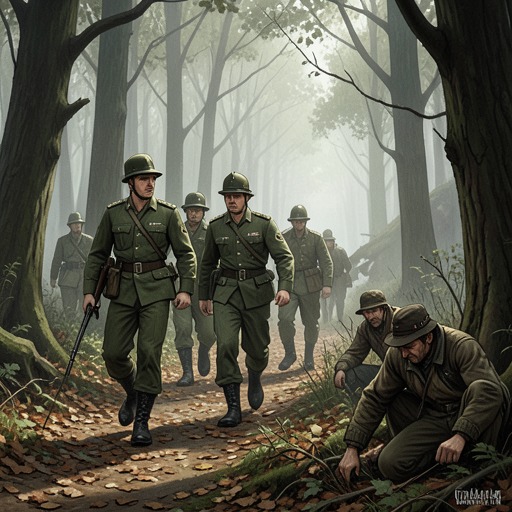
The soldiers operate on behalf of the sheriff and pursue the robbers through the woods. Their presence represents formal law and organized force in a story where the robbers also live by their own customs, loyalties, and codes. The groups’ conflict is not resolved through a single shared system of judgment: the sheriff’s men hunt and capture robbers, while the rival bands make their own decisions about protection, leadership, and how to answer a threat.
The soldiers’ role is largely defined by what their pursuit compels the robbers to do. They make the danger of the robber life tangible, first by driving Borka’s men from their cave and later by setting ambushes on Robbers’ Walk. The consequences fall not only on the people they capture or wound, but also on the relationship between Matt and Borka: pressure from outside makes their feud increasingly costly.
Pursuit and Pressure on the Robbers
When the sheriff’s men had persistently hunted Borka’s band, they eventually found the cave that had served as its den. By then it was deserted and empty of loot, with no sign of Borka. The soldiers left Borka’s Wood, glad to be away from the dark, cold, rainy place as autumn arrived. Their discovery did not end the pursuit of robbers altogether; they knew that Matt’s band remained in Matt’s Forest, but preferred not to think about that harder target. The episode establishes both the reach of the sheriff’s search and its limits: Borka had disappeared, while Matt’s forest stronghold remained too difficult to approach safely.
Later, the sheriff’s men became more dangerous to Matt’s band as well. After Matt’s men rescued Peller and two of Borka’s robbers from the sheriff’s dungeon, the soldiers began swarming through the woods. Matt explained that this response followed the rescue, while Noddle-Pete warned that the sheriff would ultimately prevail if the two bands remained divided. The rescue had been an act of solidarity across the feud, but it also intensified the formal authorities’ attention to the robbers.
The warning soon proved immediate rather than abstract. Borka rode to Wolf’s Neck early one morning, before Matt’s robbers had saddled their horses, and told Matt that the soldiers had lain in ambush on Robbers’ Walk. They had captured two of Borka’s men; a third had been badly wounded by an arrow while trying to escape. Borka came to warn Matt because he had recently benefited from Matt’s rescue of two of his own men. The exchange shows the sheriff’s campaign producing a reciprocal obligation between former enemies: the danger was shared, and Borka returned the service by bringing news before Matt’s band rode into the trap.
Conflict Between Law and Robber Custom
The soldiers’ captures and ambushes stand against the robbers’ own standards of loyalty. Matt insists that no one hangs one of his men and takes pride in having taught Peller that robbers do not remain where they are put. His response is not submission to the sheriff’s authority but a declaration of protective responsibility within his own band. That self-imposed obligation has consequences beyond Matt’s followers: the rescue also frees two of Borka’s men, extending protection across the boundary between rival groups.
The story therefore distinguishes the sheriff’s authority from the robbers’ internal arrangements without presenting the latter as innocent. The soldiers pursue people who make their living by taking other people’s property; the robbers, in turn, treat escape, rescue, and defense of their companions as matters of honor. The clash between these systems is made concrete by the dungeon, the ambush, the captured men, and the arrow wound. Each side’s power carries real consequences, but the evidence here shows the soldiers as a threat to the robbers rather than as characters whose motives or methods are explored independently.
Effect on Matt and Borka’s Feud
The sheriff’s pressure gives Noddle-Pete’s repeated advice a practical urgency. He argues that one strong band might be able to contend with the sheriff and his men, whereas two separate bands waste their strength deceiving one another and fighting over plunder. Matt resists the argument because he cannot accept Borka as an equal: he wants to remain the mightiest chieftain and fears that joining forces might mean yielding leadership. The soldiers’ pursuit thus sharpens a conflict already rooted in rivalry over rank and authority.
Borka’s warning at Wolf’s Neck helps turn that debate into a decision. When Matt reacts to news of the ambush by saying, “We can’t have this sort of thing!”, he realizes only afterward that he has spoken as though Borka and he already shared a cause. He eventually proposes that they join forces. The soldiers do not themselves settle the dispute between the chiefs, but their attacks make continued separation look increasingly untenable and furnish the immediate occasion for cooperation.
Consequences of Unity
The agreement does not erase the rivalry; Matt and Borka settle the leadership question through a wild beasts’ match, in which a range of rough holds and attacks is permitted, with a kick between the legs the one expressly forbidden move. Matt wins and remains chief, while granting Borka a chieftain’s name and standing and allowing him to continue with his own men. Their arrangement preserves Borka’s position but places Matt’s word above his. A feast that evening brings both groups together under the new settlement.
The account later reports that Matt is pleased with Borka’s work and that the united band brings in one fine haul after another while fooling the sheriff’s men. Matt expects that the soldiers will soon be driven out of Matt’s Forest. Noddle-Pete cautions him with the proverb “Brag when you’re riding home,” but the reported successes show a changed balance: the force that had captured and wounded members of the separate bands now faces their combined operations. The soldiers remain a continuing danger, not a defeated enemy, and the narrative does not establish that they are finally expelled. Their most decisive effect is to make the old feud answerable to a new calculation of survival.