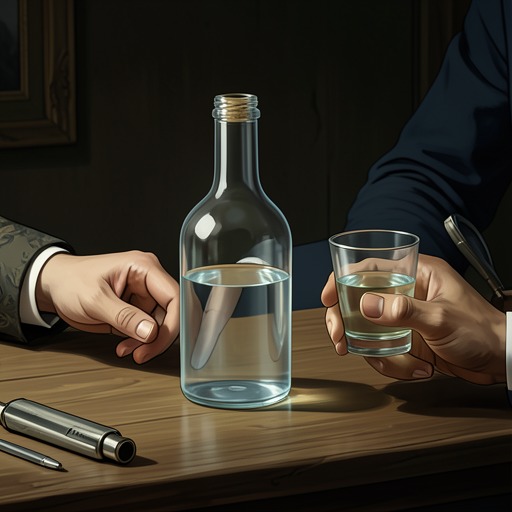
Gentlemanly drinking
SanctuaryGentlemanly drinking is presented as a ritual of cultivated identity rather than merely the consumption of alcohol. Gowan Stevens treats drinking as a lesson acquired at elite school: a gentleman knows what to drink, how to prepare it, how much to tolerate, and how to preserve composure before other men. Yet the scene that most vividly defines the practice turns its promise inside out. Gowan’s polished vocabulary and confidence cannot master the liquor placed before him; the ideal of civilized command becomes a performance whose failure is written on his sweating face, vomiting body, and confused speech.
Education as Drinking Culture
Gowan associates gentlemanly drinking with institutions and regional status. When he complains that the liquor available in Jefferson is inferior to what is served “up at school,” he identifies education not simply with academic training but with a social curriculum. He says that he attended school in Virginia and that the place taught him how to drink. His claim makes drinking a form of cultural capital: the educated man possesses a specialized knowledge that distinguishes him from local drinkers and gives him authority over the proper manner of convivial behavior.
The distinction is reinforced by Gowan’s contrast between ordinary local liquor and the standards he attributes to Virginia. He says that people at Virginia do not drink “rotgut,” presenting rough alcohol as a mark of provincial inadequacy. In this opposition, the drink itself becomes a classed object. The local mixture is described as crude and nearly undrinkable, while the imagined school culture supplies taste, technique, and a code of conduct. Gowan therefore uses the vocabulary of refinement to place himself above the men around him, even before his actions have demonstrated the control he claims.
Ritual, Technique, and Display
The practice also depends on visible technique. In a confectionery-lunchroom, Gowan asks for sugar, water, and a lemon, then makes a whiskey sour while the others watch. He explains that he was taught to drink it that way, turning preparation into instruction and performance at once. The cocktail is not only a beverage; it is evidence of training. By displaying the correct mixture, Gowan tries to transform an improvised encounter with a fruit jar into a scene governed by gentlemanly form.
His language continues to frame quantity as a test of style. He says that at school it is considered better “to go down than to hedge,” a maxim that converts drinking heavily into a matter of decisiveness. Refusing moderation allows him to present excess as courage and hesitation as weakness. The others drink more cautiously, but Gowan repeatedly fills his glass, challenges their doubts, and insists that the quantity cannot determine his limit. The performance is public and competitive: his gentlemanly identity requires witnesses who will recognize his command.
The Collapse of Self-Command
The central irony is that Gowan’s performance succeeds rhetorically only until the body intervenes. After he fills the glass level full and empties it steadily, the narrative shifts from his confident self-presentation to fractured perception. He becomes aware of a train, cold open air, and then a cramped, dark place smelling of ammonia and creosote. There he vomits into a receptacle while still trying to explain that he learned to drink like a gentleman. The repeated assertion survives after the ability it is meant to describe has disappeared.
The physical details strip the ideal of its ornamental language. Gowan experiences extreme lassitude and weakness; his eyes focus slowly, and he must lean against a wall. In the flare of a match he reads a name written there in pencil, then sways, drools, and falls asleep. The scene supplies no successful recovery of dignity. Instead, gentlemanly drinking is revealed as a fragile social fiction, dependent on the suppression of bodily evidence. Once sweat, vomiting, weakness, drooling, and sleep become visible, the distinction between cultivated drinking and crude intoxication can no longer hold.
Social Performance and Its Aftermath
Gowan’s humiliation is not wholly private because the ritual began as a demonstration before companions. He tries to maintain the role through speech even while losing physical control, repeating that he has learned to drink like a gentleman. The words function like a failing script: they name the identity he wants others to see, while the surrounding action supplies contradictory evidence. The more insistently he invokes the lesson, the more clearly the narrative exposes its failure.
The episode also connects gentlemanly drinking to masculine competition. Gowan challenges the men to watch him, treats their warnings as attempts to limit him, and makes his capacity for alcohol a test of rank. His education gives him a vocabulary of superiority, but the liquor turns that vocabulary into an ordeal. What appears at first to be cultivated freedom becomes obedience to a different social command: he must continue drinking in order not to surrender the image of the gentleman.
Narrative Significance
The concept links refinement and degradation through the same ritual. In the garden, Miss Jenny recalls the Virginia gentleman who had explained that “Put a beetle in alcohol, and you have a scarab; put a Mississippian in alcohol, and you have a gentleman—” The saying treats alcohol as a miraculous agent that converts regional identity into social polish. Gowan’s later collapse provides the counter-image. Alcohol does not reliably produce the gentleman; it can dissolve the very composure that the label presupposes.
Gentlemanly drinking thus exposes the tension between inherited or institutional prestige and material reality. Gowan possesses the school story, the cocktail technique, the maxim about decisive drinking, and the confidence to instruct others. He lacks the bodily mastery that would make those signs coherent. The concept matters because it shows how class identity is enacted through habits that appear natural only when successfully performed. In Gowan’s case, the performance ends with the language of refinement still audible but the gentleman himself reduced to a swaying, drooling body asleep beside a train.