Goodwin's moonshine still
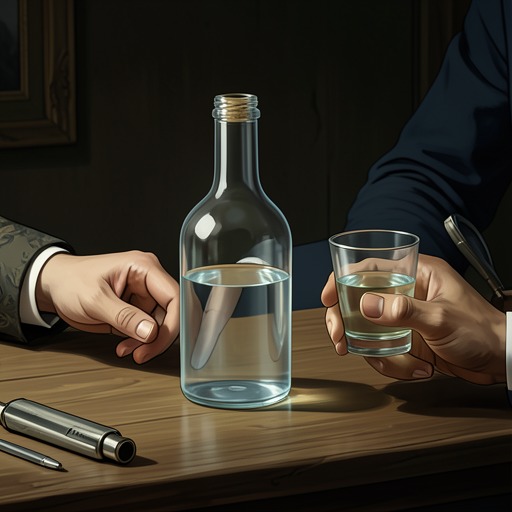
SanctuaryGoodwin's moonshine still is more than a hidden machine for making whiskey. It is the practical basis of Lee Goodwin's livelihood, the object around which a rural production network and an urban liquor market meet, and the tangible evidence that allows the authorities and the town to convert suspicion into a public case against him. Its discovery changes the still from a useful, concealed instrument into an incriminating object: once the kettles are found and destroyed, Goodwin's business is finished even before the legal struggle over Tommy's death has been resolved.
Production and the Underground Market
The still belongs to the small-scale side of Goodwin's liquor operation. Tommy explains that Goodwin makes little quantities in “piddlin little quarts and half–a–gallons” mainly as an accommodation, earning an extra dollar or two rather than pursuing the larger profits available elsewhere. The serious money lies in making a run and getting rid of the liquor quickly, a distinction that places the still within a wider commercial system rather than treating it as an isolated household contrivance. Goodwin's equipment supplies local production, while Popeye's truck and the Memphis connection represent the more profitable business of rapid transport and distribution.
The contrast also reveals the economic pressure behind the device. Tommy identifies Memphis as the place where the money is, while Goodwin's still supports the lower-margin work that can be done locally. Goodwin therefore occupies an exposed middle position: his equipment makes him a producer visible enough to be useful to customers, yet not powerful enough to control the more lucrative traffic. Stevens says that he has been buying liquor from Lee for three years, confirming that the still sustains a recurring customer network and that Goodwin's activity is established rather than accidental.
Concealment and Physical Evidence
The still is hidden at Goodwin's rural property, where the house, barn, and surrounding outbuildings form a landscape of concealment. When Goodwin surrenders, the authorities search the place and find the equipment. Horace Benbow later reports that the sheriff's searchers destroyed the still, an act that ends the operation materially: Goodwin's business is “finished now,” regardless of what the court may decide about the murder charge. The destruction is thus both enforcement and economic punishment, removing the means by which Goodwin could support himself, his wife, and their child.
The still's discovery is especially consequential because it gives the community a concrete object on which to fasten its judgment. Before the search, Goodwin can insist that the case must be proved and that the available facts do not establish his guilt. After the equipment is found, the town can present him not only as a suspected killer but as a moonshiner whose illegal work appears to confirm every hostile assumption about him. The object does not itself prove that Goodwin shot Tommy, but its presence makes his social and legal vulnerability unmistakable.
Law, Public Morality, and Punishment
The destruction of Goodwin's still occurs within a larger campaign of moral denunciation. Horace describes how the local customers who had bought whiskey from Goodwin, and who had accepted liquor he gave away, turn against him once he is down. The Baptist minister uses him as a sermon subject, condemning him as both murderer and adulterer and imagining a punitive spectacle in which Goodwin and the woman would be burned as an example to the child. The still therefore becomes part of a chain linking illicit production, sexual scandal, religious rhetoric, and mob judgment.
That chain exposes the hypocrisy of the surrounding community. The same “good customers” who benefited from Goodwin's liquor help produce his downfall, while the minister converts the case into a defense of the county's supposedly pure democratic and Protestant atmosphere. The still makes the contradiction visible: private demand has sustained the enterprise, but public respectability disowns it when punishment becomes possible. Its destruction allows the community to erase its own participation and to represent Goodwin's illegal work as a solitary pollution.
Material Object and Narrative Consequence
As an object, the still moves through three distinct states. At first it is functionally transparent, part of the ordinary mechanics of Goodwin's work and known mainly through the liquor it produces. When the authorities search for it, it becomes conspicuous evidence, a hidden thing made legible by investigation. After it is destroyed, it survives only through Horace's account, as a remembered absence that marks the collapse of Goodwin's business. The narrative gives the object force precisely at the moment when it ceases to function: its destruction exposes how dependent Goodwin's household and future plans were on concealed material equipment.
Goodwin's attempt to protect his family depends on whatever money he has managed to preserve from this enterprise. He has nearly one hundred and sixty dollars buried in a can in the barn, which he is allowed to recover after surrendering. He tells the woman that the money will keep her until the case is over and that they will then leave, a plan they had already considered for some time. The still is not identical with this buried cash, but the two objects belong to the same economic structure: one produces the livelihood, the other preserves its residue. Once the still is destroyed, the family can imagine escape only through the money already hidden away.
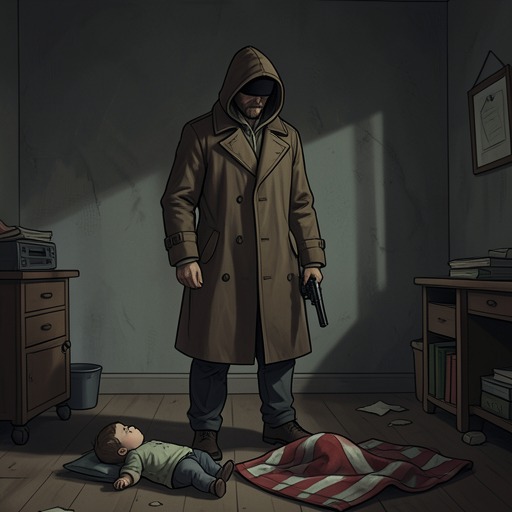
The still also sharpens the irony of Goodwin's defense. He emphasizes that he notified the sheriff, did not run, and remained at the house with his wife, child, and Pap, while the dead Tommy lay in the barn. Yet the existence of the still means that the authorities and the jury encounter him not as an abstract innocent citizen but as a man operating within an illegal economy. The District Attorney's later confidence that the conviction may not hold reflects the difficulty of separating the murder evidence from the broader social case against Goodwin. The still helps explain why the legal process is burdened by moral hostility even when the proof of the killing remains contested.
Significance
Goodwin's moonshine still condenses the book's conflict between economic necessity, prohibition, and respectable public order. It answers a real demand for liquor and connects Goodwin to customers, transporters, and Memphis dealers, yet it also provides the authorities with a material target whose destruction can be displayed as the restoration of order. The device makes the underground economy tangible, but it cannot make that economy legitimate; once exposed, it becomes an instrument of condemnation rather than survival.
Its fate parallels Goodwin's own. While the still operates, he has work, customers, and at least the possibility of leaving with his family. Once it is found and destroyed, his livelihood is removed, his household's precarious security is reduced to buried cash, and the town's moral narrative closes around him. The still's disappearance does not settle whether Goodwin killed Tommy. Instead, it demonstrates how quickly the destruction of a material means of subsistence can become part of a larger verdict against a person.