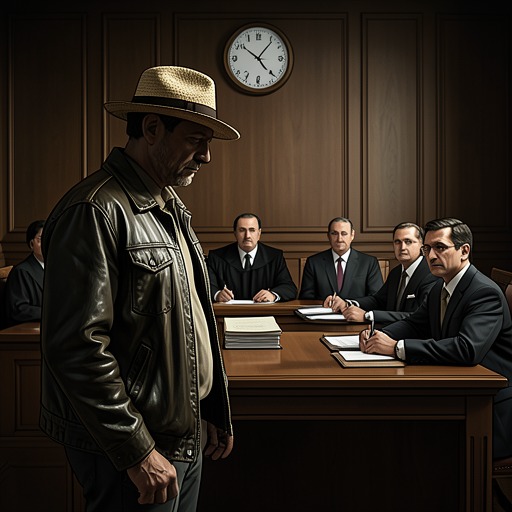
The stained corn cob
SanctuaryThe stained corn cob is the trial’s most consequential physical exhibit, because it gives material form to an event that has previously existed through testimony, inference, and accusation. Found at the crime scene and presented as a corn cob marked with a dark brown substance, it is initially an ordinary rural object made conspicuous by its damage and discoloration. Its force comes from the way the prosecution reclassifies it: from a piece of agricultural debris into an instrument of proof, then into a visual weapon directed at Temple Drake.
Discovery and Material Appearance
The object is introduced by the district attorney as something “found at the scene of the crime.” He holds it before the jury, explaining that it appears to have been dipped in dark brownish paint. The description deliberately preserves uncertainty. The substance is not immediately named, and the cob’s significance is not self-evident. It therefore occupies an unstable position between commonplace matter and incriminating artifact: something associated with the rural landscape becomes charged because the court places it within a narrative of criminal violence.
That delayed meaning is central to the object’s operation. The district attorney says that it was not offered earlier because its bearing on the case became clear only after the testimony of Lee Goodwin’s wife had been read aloud from the record. The cob does not speak independently; its evidentiary power is produced by an institutional arrangement linking it to testimony and interpretation. Yet once it is placed before the jury, its physical presence seems to promise a certainty more immediate than language. The court’s desire to make the crime visible is concentrated in a small, damaged object.
The Prosecution’s Use of the Exhibit
The district attorney does not present the stained corn cob neutrally. He surrounds it with medical testimony from a chemist and a gynecologist, invoking the authority of the latter as an expert on what he calls the most sacred affairs of womanhood. He then attempts to convert the exhibit into a justification for extreme punishment, claiming that the matter is no longer one for the hangman but for a gasoline bonfire. Horace Benbow objects that the prosecution is trying to sway the jury, and the court sustains the objection, ordering the clerk to strike the disputed phrase and instructing the jury to disregard it.
The ruling exposes a conflict between legal procedure and theatrical persuasion. Formally, the court limits what may be said about the object. In practice, the exhibit has already been staged before the jury, and the prosecutor’s language has attached it to sexualized horror, medical authority, and the imagined purification of the community. The cob thus participates in a wider public campaign against Lee Goodwin and the woman associated with him. Elsewhere, Goodwin’s still has been destroyed after his surrender, and local religious denunciation has represented him not only as a murderer but also as an adulterer who polluted the supposedly respectable atmosphere of Yoknapatawpha County. The exhibit belongs to the same process by which local institutions transform private catastrophe into a public moral spectacle.
Temple Drake and Recognition
The object reaches its decisive moment when the district attorney turns from the jury to Temple. She sits at the witness stand in a black hat, with tight red curls escaping beneath it, a rhinestone ornament, a platinum bag, a pale tan coat, and motionless hands resting palm-up in her lap. Her posture is detached and cringing at once, while her gaze remains fixed on something at the back of the courtroom. The detailed description makes her body another object under inspection, arranged before the “ranked intent faces” of the spectators as the legal process scrutinizes both her testimony and her appearance.
The district attorney steps into Temple’s line of vision and lifts the stained corn cob before her eyes. The courtroom responds with a long, hissing breath. The gesture is not merely a request for identification. It interrupts the distance Temple has maintained between herself and the proceedings, making the object a device for directing her gaze and controlling the scene. The prosecutor asks whether she has ever seen it before. Temple answers, “Yes.” That single recognition supplies the exhibit with the confirmation the earlier display could not provide.
The next question asks what Popeye did after holding the pistol, and Temple answers, “He shot him.” The cob and the recollection are therefore placed in immediate sequence: the object is made to reactivate a remembered act of violence, while the testimony gives the object its human referent. The exhibit does not simply corroborate her words from outside; it is used to make her body and memory perform corroboration in public. Its evidentiary power depends on the pressure exerted by the prosecutor’s gaze, the jury’s attention, and the court’s demand that recognition take the form of a short, usable answer.
Object, Spectacle, and Power
The stained corn cob exposes the instability of material proof. Its visible stain seems to promise an objective truth, but the narrative shows that its meaning depends on who displays it, what testimony surrounds it, and how the courtroom interprets Temple’s response. The prosecution first treats it as a neutral object found at the scene, then folds it into a medical and moral argument, and finally places it directly before the witness as an instrument of interrogation. Each stage adds power without changing the cob itself.
Its rural materiality also matters. The cob belongs to the agricultural world surrounding the Old Frenchman place, a ruined plantation house standing amid land whose cotton fields, gardens, and lawns have returned to jungle. That landscape is marked by the afterlife of slavery, plantation ownership, poverty, and persistent efforts to extract value from ruins: neighbors dismantle the old house for firewood while others search for the gold reputedly buried there during Grant’s Vicksburg campaign. Against this background, the cob is not an exotic or exceptional substance. It is an ordinary remnant of the local economy, made horrific by its removal from daily use and insertion into a legal ritual.
The object’s transformation resembles the broader social movement through which the case is constructed. Lee Goodwin’s moonshine still is treated as both a practical source of income and a mark of illicit identity; the courthouse crowd, drawn from wagons, cars, stores, radios, and religious opinion, converts the case into communal entertainment and judgment. The corn cob condenses that process. It is an agricultural fragment turned into a token of crime, then into an emblem of violated womanhood, and finally into a means of compelling Temple’s recognition.
Narrative and Thematic Significance
The exhibit’s importance lies in its combination of smallness and authority. It is materially insignificant when detached from the trial, yet its presentation reorganizes the room: the district attorney lifts it, Temple looks at it, and the courtroom breathes in response. This is a form of thing-power produced through human institutions. The cob does not act independently, but once the legal apparatus assigns it a place in the story, it alters the conduct of the prosecutor, the witness, the jury, and the spectators. It becomes an active node in the network of testimony, memory, medical expertise, and punishment.
At the same time, the cob reveals the court’s dependence on ambiguity. Its stain is described as resembling dark brownish paint rather than being immediately identified; its significance is said to have become clear only retrospectively; and its connection to the crime must be supplied by testimony. The object appears to offer certainty while remaining dependent on interpretation. That tension gives it its disturbing force. The jury is invited to see a fact, but what it sees has already been framed by an argument about sexuality, violence, race, and communal purity.
The stained corn cob therefore functions as both evidence and coercion. It anchors the prosecution’s account in a tangible thing, but it also helps turn Temple’s trauma into a spectacle that can be displayed, named, and used. Her recognition confirms the exhibit within the courtroom’s logic, yet the scene makes clear that recognition is extracted under concentrated public pressure. The cob’s decisive significance is not that it resolves every uncertainty, but that it demonstrates how a material object can be made to carry the authority of an entire social order.