Popeye's pistol
SanctuaryPopeye's pistol is more than a weapon carried by Popeye: it is the material sign of a violence that turns ordinary encounters into scenes of coercion and death. In the novel's early roadside meeting, the pistol is suspected before it is seen, and in later episodes its sudden appearance converts fear into action. Its smallness and concealability make it especially threatening. It can remain hidden in a pocket, emerge with almost no warning, and impose Popeye's will before anyone around him can organize resistance.
Appearance and Concealment
The pistol first enters the narrative through suspicion. Kneeling beside a spring, the drinking man asks Popeye whether he has a pistol in his pocket. Popeye does not answer the question directly; instead, he demands to know what is in the other man's pocket. The exchange makes the weapon part of a contest of guarded knowledge. Popeye's concern is not merely whether danger exists, but who possesses an object capable of danger and what that object might reveal about the person carrying it.
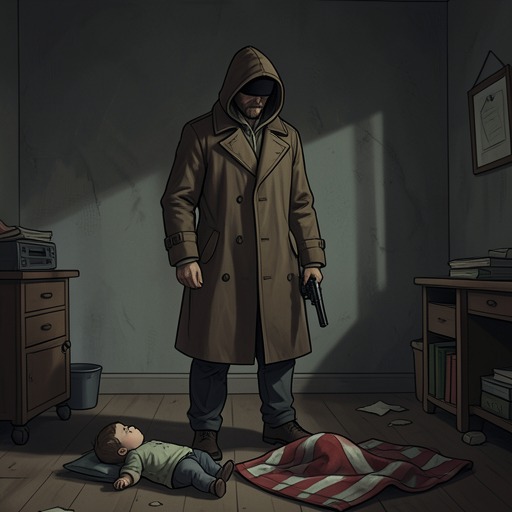
The weapon's concealability is central to its effect. Popeye is described with his hands in his coat pockets, and the pistol remains associated with that controlled, almost mechanical posture. It is not displayed as a large emblem of masculine force. Its menace lies in the gap between Popeye's stillness and the violence that the pocket may contain. The hidden object makes every gesture potentially consequential: a hand in a coat pocket becomes both an ordinary posture and a warning.
The Weapon as an Extension of Fear
The pistol is already linked to disproportionate violence before Popeye's major confrontation with Temple. Tommy recounts that Popeye shot Tommy's old dog after the animal merely came from under the house and sniffed his heels. Tommy emphasizes that the dog would not have hurt anyone, yet Popeye flinched as though confronted by a venomous snake, drew his “little artermatic pistol,” and killed it. The weapon therefore exposes the distance between an actual threat and Popeye's response. It does not defend against demonstrated danger; it makes Popeye's reflexive fear lethal.
That episode also gives the pistol a social meaning. Tommy's story treats the killing as both grotesque and astonishing, while Popeye's conduct turns a harmless domestic animal into a casualty of his suspicion. The weapon makes no distinction between genuine attack and imagined vulnerability. It translates an inward panic into an irreversible external fact, leaving others to measure Popeye's character through the dead dog.
Refusal, Pursuit, and Sudden Force
When Temple needs transportation to town, she asks Popeye to drive her and offers to pay. Popeye is leaning against a post, lighting a cigarette, and answers with a simple refusal. In this scene the pistol need not be drawn to exert pressure. Its presence stands behind Popeye's silence and helps explain why an ordinary request cannot become an ordinary negotiation. The Packard represents movement and escape, while the concealed weapon marks the limits of Temple's ability to bargain for either.
Later, Popeye finds Temple and Tommy in the loft. He orders the door opened, then asks Tommy whether he has not already been warned about following him. Tommy denies following Popeye and says that he was watching the man in the house. Popeye replies, “Watch him, then,” and Tommy turns his head. At that moment Popeye draws his hand from his coat pocket. The command and the movement work together: the pistol appears only after Popeye has arranged Tommy's attention elsewhere, making the weapon part of a calculated sequence rather than an uncontrolled outburst.
Temple hears the shot as no louder than the striking of a match. The pistol's power is thus presented through a paradox of scale: the sound is brief and minor, yet it shuts down the scene with profound finality. In her perception, sound and silence become inverted. The weapon does not merely produce noise; it reorganizes the world around the act, isolating the moment and erasing any possibility that what has happened can be taken back.
The Pistol and Temple's Traumatic Perception
After the shot, Popeye turns toward Temple, waggles the pistol slightly, and puts it back into his coat. The gesture is small but decisive. The weapon is displayed just long enough to confirm its authority, then concealed again, returning the threat to the pocket from which it came. Popeye's movement toward Temple is described as soundless, while the released door seems to clap without making a sound. The pistol has altered not only the physical stakes but also Temple's experience of time, sound, and causality.
Temple sits among cottonseed hulls and gnawed corn cobs with her legs straight before her and her hands limp, palms upward. She looks at Popeye's tight back and the pistol lying behind him against his flank. The object becomes the visible remainder of the killing: its presence connects Popeye's body, Tommy's fate, and Temple's helplessness. Her repeated cry that something is happening to her turns the pistol's immediate violence into a larger recognition that she has been drawn into a situation governed by another person's weapon and will.
Testimony and Retrospective Confirmation
The pistol remains crucial after the immediate scene because later questioning reconstructs the violence through it. When a witness is asked whether Lee Goodwin had anything in his hand, the answer is that he had the pistol. The object thus becomes a piece of testimony, a concrete link between Goodwin's entry and the danger surrounding the confrontation. Its identity is stable even when accounts of the event are partial or contested: the pistol supplies a material fact around which memory and responsibility can be organized.
The weapon's association with Popeye is also complicated by its circulation through the plot. It can be held by another man, yet it remains identified as Popeye's pistol, carrying the force of its prior ownership and use. That displacement matters because it shows how violence survives the immediate presence of its perpetrator. The object can move from hand to hand while preserving the suspicion, fear, and legal consequences attached to Popeye.
Narrative Significance
Popeye's pistol gives physical form to a system of power based on anticipation rather than explanation. Before it fires, it governs speech, posture, movement, and attempts at escape; after it fires, it reduces a living scene to evidence and aftermath. Its repeated concealment makes danger intimate and uncertain, while its sudden exposure creates irreversible value shifts from safety to terror and from possibility to death.
As an object, the pistol is most revealing when it ceases to function as a transparent tool and becomes an intrusive presence. A pocket, a hand, a match-like report, and a brief waggle make its material existence visible at the exact moments when human relations fail. It is therefore both an instrument and a sign: an instrument of killing, and a sign that Popeye's private fear can become public violence without warning. Through it, the novel binds together suspicion, coercion, testimony, and the fragile boundary between an ordinary encounter and catastrophe.