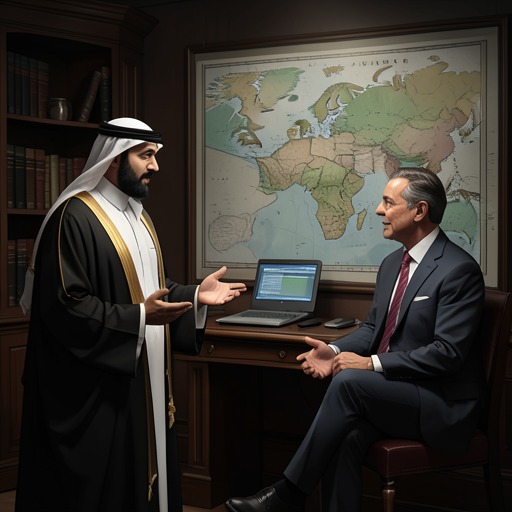
Saudi Arabia
September 11Saudi Arabia is presented as a pivotal setting in the book’s account of the September 11 attacks and the politics surrounding the ensuing war: a U.S. client state, a source of acute grievance for Osama bin Laden and his associates, and a central location in the struggle over Gulf energy and military influence. The country’s significance lies in how these roles intersect, rather than in any single description of it.
Political and Religious Position
Chomsky rejects the idea that Arabs are, by definition, fundamentalists. He distinguishes religious identity from political alignment, arguing that the United States has not opposed religious fundamentalism as such. In his account, Saudi Arabia was the most fundamentalist state in the Islamic world apart from the Taliban government, yet it had been a U.S. client from its beginnings. He also describes the Taliban as products of the Saudi version of Islam. The juxtaposition challenges explanations that treat the conflict as a simple contest between Western societies and an inherently fundamentalist Arab world.
Saudi Arabia’s alliance with the United States also sits alongside a wider history of U.S. relationships with radical Islamist forces. Chomsky says that the United States supported such militants during the 1980s because they were effective fighters. His argument is that power and service to it, not religion, determined which groups the West treated as enemies or allies. Saudi Arabia therefore appears not as an external opposite to U.S. policy, but as a client within the political relationships that shaped that policy.
U.S. Military Presence and Bin Laden’s Grievance
Chomsky attributes to bin Laden, as reported by Robert Fisk, a deep anger over the U.S. military presence in Saudi Arabia, U.S. support for atrocities against Palestinians, and the U.S. role in the destruction of Iraqi civil society. He stresses that this anger was not confined to the poor or to one political constituency; it extended across social classes and political positions in the Middle East.
Saudi Arabia has particular importance in bin Laden’s account because it contains Islam’s holiest sites. Chomsky says that bin Laden and his associates regarded the permanent U.S. military presence there as comparable to the Russian occupation of Afghanistan. After the United States established that presence, they turned their weapons against the Americans. Chomsky notes that this reversal had a precedent in 1983, when U.S. forces were present in Lebanon. In this telling, Saudi Arabia becomes both a strategic ally of Washington and a focal point for opposition to foreign military presence.
Chomsky distinguishes this account of political grievance from endorsement of bin Laden’s actions. He says that bin Laden’s crimes gravely harmed the poorest and most oppressed people in the region, and that the September 11 attacks dealt a severe blow to Palestinians. Yet he argues that resistance to real oppressors could make bin Laden appear heroic to some audiences, even when his actions inflicted suffering on the people he claimed to defend. Saudi Arabia’s place in this analysis helps explain the force of the grievance without making the violence politically or morally defensible.
Oil, Regional Power, and U.S. Policy
The country’s importance extends beyond the political symbolism of the U.S. military presence. Chomsky identifies the world’s principal energy reserves as lying mainly in Saudi Arabia and across the Gulf, with significant reserves also in Central Asia. He describes Afghanistan as a comparatively minor piece on this strategic board, while noting that proposed pipelines there had figured for years in U.S. efforts to shape access to Central Asian resources.
This resource geography frames Chomsky’s account of Washington’s diplomatic calculations. He says the United States was proceeding cautiously because the principal energy reserves were at stake, especially those in Saudi Arabia and the wider Gulf. He also connects the establishment of major U.S. bases in Central Asia to the effort to control regional resources and to the broader network of bases oriented toward the Gulf. Before the war in Afghanistan, he identifies Diego Garcia as the safest of those bases; subsequent deployments, in his account, improved the capacity for intervention.
Chomsky further argues that U.S. policy has supported governments in the region that are corrupt and brutal, obstruct democracy and development, and serve the purpose of protecting U.S. interests in Middle Eastern oil. He cites this explanation in discussing long-standing popular anger in the Arab world, and notes that after September 11 that anger was intensified by U.S. policy toward Israel and the Palestinians and toward Iraq. Saudi Arabia thus appears within a regional system where energy interests, military relationships, and public grievances are closely linked.
Alliance, Military Reach, and the Limits of Change
Chomsky treats the post-September 11 coalition-building effort as unlikely to transform the established basis of U.S. policy. He recalls that the Clinton administration had described its approach as acting multilaterally when possible and unilaterally when necessary, and says that this position was repeated by Madeleine Albright and Defense Secretary William Cohen. He argues that the later coalition might soften the rhetoric but was unlikely to change the policy: the United States reserved the right to act as it chose, while coalition members were expected to support it without demanding a genuine share in decision-making.
The account also places Saudi Arabia within a wider contest over military dominance. During Prince Abdullah’s visit to the United States in April, he urged the administration to take Arab reactions into account, particularly reactions to U.S. support for Israeli repression. Chomsky recounts that U.S. officials answered that they were not concerned with what he or other Arabs thought. He presents this exchange as evidence of a policy that emphasized the demonstration of American power rather than accommodation of regional opinion.
For Chomsky, the strategic significance of Saudi Arabia is therefore inseparable from the limits he identifies in the post-September 11 response. The country is at once a U.S. ally, a focus of bin Laden’s declared opposition, and a site of immense energy importance. Those roles expose a recurring tension in the book’s analysis: official language about counterterrorism and coalition-building sits beside enduring calculations about military reach, resources, and political control.