“To serve the Division Commander and his family is to Serve the People”
Serve the People!“To serve the Division Commander and his family is to Serve the People” is the household-service maxim that governs Wu Dawang’s work as the Division Commander’s orderly. Repeated as instruction, correction, permit, and official justification, it recasts service to one senior officer’s family as service to the public. The phrase’s changing circumstances give it a double force: it disciplines Wu Dawang’s conduct while exposing how political language can make private household demands appear to be revolutionary duty.
Origin and Instruction
The maxim is introduced as the culmination of Wu Dawang’s preparation for his appointment as the Division Commander’s full-time orderly and cook. Wu has earned the post after an exemplary performance at a Mass Theory and Practice of Frontline Logistics Competition, where he recites Mao Zedong quotations and essays, cooks a four-dish meal and soup, and wins further praise as a Model Soldier. His service record and appetite for promotion make him an especially valued choice, while the Division Commander’s wife, Liu Lian, remains a subject about whom Wu knows almost nothing.
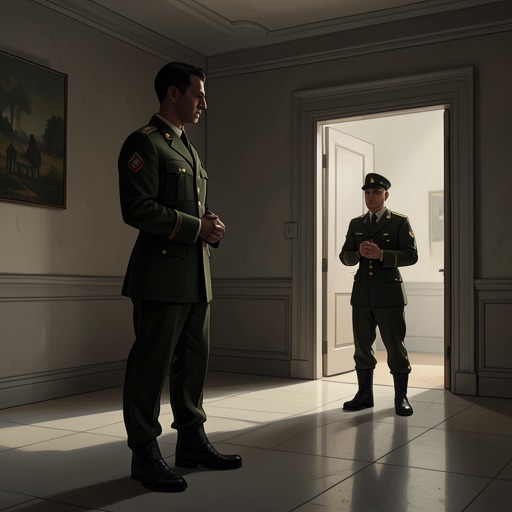
Before he begins work, the Head of Management quizzes Wu on the rules for serving the Commander. Wu first recites the injunction not to ask, do, or say what he should not. Asked to add the central principle, he answers, “To serve the Division Commander is to Serve the People.” The Head of Management insists that correct words alone are insufficient: Wu must mean what he says, unite theory with practice, and make his actions match his speech. Wu promises to speak as he thinks and act as he speaks, presenting himself as both Red and Expert. The maxim is therefore established not as casual encouragement but as a test of political and practical loyalty.
A Household Rule Made Public
The wording expands as the story places Wu inside the Commander’s household. When Liu Lian challenges his conduct, Wu repeats the principle in a form directed to her as well as her husband: “To serve you and the Division Commander is to Serve the People.” The exchange connects the public doctrine to the immediate household, where the senior officer’s wife can judge Wu’s performance and complain about it to his superiors. What counts as service is thus shaped not only by military regulations but also by the expectations of the people Wu has been assigned to serve.
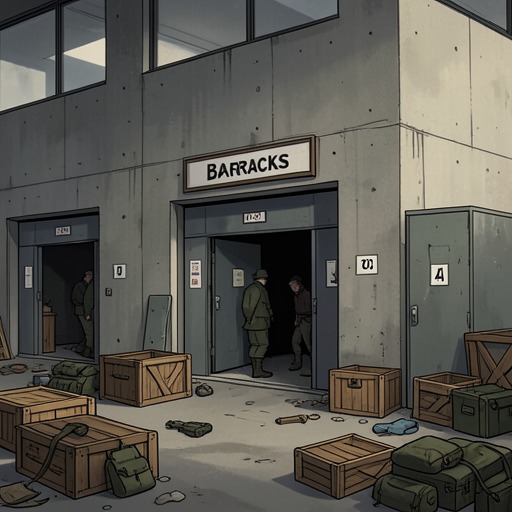
The maxim also travels beyond the house. As the barracks fill with soldiers engaged in political study and post-meal drills, a guarded residential compound separates the senior officers’ homes from the rest of military life. Wu gives little thought to the officers’ private isolation; his governing assumption is simply that serving them is serving the people. The expression turns a sharply hierarchical arrangement into a seemingly unified political duty, linking the orderly’s work to the broad revolutionary activity surrounding him without changing the unequal positions of the people involved.
That formula becomes especially consequential after Wu’s conduct brings Liu Lian’s complaint to the Political Instructor. The Instructor rebukes him for failing to understand that service to the Division Commander and his wife is service to the people, and threatens to replace him. He then invokes revolution, military readiness, and international dangers to argue that Wu’s ability to look after Liu Lian affects the Commander’s concentration, the Division’s training, and ultimately the army’s preparedness. The grand chain of consequences makes a household dispute sound like a matter of national security. At the same time, the Instructor’s practical warning is personal: Wu’s future promotion and the transfer of his family to the city may depend on the Commander’s favor, which Liu Lian can influence.
Repetition, Discipline, and Separation
The maxim is reinforced through small acts of military correction. When Wu encounters his Captain, the Captain asks what a soldier must remember while working for a senior officer. Wu initially gives only the prohibitions against saying or doing what he should not. The Captain marks this answer as wrong until Wu supplies the service maxim, now explicitly including the Commander’s family. He is told to repeat it louder, but glances at nearby dormitories and keeps his voice below full volume, explaining that the other soldiers are asleep. The exchange turns repetition into a public test: Wu knows the formula, but his hesitation shows that its performance is constrained by the setting and by his awareness of who might hear it.
The same principle appears in a permit that separates Wu from his company. When he discovers that nearly the whole company has departed for camp and field training, he learns that he has been left behind with a small staff to tend the pigs and vegetable garden. The permit issued by his superiors contains one sentence reminding him to serve the Commander’s family. Rather than joining his comrades, he must remain at the household post. The maxim therefore operates as an administrative instruction with concrete consequences: it explains his absence from collective training and sharpens his sense of being abandoned by the unit.
His superiors also use the household assignment to regulate his movements after the Division’s fate changes. When Wu returns from leave, the Political Instructor explains that Liu Lian personally requested an extended furlough for him, citing serious family problems. The Division Commander has meanwhile volunteered his unit for a pilot scheme to streamline and restructure the army, which will result in the Division’s disbandment. Promotions are suspended, but an exception is arranged for Wu: work in a city in his native province, relocation for his family, and employment for his wife. Because the Commander’s household has become unstable amid staffing changes, Wu is instructed not to return to his old post or visit the house unless pressing circumstances require it. The earlier principle has helped bind his service to the household; now decisions made through that connection both benefit and exclude him.
Public Justification and Irony
The expression reaches its fullest institutional performance at Wu’s farewell. His departure is arranged with conspicuous speed and care: boxes and crates are supplied, his company prepares a final supper, and a farewell meeting follows. In front of a hundred uniformed soldiers, the Political Instructor announces Wu’s special early discharge for a factory job in the city. The Head of Management then awards him the Third Order of Merit and describes him as an exemplary revolutionary thinker who has joined theory to practice. Wu is also proclaimed the Division’s sole Exemplary Servant of the People; his state-allocated job is publicly explained as the reward for serving the people with his whole being.
The ceremony makes the maxim’s irony unmistakable without cancelling its practical force. Wu’s city placement is connected to his exceptional standing with the Division Commander and Liu Lian, while the official account presents the outcome as a public reward for exemplary service. The senior officers’ decisions, the personal relationship behind the household assignment, and the bureaucratic process of discharge converge in an honorific narrative that the assembled company has not anticipated. Even Wu, his Captain, and the Political Instructor do not know beforehand how the evening’s presentation will end.
The phrase thus changes function while remaining recognizable. It begins as a lesson in obedience and political sincerity, becomes a measure by which Liu Lian’s complaint can threaten Wu’s career, appears as the written rationale for keeping him at home while his company trains, and ends as the language used to celebrate his early discharge. Each recurrence links a private arrangement to a collective ideal. Its central contradiction is that service to the Commander’s family is represented as service to everyone, even as the phrase helps channel military opportunity and official recognition toward a favored individual.