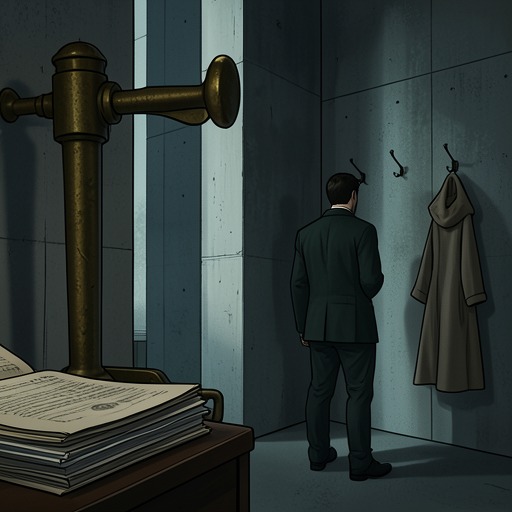
Accountant Zhao
Serve the People!Accountant Zhao is the commune official whose assessment of Wu Dawang’s handwriting turns a chance assignment into a route toward military service and marriage. As Zhao Ezi’s father, he makes that marriage conditional on a precise program of advancement and relocation; years later, disappointed by its results, he throws the written pledge back at his son-in-law. His role links bureaucratic opportunity to family bargaining, showing how Wu’s career and marriage become bound to promises whose fulfillment depends on institutions beyond his control.
Position and First Encounter
Although Zhao’s wife and children remain classified as peasants and draw income from the land, Zhao himself is on the state payroll. That status makes him a government official, on a social and professional footing with the commune director. The distinction gives his position unusual leverage in a village where leaving farming for a state job and urban life is a widely shared aspiration.
Zhao first meets Wu at a rush-harvest meeting after the village production-team leader falls ill and appoints Wu as his deputy. The commune needs an attendee list copied out so Zhao can issue each person expenses of three steamed buns and one yuan. Wu volunteers to write it. Zhao notices the neatness of the list and praises his ballpoint handwriting, recognizing a practical skill where Wu’s prospects had seemed stalled. The encounter later leads the production-team leader to bring Wu the news that Zhao has taken an interest in him.
Matchmaking and the Written Promise
Zhao’s interest is both familial and strategic: he is seeking a husband for his only daughter, Zhao Ezi, and sees military service as a means for Wu to acquire education, training, Party membership, commendations, and a chance of promotion. In Zhao’s spacious, three-room tiled house, he tells Wu that he will arrange for him to join the army before the year is out. Once Wu becomes an official, Zhao explains, he could obtain an urban registration permit for Zhao Ezi, enabling her to live with him in the city. The proposed marriage thus rests not simply on personal attachment but on a projected chain of career success and family relocation.
That chain is interrupted when Wu’s mother is dying of cirrhosis of the liver and asks him to marry in the village so she can know that a daughter-in-law will tend her grave. Wu approaches Zhao with the request, but Zhao measures the proposal against Wu’s prospects: he has won no commendations, has not joined the Party, and cannot say whether promotion is likely. Zhao says that people naturally hope for the best for their daughters and questions what kind of life Wu can offer Zhao Ezi.
Wu answers by kneeling and promising that he will meet Zhao’s conditions. He offers to put the promise in writing, and the resulting prenuptial pledge sets deadlines: commendations within one year, Party membership within two, and official status within three. It also promises that Zhao Ezi will be moved to a city home where she can eat steamed rolls every day, and that Wu will not return to Wujiagou if he fails. The document makes the unequal terms of the match explicit: Wu’s future standing is tied to his ability to deliver the urban life Zhao expects for his daughter.
Wu and Zhao Ezi marry almost as soon as the pledge is written. Two weeks later, Wu’s mother dies with a smile, having seen her son marry. Zhao’s conditions, however, do not end with the ceremony. They continue to organize Wu’s working life and his understanding of what he owes his wife and father-in-law.
The Pledge Meets Army Life
After returning to the army, Wu works hard but does not receive a commendation; the following year, he struggles to enter the Party and again fails. Each letter from his wife or father-in-law asking how he is progressing increases his anxiety. The promise has turned routine delays in recognition into apparent threats to his marriage and future, and Wu considers suicide when his name repeatedly fails to appear on lists of new Party members and recipients of commendations.
An opening in the Catering Squad eventually changes the course of his service. The vacant post of sergeant attracts eight ambitious soldiers, and Wu wins an opportunity by attracting the Political Instructor’s attention through an episode involving the instructor’s son. Transferred first as deputy sergeant, Wu takes responsibility for the company’s food and water. Over the next year and a half he becomes a full sergeant, joins the Party, and receives commendations and awards with the Political Instructor’s help. The remaining clause in Zhao’s plan—promotion to officialdom—continues to elude him for reasons including a high blood-pressure test, lost promotion quotas, and other soldiers being chosen first.
Zhao is not shown directing Wu’s later army assignments, and the account does not establish that he personally arranges Wu’s awards or promotion. His influence lies earlier and more durably in the terms he sets for the marriage: Wu interprets advancement as a debt to be paid to Zhao Ezi and her family. Even when the military’s promotion system frustrates those terms, the promise continues to shape what Wu fears losing and what he hopes to gain.
Repudiation and Aftermath
When Wu remains at home for almost six weeks after his leave, the village team leader urges him to return to the army if he has not been discharged. The conversation takes place in the courtyard of Wu’s thatched house, where the “Serve the People!” sign has been set on a pile of yellow earth while Wu prepares to build an energy-saving stove. The leader kicks the sign apart while making his point about another private matter. The next day, Zhao comes to Wu’s house.
Now old, with no further prospect of advancement himself and no success in moving any of his children to the city, Zhao arrives visibly frustrated. He refuses both the water his daughter offers and the stool his son-in-law presents, choosing to deliver his judgment standing up. He says that allowing his daughter to marry Wu was the biggest mistake of his life. Then he takes the neatly folded prenuptial pledge from an envelope, opens it, strikes at the signature, and throws it at Wu before returning to the commune to complete the canteen’s end-of-month accounts. The document lands on the sandy ground, its pale color matched to Wu’s face.
The repudiation marks a reversal in Zhao’s role: the man who once identified Wu as a promising route to a better future now rejects the agreement that tied his daughter’s prospects to that route. His anger reflects not only Wu’s unfulfilled promises but his own long-standing failure to secure urban opportunities for his children. The pledge had made Wu’s career seem like a family pathway out of village life; Zhao’s gesture declares that pathway a failure, without undoing the years during which Wu has lived under its terms.
A Promise Repeated in Another Marriage
The novel later echoes Zhao’s bargain through the Political Instructor’s account of his own marriage. The instructor asks Wu to seek Liu Lian’s help with the Division Commander so he can remain in the army long enough for his wife to join him. He explains that his father-in-law consented to the marriage because he expected military service to secure a city job for his daughter, and that he, too, had to write a prenuptial guarantee promising to do whatever it took. Wu is struck by the similarity to his own arrangement with Zhao.
This parallel places Zhao’s demand within a broader pattern rather than presenting it as an isolated family quarrel. Marriage, military service, advancement, and urban relocation repeatedly become parts of negotiated promises. The novel’s later disruptions—the Division’s disbandment, suspended promotions, and arrangements for Wu’s family to move to a city—show how such expectations depend on military decisions and private patronage as well as individual effort. Zhao’s pledge gives that instability an early, intimate form: a carefully written plan for a family’s future that neither work nor good intentions can guarantee.