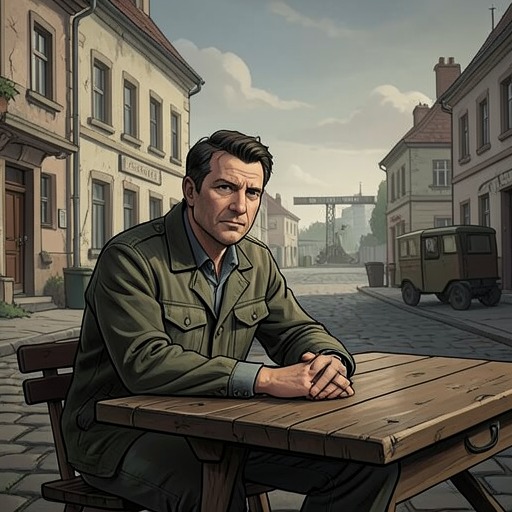
Balou Mountains
Serve the People!The Balou Mountains are the setting for Wu Dawang’s return to rural life during a six-week leave, but they are more than a remote backdrop: from there, he looks back toward the army and the relationship he has left behind, while an institutional upheaval gathers beyond his knowledge.
Setting and Village Life
Wujiagou lies among the Balou Mountains, its roughly twenty households scattered across a mountainside. Its hundred-odd residents depend on both collective and private farming. Families try to supplement their food by planting beans or sesame along the edges of collective fields, or cabbages and radishes on sandy river bends; these marginal plots are an uncertain contribution to three daily meals, not a guarantee of a full harvest.
After returning from the army, Wu Dawang works diligently at the agricultural tasks expected of him, including harvesting corn, binding sheaves, ploughing, sowing wheat, and spreading fertilizer. In the fields, he recounts what he has seen of the outside world to fellow villagers. The ordinary demands of village work give shape to his days, but do little to occupy his nights.
A Place of Separation and Memory
During his leave, Wu Dawang draws consolation from the memory of Liu Lian’s final smile as she waved to his departing vehicle beneath a vine trellis. He does not yet know how much that image will endure: it becomes a lasting presence in his memory and his principal comfort during the lonely weeks in the mountains.
Back in Wujiagou, he stays awake long after his wife and son have gone to bed, sitting in the courtyard or on a nearby hillside and staring toward the distant barracks. The landscape holds two directions at once: his present obligations are in the village, while his attention remains fixed on the military life and relationship he has left behind. The narration presents the mountains as the setting for this separation, not as a cure for it.
The Wider Disruption
The leave in the Balou Mountains coincides with events that Wu Dawang cannot see. While he spends six weeks away, the division he has served for five years is preparing to disappear from the state military system under an authorized restructuring plan. Its demobilization will affect many people, and the army’s leadership is also preparing to erase Wu Dawang’s service history. The gap between his quiet, lonely leave and the institutional decisions being made elsewhere gives the mountain setting a further narrative significance: he is physically removed from the forces already reshaping his future.
On returning to the barracks, Wu Dawang learns that the Division Commander volunteered the division for a pilot scheme to streamline and restructure the army, a decision that means the unit will be disbanded. Promotions have been suspended during the changes. Although the Division Commander has arranged for Wu Dawang to receive a job in a city in his home province, the division’s household also instructs him not to return to his former post or visit Compound Number One except on pressing business. The leave among the mountains thus stands between the intimacy he remembers and the administrative changes that close off his return.