Central Military Commission
Serve the People!The Central Military Commission is the national military body that organizes the Beijing seminar at which the Division Commander volunteers his unit for a pilot scheme to streamline and restructure the army. That choice makes the Division an early test case for disbandment, bringing a large institutional reorganization into direct contact with Wu Dawang’s career and future civilian life.
Role in the Restructuring
At the seminar, the Division Commander accepts an assignment that no other division has been prepared to take on: testing a pilot scheme for restructuring and streamlining the entire army. The consequences are immediate for his command. The Division is to be disbanded and, in the narrator’s image, disappear within the larger machinery of the People’s Liberation Army. Most companies are slated for demobilization, while a minority will be transferred.
The change reaches beyond unit organization. Promotions are cancelled for the time being, leaving Wu Dawang’s longstanding ambition to become an official threatened by a decision made at a level far above him. The novel thus presents streamlining not as an abstract administrative proposal but as a reallocation of military roles, opportunities, and futures.
Effects on Wu Dawang
The reorganization comes after years in which Wu Dawang has tried to advance through military service. His marriage pledge to Zhao Ezi tied commendations, Party membership, and official rank to the prospect of moving his family from Wujiagou to a city. He earns commendations, joins the Party, and becomes a Sergeant, but official promotion remains beyond reach. The cancellation of promotions appears to close off that final step once again.
Yet the institutional upheaval also creates an exception for him. The Division Commander instructs that Wu Dawang be given a job in a city in his native province, with his family moved there and suitable work found for his wife. His departure is therefore shaped by two forces at once: the general disbandment that removes his military position and the personal favor that arranges a civilian destination for him. The post promised is not the official rank he had pursued, but a city job and a new household settlement.
Organization and Personal Discretion
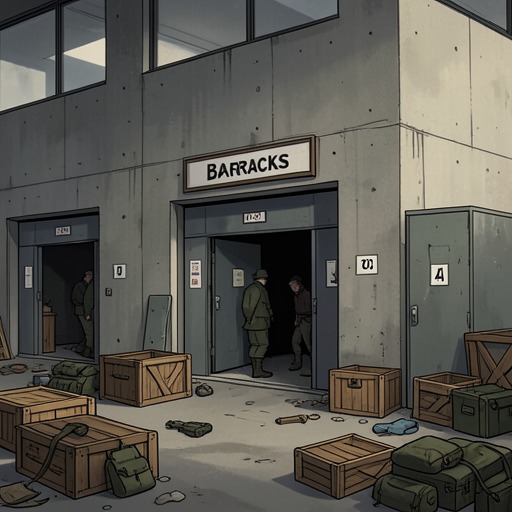
The account distinguishes the Commission’s broad restructuring initiative from the local decisions through which it affects individuals. The Commission directs the seminar; the Division Commander volunteers the unit; and the eventual arrangements for Wu Dawang are conveyed and carried out by the Political Instructor and other officers. When Wu returns to the Division barracks, the Political Instructor explains the planned disbandment, suspended promotions, and Wu’s city placement, while also telling him not to visit the Commander’s household amid personnel instability.
This chain shows how formal organizational change and personal discretion operate alongside one another. The Division’s future is determined by the army-wide pilot, but Wu’s particular exit is softened by the Commander’s intervention and his wife’s support. As his discharge approaches, officers arrange his travel and belongings, and a farewell gathering publicly presents his early discharge and factory job as recognition for exemplary service. The ceremony’s official explanation and the private favor behind his placement are not identical, a contrast that makes the reorganization’s human consequences especially visible.