Central Streamlining Plan
Serve the People!The Central Streamlining Plan is an army restructuring initiative whose pilot implementation leads to the disbandment of Wu Dawang’s division. Presented as an organizational decision made at the highest levels, it reaches into individual careers through cancelled promotions, transfers, demobilization, and exceptions granted through personal connections. Its consequences intersect with Wu Dawang’s earlier marriage pledge and military ambitions, while the dismantling of the division makes the apparent promise of his affair with Liu Lian newly uncertain.
Origins and Scope
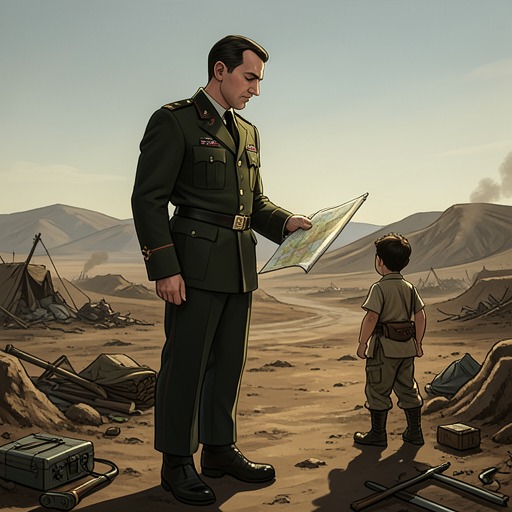
At a seminar in Beijing organized and directed by the Central Military Commission, the Division Commander volunteered his unit for a pilot scheme to streamline and restructure the army. No other division had been prepared to undertake the assignment. The practical consequence, as the Political Instructor explained to Wu Dawang, was that the division itself would be disbanded and disappear from the larger People’s Liberation Army.
The initiative thus arrives not as a distant policy discussion but as a change to the organization that has structured Wu Dawang’s life. The announcement connects the division’s fate to an army-wide program while leaving its human effects to be handled through local personnel decisions: some companies would be demobilized, others transferred, and promotions suspended during the reorganization.
Career Promises and Institutional Change
The plan collides with a promise Wu Dawang had made before marrying Zhao Ezi. In a written pledge, he set himself deadlines to earn commendations, join the Party, and become an official, tying those ambitions to moving his wife to a city where she could eat steamed rolls every day. He promised that if he failed, he would never return to Wujiagou unless Zhao Ezi permitted it, and would serve her as she chose. The pledge made advancement more than a personal ambition: it was a condition attached to his marriage and his family’s hoped-for future.
His path through the army had already shown how opportunity depended on both performance and available posts. After struggling without commendations or Party membership, he obtained a position in the Catering Squad, where the difficult work was known to offer quicker advancement. Within a year and a half he became a full Sergeant, joined the Party, and received commendations, but promotion to officialdom remained out of reach. The four-pocket jacket associated with officials stayed tantalizingly beyond him, despite his improved prospects.
The restructuring interrupts that effort at the institutional level. Because most companies were to be demobilized and a minority transferred, promotions were cancelled for the time being. Wu Dawang’s expected next step therefore appeared likely to fail through bureaucratic circumstance rather than any newly stated shortcoming of his own. The initiative changes the terms of his career just as he has moved close enough to promotion to imagine it within reach.
Discretion, Exception, and Unequal Outcomes
The Political Instructor’s account also reveals that the plan’s effects were not distributed through a uniform process alone. The Division Commander had left instructions that an exception be made for Wu Dawang, whom he and Liu Lian favored. A job was to be arranged for him in a city in his native province, his family was to move there, and suitable work was to be found for his wife. The arrangements answer the practical aim of Wu Dawang’s marriage pledge even as the promotion he had pursued is suspended.
That exception sits alongside a broader climate of uncertainty. The Commander’s household had seen a high turnover of orderlies during the reorganization; despite their discretion and Liu Lian’s efforts to smooth matters over, each had somehow incurred the Commander’s anger. Wu Dawang was specifically told not to return to his former post or visit the house unless pressing business required it. The policy therefore reshapes not only the division’s staffing but also the private and professional space in which Wu Dawang’s relationship with Liu Lian had developed.
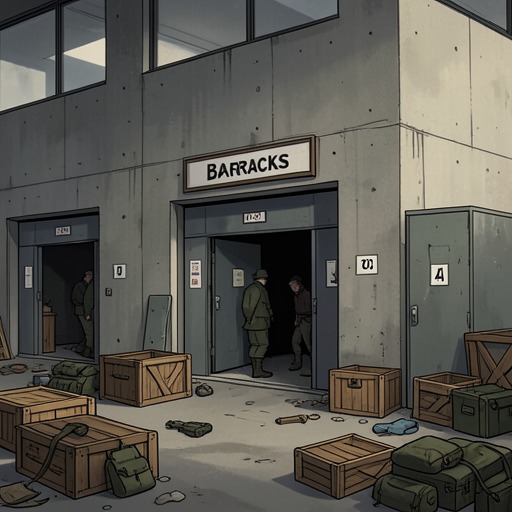
Local officers translate the upheaval into concrete decisions and warnings. When Wu Dawang returned to barracks, the Political Instructor received him with unusual care, gave him water and soap, and arranged food before explaining his extended home leave, the division’s impending disbandment, and the city arrangements. Later, the Captain ordered him to tell no one what he had heard or seen, warning that disclosure to the Division Commander would place them all in danger. Such acts show how the reorganization is experienced through individual discretion, instructions, and secrecy as much as through formal announcements.
Demobilization and Narrative Consequences
At first Wu Dawang takes the favorable outcome at face value. Within a week of his return, he and his family have work and housing in the city nearest their village, and he needs only to complete and sign the forms given to him by army bureaucrats. While comrades remain anxious about their prospects, the speed and apparent ease of his own arrangements make it seem that his future has been secured. He treats the discharge, city work, and family move as the fruits of his relationship with Liu Lian.
His final days in the army complicate that interpretation. With time to revisit the barracks, see comrades from his village, and reflect, Wu Dawang begins to suspect that the affair was part of an elaborate scheme directed from behind the scenes. He senses that he had been cast in a role and that his freedom lay chiefly in whether he became emotionally involved in it. At the same time, he resists concluding that the Division Commander had exploited the streamlining initiative for self-interested reasons, even as he learns that three battalions and four companies have already been sent five hundred miles away to a frontier division.
The consequences of the plan become visible in the departing troops. Under the Corps Commander’s direction, units leave in succession: the First Regiment, then the First Battalion of the Second Regiment, then the Machine Gunners. Farewell banquets give way to anger and grief; soldiers smash windows and equipment associated with years of service, and weep openly before leaving, apparently resigned never to meet again. Against this collective rupture, Wu Dawang’s swift urban placement is a marked exception, not evidence that the reorganization has spared the rest of the division.
The plan’s decisive narrative function is to make institutional change inseparable from private uncertainty. It offers Wu Dawang a city future while closing off his military advancement, separates him from the household where his affair began, and provides the circumstances in which he reconsiders how much of that relationship was genuinely his own. The division’s disappearance is at once a large-scale administrative event and the force that abruptly changes the choices available to individuals.