Compound Number One
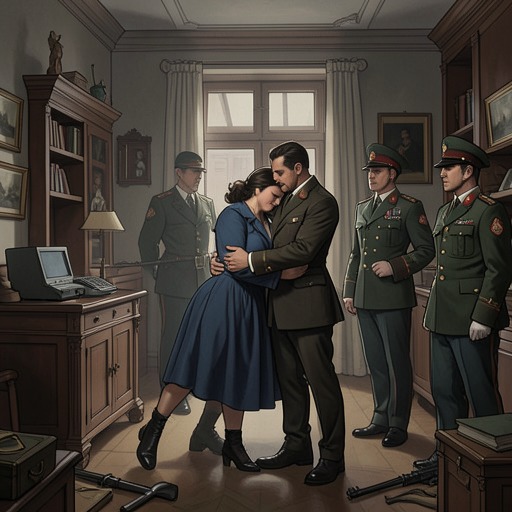
Serve the People!Compound Number One is the Division Commander’s residence and Wu Dawang’s workplace, a walled domestic enclave inside the military barracks. Its strict separation from ordinary troop life gives shape to the story’s central contrast: Wu Dawang serves the household in the name of the People, while private relationships and military decisions within the compound redirect his personal and professional future.
Setting and Structure
For six months, Wu Dawang worked in the Division Commander’s household, cooking, growing vegetables, cleaning the floor and front yard, tending the flower beds, and pruning trees. After a brief period of home leave, he rarely left the post. His conscientious service coincided with a centrally directed streamlining initiative that reduced the Commander’s household staff to one. During the workday, the large residence was left to Liu Lian, the Commander’s thirty-two-year-old wife, and Wu Dawang, her twenty-eight-year-old orderly.
The compound stood among six residences for the division’s senior officers, arranged in two rows of three to the north of the barracks. A red-brick enclosure and guards separated these houses from the rest of the base; reinforced steel fences and thick vines divided each residence from its neighbours. The officers met during the day but returned to their separate homes in the evening. Wu Dawang took this hierarchy and separation as part of the order of service: to serve the senior officers, he believed, was to Serve the People.
Work and Private Attention
The compound’s gardens and kitchen made Wu Dawang’s duties visible in small, repeated acts. He watered pak choi, radishes, and chives and prepared vegetables for Liu Lian, who preferred greens between meals and pine kernels afterward. While he worked outside, Liu Lian watched him from the house and studied him over time. Wu Dawang did not recognize this attention as the beginning of a change in their relationship.
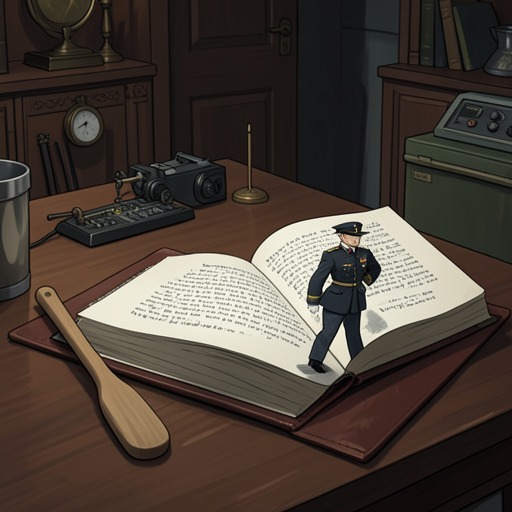
The “Serve the People!” sign, normally associated with the dining room, appeared on the kitchen worktop while Wu Dawang was outside watering the garden. Returning with pak choi for Liu Lian, he saw the sign and froze; the vegetables slipped from his hands onto the floor. The object’s relocation turns an official slogan into an intimate summons within his place of work, joining the household’s political language to the private encounter developing there.
When Liu Lian complained about Wu Dawang’s conduct, the Political Instructor summoned him and said she had requested a replacement. He did not disclose what had happened. Instead, the Instructor offered him one more day at the house to put matters right, taking responsibility for sending him back. He also framed Wu Dawang’s household duties as consequential to the Commander’s work and, by extension, the division’s readiness. The scene shows how authority translated domestic service into military obligation, even as Wu Dawang kept the private cause of the dispute to himself.
Separation, Confinement, and Return
The compound’s gates and fences became more than markers of rank when Liu Lian shut the entrance gates, padlocked them from the outside, and locked both the front and back doors. The locked residence created the setting for a three-day period in which Wu Dawang and Liu Lian remained together, apart from the routines and supervision of the barracks. Their seclusion intensified the contrast between the public military world beyond the walls and their private life inside them.
The separation was reinforced when the division left for camp and field training. After nearly a week behind Compound Number One’s reinforced fence, Wu Dawang was taking his bicycle out toward the market when the division jogged past in battle dress. He learned from a sentry that the troops were departing for training. The scene briefly returns him to the rhythms of military mobilization, but also makes clear how long he has been enclosed in the Commander’s household.
When Wu Dawang later returned to the barracks, the Political Instructor received him with unusual care: he offered hot water, brought out scented soap, and arranged egg noodles after learning that Wu Dawang had missed lunch. He explained that Liu Lian had requested an extended home leave for him because of serious family problems. He also said the Division Commander had volunteered the division for a streamlining and restructuring pilot, which meant the unit would be disbanded. Promotions were suspended, but the Commander had ordered an exception for Wu Dawang: a city job, a move for his family, and work for his wife were to be arranged. At the same time, because the Commander’s temper had become uncertain amid staff turnover, Wu Dawang was told not to return to the household or visit it without urgent cause.
Institutional Change and Significance
Compound Number One sits at the intersection of private patronage and formal military reorganization. Wu Dawang’s early pledge to earn commendations, join the Party, and become an official had tied his prospects to promotion and a move to the city. His rise through the Catering Squad, Party membership, awards, and eventual household appointment brought him closer to that ambition. The Commander’s decision to make an exception during the division’s dissolution then provided a route to city work and housing even as the normal promotion system was suspended.
The compound’s guarded boundaries therefore do not simply protect the senior officers’ privacy. They separate Wu Dawang from ordinary barracks life while placing him near the people whose decisions can determine his prospects. His transfer into the household begins as a reward for dutiful service, becomes the setting for an undisclosed affair, and ends with instructions to stay away as the division is dismantled. The residence is at once a workplace, a symbol of military hierarchy, and the enclosed space through which personal dependence and institutional power shape Wu Dawang’s future.