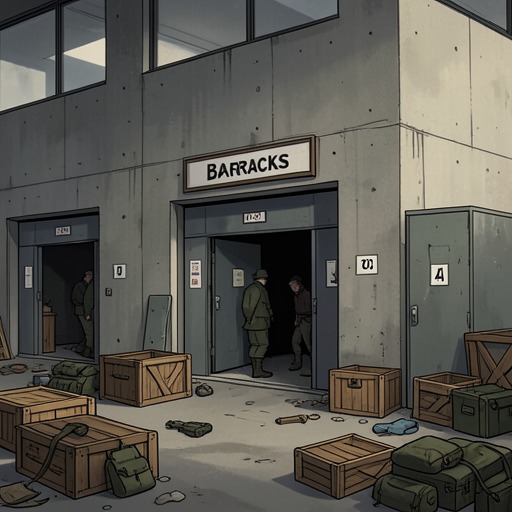
Division Disbandment and Erasure of Wu Dawang’s Service Record
Serve the People!The Division’s disbandment and the erasure of Wu Dawang’s service record join a sweeping military reorganization to the carefully managed fate of one soldier. The Division Commander volunteers his unit for a pilot streamlining scheme; amid the resulting personnel upheaval, Wu Dawang is given extended leave, barred from returning to his old post, and rapidly discharged with city employment and housing arranged for his family. His departure is presented as reward for exemplary service even as the military’s actions make him and his past disappear from the institution. The contrast between public ceremony and private administrative purpose makes this both a collective organizational rupture and an exercise in selective protection and forgetting.
Causes and Background
The disbandment follows the Division Commander’s decision at a Beijing seminar organized and directed by the Central Military Commission to volunteer for a pilot scheme to streamline and restructure the army. No other division had been prepared to undertake the assignment. In practical terms, the Division was to be disbanded and disappear from the structure of the People’s Liberation Army. The account describes the change as an officially authorized operation, driven by pressures within the military system that Wu Dawang cannot see while he is away on leave.
The reorganization intersects with an earlier set of personal and career commitments. In his written marriage pledge to Zhao Ezi, Wu Dawang promised commendations within a year, Party membership within two, and official rank within three; if he could not secure a city home for her, he swore not to return to Wujiagou unless she allowed it. Those goals were difficult to achieve: he initially missed both commendations and Party membership, and the Sergeant position he eventually secured required filthy, exhausting catering work. After his transfer to the Catering Squad, however, he became a full Sergeant and joined the Party, with help from the Political Instructor, while official promotion remained out of reach. The restructuring would abruptly change the terms of his prospects, not by delivering the rank he had pursued but by arranging a different route out of the army.
The Decision and Its Administration
During Wu Dawang’s six-week leave, the Division authorities move to make him absent from the military system. The narrative says that the Division’s commanders are conducting a premeditated, officially authorized operation to obliterate the Catering Squad Sergeant and his personal history from view. Its compressed institutional motto is “Amnesia would become the Division’s new watchword.” Wu Dawang, meanwhile, spends the leave thinking about the barracks and the last smile Liu Lian gave him as he drove away, unaware of the scale of the changes or their consequences for his comrades.
When Wu Dawang returns to the barracks, the Political Instructor receives him with unusual care: he provides hot water, lets him wash with scented soap, and orders egg noodles after learning that Wu Dawang has not eaten lunch. He then explains the arrangements. Liu Lian has personally said that serious family problems require a three-month period of home leave, and an extended furlough has been granted unless urgent business requires Wu Dawang’s return. At the same time, the Division is to be disbanded; most companies will be demobilized and a minority transferred, so promotions are cancelled. The Commander has nevertheless instructed that an exception be made for Wu Dawang: a city job in his native province, a move for his family, and work for his wife are to be arranged.
The instruction to stay away from the Commander’s household is part of the same unsettled personnel situation. Frequent changes among the household orderlies have angered the Commander, and Wu Dawang is told not to return to his former post or visit the house unless a pressing matter arises. He takes the explanation as reassurance that his affair with Liu Lian has not been discovered. The Political Instructor’s solicitude and the promised exception soften the shock, but the explanation also keeps Wu Dawang from understanding how his removal fits into the Division’s larger disappearance.
Unequal Outcomes and Managed Secrecy
The Captain reinforces the boundary around what Wu Dawang may know. After asking whether he has visited the Commander’s house, the Captain orders him to tell no one what he has heard or seen, warning that disclosure to the Division Commander would put them all in danger. Wu Dawang returns to the barracks without understanding the reorganization’s complexities. He concentrates instead on what he believes his relationship with Liu Lian will secure: an honorable discharge and city jobs for himself and Zhao Ezi.
His departure is markedly faster and more secure than that of the soldiers around him. Within a week, work and housing have been arranged for Wu Dawang and his family in the city nearest their village. While his comrades face uncertainty about their futures, he only has to complete and sign a few forms. The text connects that favorable exception to the Commander’s and Liu Lian’s personal regard for him, even though promotions across the Division have been suspended and most companies are being demobilized. Institutional upheaval does not affect everyone equally: the same process that unsettles the unit gives Wu Dawang an expedited path to civilian life.
The hurried logistics make the planned departure tangible. The Division supplies cardboard boxes, wooden crates, and rope for his belongings, and his company prepares a final supper before his 12:30 a.m. train. A farewell meeting follows dinner, attended by the hundred-strong company in uniform. There, amid songs and recitations of Mao quotations, the Political Instructor announces Wu Dawang’s special early discharge for a factory job in the city. A senior management official, unusually present in person, announces that Wu Dawang is receiving the Third Order of Merit. The speed and precision of the arrangements contrast with the uncertainty confronting the rest of the unit.
Public Honor and Erasure
The farewell presents Wu Dawang’s departure as a moral and political success. The official account credits his study of The Collected Works of Chairman Mao and his ability to put theory into practice; it names him an Exemplary Servant of the People, the only soldier in the Division to receive that distinction, and explains the state-allocated job as a reward for service. Yet none of Wu Dawang, the Captain, or the Political Instructor knew beforehand that the evening’s proceedings would end with this public honor. Its prepared-sounding rationale therefore does not simply report a career already understood by those involved: it gives the departure a ceremonial meaning at the moment the institution is expelling him from its daily life.
That ceremony sits against the narrative’s account of deliberate erasure. Wu Dawang has been separated from the barracks while the Division dismantles itself, and his own history is being removed from the military system. The distinction between his hidden administrative removal and his highly visible commendation is central: the institution can publicly praise him even as its restructuring makes his service record, and the unit that produced it, vanish. His discharge resolves some of the aims laid out in his marriage pledge by securing a city move and work, but it does so through an exception granted amid collective demobilization, not through the official promotion he had spent years pursuing.
The episode thus sets bureaucratic process, personal patronage, and public ideology alongside one another without making them interchangeable. The pilot scheme supplies the formal reason for the Division’s dissolution; the Commander’s instructions and Liu Lian’s intervention shape Wu Dawang’s special leave and destination; the final meeting turns his exit into an exemplary story of service. For Wu Dawang, the arrangement initially appears to be the fortunate harvest of his affair and his years of ambition. For the reader, the larger frame is darker: while he believes he is being rewarded, the Division is carrying out a coordinated disappearance, and the institution’s praise becomes part of the means by which that disappearance is made orderly.