Institutional Erasure
Serve the People!Institutional Erasure is the novel’s account of how a military organization can make a person disappear from its official story while continuing to determine his future. As the Division approaches dissolution, Wu Dawang is given explanations, leave, a city job, and a public farewell, yet the officers’ actions are arranged above his understanding and away from his control. The contrast between his private memories and the institution’s managed account of his service turns forgetting into an active administrative practice.
Personal Ambition and Institutional Dependence
Wu Dawang’s vulnerability to the organization begins with a promise he writes before marrying Zhao Ezi. He pledges to earn commendations within a year, join the Party within two, and become an official within three; if he cannot secure a city home for his wife, he swears never to return to Wujiagou unless she permits it. The pledge makes advancement more than a military ambition: it binds his career to a family’s prospects and gives institutional decisions lasting consequences for his marriage and home.
His first two years in the army do not fulfill the pledge. He earns neither a commendation nor Party membership, and letters from Zhao Ezi and her father intensify his fear that he will fail. When a Catering Squad sergeant’s post opens, eight ambitious soldiers compete for it. The Political Instructor’s judgment helps determine the outcome, illustrating how formal rank and advancement depend not only on labor but also on the discretion of immediate superiors.
Wu Dawang secures the post after the Political Instructor sees him entertaining the latter’s son, then presents a political argument about serving the needy. Transferred as Deputy Sergeant, he becomes responsible for the company’s food and water. Within a year and a half he is promoted to full Sergeant, admitted to the Party, and given awards with the Political Instructor’s help. Officialdom alone remains beyond reach. His career therefore appears to reward diligence, but it is also shaped by personal favor, openings in the hierarchy, and decisions made by others.
Rules, Service, and Household Authority
The organization’s language of service makes private obedience appear to be public duty. When the Political Instructor confronts Wu Dawang over his conduct in the Division Commander’s household, he frames care for the Commander’s wife as service to the people. He expands the consequences from the household to the Commander’s ability to work, the Division’s training, and even the army’s readiness. In this account, a subordinate’s intimate and domestic duties are folded into the institution’s political and military mission.
An exchange with his Captain makes the same hierarchy concrete. Asked what he must remember while working for a senior officer, Wu Dawang answers that he must not say or do what he should not. The Captain marks the answer wrong. The scene leaves the rule unsettled, but underscores that obedience is not simply a clear maxim: a subordinate’s understanding of proper conduct remains subject to the superior’s judgment.
The Division Commander’s household becomes a place where official roles and private life overlap. After Liu Lian tells Wu Dawang’s Captain and Political Instructor that she is afraid to be alone while her husband is away, she reports that Wu Dawang has addressed her earlier criticism and asks that he stay in the house. His superiors agree, treating the orderly’s conduct as a reflection on the company and its Party representatives. His daily gardening continues in public, preserving the visible appearance of ordinary service while his relationship with Liu Lian changes in secret. The household thus shows how the chain of command can authorize arrangements that conceal realities it does not openly acknowledge.
Restructuring and the Management of Absence
During Wu Dawang’s furlough, the Division’s future is being settled without his knowledge. He leaves after Liu Lian has arranged his departure, and at the railway station an official gives him a standard berth ticket and a special military travel permit, instructing him to keep the permit with him. Alone in the waiting room, Wu Dawang is overtaken by solitude. He cannot know that the Division is preparing to vanish from the state military system or that its commanders are conducting an authorized operation to erase the Catering Squad Sergeant and his personal history. The narration names the emerging policy of oblivion as the Division’s new watchword.
When Wu Dawang returns, the Political Instructor receives him with conspicuous hospitality: hot water, scented soap, and egg noodles. Then he explains that Liu Lian personally reported serious family problems and secured a three-month home leave for him, extendable if the barracks has no urgent need to recall him. The welcome settles Wu Dawang’s immediate fear that his affair has been discovered, but the carefully managed account also keeps him from seeing the larger operation underway.
The second explanation is that the Division Commander volunteered at a Beijing seminar organized by the Central Military Commission to test a scheme for streamlining and restructuring the army. In practice, the Division is to be disbanded and disappear within the People’s Liberation Army. Most companies are to be demobilized and a minority transferred, so promotions have been suspended. This organizational decision abruptly closes the route to officialdom on which Wu Dawang’s marriage bargain and years of service have depended.
Yet the same briefing makes him an exception. Because the Division Commander and Liu Lian favor him, the Commander has ordered a city job in Wu Dawang’s home province, a move for his family, and work for Zhao Ezi. At the same time, Wu Dawang is told not to return to his old post or visit the household unless necessary: successive orderlies have angered the Commander, and uncertainty about his temper makes the household a dangerous assignment. Help and exclusion arrive together. The institution arranges Wu Dawang’s civilian future while severing his access to the place where his most consequential personal history occurred.
Official Recognition and Private Memory
The arrangement moves quickly. Within a week, Wu Dawang and his family have work and housing in the nearest city, while his comrades face uncertainty. His discharge comes so fast that he spends his final days walking around the barracks, visiting comrades from his village, and washing his bedding and clothes. He tries to put the restructuring’s stated aims aside and remind himself that he was fortunate to have had his time with Liu Lian.
But the quiet interval also lets him suspect that the affair itself was choreographed. He begins to imagine that he had been cast in a performance directed from behind the scenes, with only his emotional response left to him. He cannot yet reconcile his memories of love with the dismantling of the Division or accept that the Commander might have used the streamlining initiative for personal advantage. Meanwhile, he sees battalions and companies sent far away, and witnesses departing soldiers sit through farewell banquets before grieving, breaking windows, and smashing familiar equipment. The institutional transition is experienced by those leaving as the end of a shared life, even as it is described through administrative arrangements.
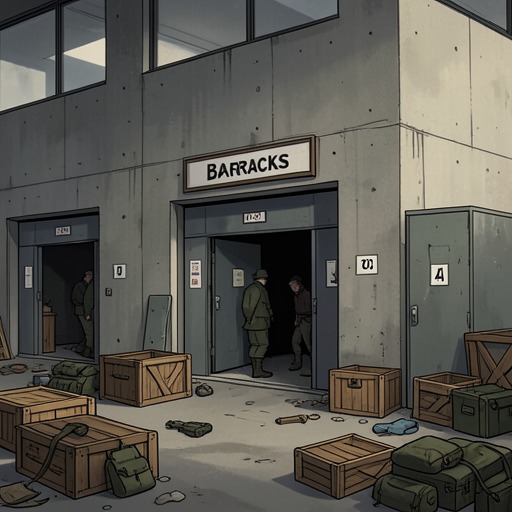
The departure is made to look orderly and honorable. The Division supplies boxes, crates, and rope for Wu Dawang’s belongings, and his company holds a lavish supper and farewell meeting before his 12:30 a.m. train. In front of a hundred uniformed soldiers, the Political Instructor announces his early discharge for factory work. The Head of Management then awards him the Third Order of Merit and names him an Exemplary Servant of the People, praising his study of Mao’s works and his ability to put theory into practice. The public ceremony presents his exceptional job assignment as a reward for exemplary service, although Wu Dawang, his Captain, and the Political Instructor did not know in advance that the evening would end with this recognition. Honorific language gives a coherent public shape to a departure whose practical arrangements have been decided elsewhere.
The ending returns the reader to the difference between official accounting and remembered experience. Years later, Wu Dawang brings Liu Lian a stiff rectangular object wrapped in red silk. She sends back a short note offering help or money; he reads it at the gate, puts it away, and leaves the object with the sentry to deliver to her. Then he walks off into the snow. The scene does not restore the relationship or the erased military past. Instead, the unsent exchange leaves a private trace where an official record has offered no comparable account: the institution can arrange a job, a journey, and a decorated farewell, but it cannot determine what Wu Dawang remembers or what he chooses to leave behind.