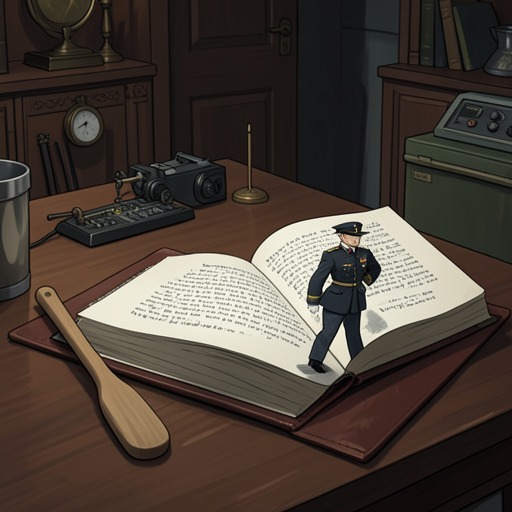
Life Imitating Art
Serve the People!Life Imitating Art is both a principle announced by the novel and a method by which its story makes experience intelligible. The narrator suggests that fiction can bring certain truths into the light, presents the tale as resembling real people and events, and then describes life as rehearsing the plot of Serve the People! The idea connects the novel’s self-conscious storytelling to the characters’ world, where political symbols and prescribed performances give shape to private experience.
Fiction and the Claim to Truth
The narrator begins from a paradox: the novel is a place for truths that may be difficult to hold up to the light elsewhere. Fiction is not offered as the opposite of truth but as a form capable of presenting it. The narrator’s claim that the story resembles real people and events makes the relationship deliberately unsettled. The tale is not presented as a transparent record, yet its invented form is linked to recognizable life.
That link becomes explicit in the description of life as having imitated art by re-rehearsing the plot of Serve the People! The phrase reverses the familiar expectation that art copies life. Here, the novel’s plot supplies a pattern that reality appears to repeat. This framing invites readers to consider not only whether fiction resembles experience, but also whether stories and symbols can influence how experience is enacted and understood.
A Story That Comments on Its Own Making
The narrator repeatedly calls attention to the construction of the narrative. When Wu Dawang enters Liu Lian’s darkened room, the narrator says the beginning of their love story has skipped over a great mass of plot details and connections. The omission is made part of the account rather than concealed as a flaw. The narrator argues that complexity does not automatically increase verisimilitude or persuasive power; at times, simplicity and economy propel drama more vigorously.
The result is a productive tension between a story that acknowledges its gaps and one that claims the power to illuminate truth. By stating that the affair’s beginning, middle, and end lack the intervening complexities a reader might expect, the narration asks readers to notice how a plot is shaped. Its compression is not merely a shortcut: it becomes an explicit reflection on the means by which fiction persuades.
Political Performance and Private Experience
The novel’s central image of imitation is made concrete by the “Serve the People!” sign. Wu Dawang, once a sergeant in the Catering Squad and now the Division Commander’s General Orderly, recognizes its political symbolism in detail. The five stars stand for the Revolution; the rifle and canteen evoke the Party’s history of armed struggle; the wheat represents the promised future of Communist harvests. His understanding of the image marks him as a model of political correctness, but it also establishes a visual language through which the story connects public doctrine with private conduct.
That language enters the lovers’ encounter as performance. Liu Lian turns the revolutionary exhortation into an instruction addressed to Wu Dawang, and he follows her direction. The scene’s political phrase is therefore not confined to public display: it is repurposed within an intimate situation. The collision between a solemn slogan and the lovers’ conduct makes the episode farcical as well as emotionally charged, showing how a public script can be borrowed, transformed, and made to organize private behavior.
The Farce of Earnestness
The narrator says that neither character fully grasps the absurdity of the scene or of the roles being played. Rather than treating farce as a break from emotional seriousness, the narration proposes that emotional truth may emerge through it. In this account, earnest restraint is not necessarily more convincing than absurdity; an affair of the heart may find its test in a scene whose ridiculousness exceeds the characters’ understanding.
The lovers’ performance does not erase Wu Dawang’s past. As the affair develops, his thoughts repeatedly return to his passionless marriage to Zhao Ezi. The narrator connects that history to the way the story proceeds: Wu Dawang’s personal past interrupts his capacity to abandon himself to the present. The contrast makes the affair more than a simple repetition of a romantic plot. The narrative places desire, memory, political language, and farce together without smoothing away their contradictions.
Rehearsal, Memory, and Narrative Shape
A further reflection on storytelling arrives when Wu Dawang lies awake and considers the turns his life has taken. The narrator remarks that plot depends not only on character but also on the experiences that bring a person to the narrative present. Wu Dawang’s marriage and earlier life therefore become more than background: remembered experience redirects the story’s movement, like a small disturbance sending fate in a new direction.
The novel thus gives the idea of life imitating art two complementary forms. At the level of its opening frame, life appears to rehearse the plot of Serve the People! At the level of narration, a character’s past is gathered into a plot that makes the present newly readable. The story’s self-conscious compression, its political emblem, and its abrupt shifts between seriousness and farce all reinforce the same central proposition: fiction does not simply copy a finished reality. It selects, arranges, and exposes patterns through which life can be seen anew.