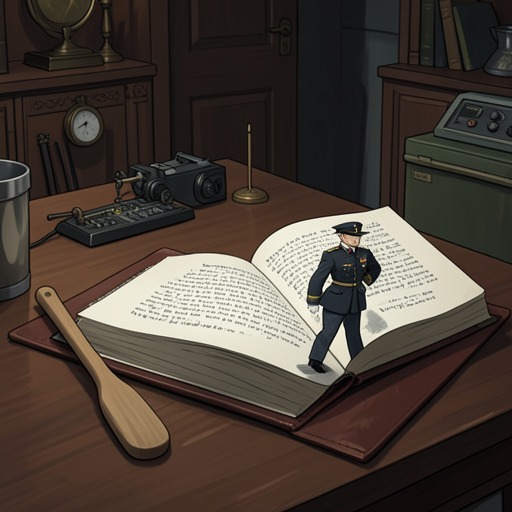
Romance as Performance and Game
Serve the People!Romance as Performance and Game is the novel’s account of how Wu Dawang and Liu Lian’s affair takes shape as both private desire and a repeatedly performed role. The lovers make the household’s “Serve the People!” sign their summons, using an object of public political instruction to organize clandestine meetings. The affair’s game-like simplicity is not a way out of the surrounding military hierarchy: it depends on that hierarchy’s language, household routines, and personnel decisions, and it eventually collides with Wu Dawang’s official future.
A Signal Turned into a Script
The arrangement begins with an understated gesture. After dinner, Liu Lian takes the “Serve the People!” sign from its usual place and sets it on the dining table. She tells Wu Dawang that when the sign is not in its usual place, she needs him upstairs. Its movement gives the sign a second, private meaning without changing its public appearance: in the household, it still stands for political service, while between them it functions as an instruction.
The code persists beyond that first explanation. Liu Lian repeats that the sign on the table means she wants him upstairs; later it appears on the kitchen worktop while Wu Dawang is occupied in the garden. A cough and a question at a closed door become further parts of the routine. The account emphasizes how little explanation the pair require. What looks like a household object displaced during ordinary chores is enough to cue an encounter, and the sign’s repeated use turns a small domestic gesture into a shared script.
The Household as a Stage
Once the relationship begins, it is protected by a public performance. Liu Lian tells Wu Dawang’s company officers that she fears being alone in the house at night while the Division Commander is away, and that Wu has satisfied her concerns about his duties. She asks that he sleep in the house rather than return to barracks. His superiors agree, treating any failure by the orderly as a reflection on the company and inviting her to report further shortcomings. Their administrative response supplies the practical cover for his continued presence.
The outward routine is carefully maintained. Wu still tends the vegetables, flowers, and shrubs, and passersby looking through the gate can see what appears to be the familiar arrangement: Liu Lian as the Division Commander’s wife and Wu as the commander’s orderly. Yet the same work now serves as a performance for observers, concealing the change that has taken place inside. The novel presents the affair not as a private world wholly separate from public life, but as a hidden alteration carried within ordinary duties and recognizable roles.
Inside that cover, the roles are repurposed. Liu Lian may summon Wu from the garden by leaving the sign where he will find it; he responds by carrying it indoors and going upstairs. She rewards his perceived success by cooking what he wants, or assigns domestic tasks as penalties. The ordinary language of service and duty therefore becomes part of their intimate game, with household favors and chores assigned new meanings. The game is treated seriously by its players even as its staged quality remains visible to the reader.
Desire, Habit, and Unequal Roles
The affair’s development is set against Wu’s unsatisfying marriage to Zhao Ezi. The novel contrasts the intimacy he experiences with Liu Lian with a marital life that has become joyless and emotionally constrained. That contrast helps explain why he experiences the affair as a revelation, but it also shows how his understanding of love is shaped by the intensity and frequency of physical passion rather than by a settled account of what the relationship means.
Over a matter of weeks, the affair expands until it competes with the other structures of Wu’s life. Their encounters vary in manner, from casual to ceremonious, while the summons can interrupt his gardening, shopping, or attention to his wife and son. The sign thus becomes more than a practical code: once he sees it, other concerns recede. The novel describes the lovers as increasingly governed by instinct, while leaving open whether the relationship’s force comes from love, desire, or the momentum of their shared performance.
That performance also exposes the limits of their imagined equality. At one point Wu speaks to Liu Lian as he might speak to his wife, expecting her to wash his clothes. She points to the sign, and its meaning reminds him of the role assigned to him in the compound and of the low status he cannot escape simply by imagining otherwise. His attempt to treat her as a domestic subordinate disrupts the game; the sign recalls that he remains a peasant soldier serving a senior officer’s household. Their private arrangement can bend the language of hierarchy, but it cannot erase the material difference in their positions.
Political Language and Institutional Consequences
The novel’s irony comes from the distance between the slogan’s official meaning and its use between the lovers. “Serve the People!” is not discarded; it is redirected into their private code. This redirection lets the affair borrow authority from the very language that structures Wu’s work. It also makes the secret relationship dependent on the public role it seems to subvert: he is in the compound because he is an orderly, and the household’s account of his service helps secure his continued presence.
The Political Instructor makes that dependency explicit when Liu Lian complains about Wu. He argues that serving the Division Commander and his wife is part of serving the People, and links Liu Lian’s care to the commander’s concentration, the Division’s readiness, and even the army’s wider duties. He gives Wu another day at the house to put matters right, while taking responsibility for the decision. The speech turns household service into an institutional obligation and makes the political chain of reasoning both a source of pressure and a means of keeping Wu in place.
After the affair begins, Liu Lian’s request that Wu stay overnight is accepted by his immediate superiors on similarly organizational grounds. Later, when Wu returns to barracks, the Political Instructor provides him with water, scented soap, and food, then explains that Liu Lian has secured him extended home leave and that the Division Commander has volunteered the Division for a restructuring pilot that will disband it. Promotions are cancelled, but the commander has ordered an exception for Wu: a city job, relocation for his family, and work for his wife. The affair remains undiscovered, and Wu initially reads the favorable arrangements as rewards connected to his relationship with Liu Lian.
The institution’s performance culminates in his departure. The arrangements are made urgently, with boxes, crates, and rope supplied for his belongings; before his late-night train, his company holds a farewell meal and meeting. In front of a hundred uniformed soldiers, officials announce his special early discharge, factory job, Third Order of Merit, and status as the Division’s Exemplary Servant of the People. The honors are presented as the result of his study of Mao’s works and exemplary service, although Wu, his Captain, and the Political Instructor had not known that the ceremony would end this way. Public praise supplies an official story for a transfer shaped by personal and institutional decisions.
Simplicity, Reversal, and Meaning
The narrator directly reflects on the affair’s structure, noting that its beginning, middle, and end omit the intervening complications a reader might expect. The story’s economy is part of its meaning: the relationship seems to arise with startling ease, and the sign’s repeated appearance gives that ease a practical form. Their established routine can make the affair feel less like a sequence of deliberated choices than a game whose rules are understood through repetition.
Yet the game is never merely frivolous. Wu and Liu Lian perform ordinary duties for onlookers while privately changing what those duties mean; they play at service, reward, and punishment with real consequences for work, marriage, and career. The novel’s question of whether life was always a game, or only recently became one, gathers these levels together. Their private performance borrows the shapes of public duty, while public institutions in turn recast Wu’s departure as a formal act of merit. Neither account fully contains the other.
The ending gives this gap a concrete consequence. Wu leaves with a city assignment and an official record of exceptional service, but his immediate superiors warn him to say nothing about what he has heard or seen, since disclosure to the Division Commander could ruin them all. He takes the practical benefits as evidence of a successful future, while the reader has also seen how hurriedly and discreetly those benefits are arranged. Romance as Performance and Game therefore names not only the lovers’ coded routine but the larger pattern by which intimate behavior, military roles, and official ceremony become performances that shape—and sometimes conceal—real outcomes.