The Division’s Dissolution
Serve the People!The Division’s Dissolution is the dismantling of Wu Dawang’s military formation under a central restructuring pilot. It brings his army career to an abrupt end, redistributes the unit’s personnel, and disperses the people who might have preserved the secret of his affair with Liu Lian. The Division’s disappearance is presented not as a single order alone but as a process: a decision made above the soldiers’ heads, a succession of transfers and demobilizations, and a meticulously managed departure whose public honors obscure how uncertain the institution has become.
Causes and Institutional Decision
At a seminar in Beijing organized and directed by the Central Military Commission, the Division Commander volunteered his formation for a pilot scheme to streamline and restructure the entire army. No other Division had been prepared to take on the assignment. In practical terms, the decision meant that the Division would be disbanded, disappearing from the larger People’s Liberation Army. The narrative establishes the crucial asymmetry: the Commander’s choice was made at the center of military authority, while the rank and file encountered its consequences as changes to their posts, prospects, and relationships.
The restructuring immediately disrupted the ordinary career system. With most companies scheduled for demobilization and a minority for transfer, promotions were cancelled for the time being. That policy collided with Wu Dawang’s long-standing hope of becoming an official: he had already worked his way from Deputy Sergeant in the Catering Squad to full Sergeant, joined the Party, and received commendations, but promotion had remained out of reach. The disbandment did not simply close a unit; it removed the institutional ladder on which his ambition depended.
From Orders to Departures
The transition became visible in the movement of whole formations. Three battalions and four companies had already been sent to a remote frontier division five hundred miles away. The First Regiment then left in its entirety, followed by the First Battalion of the Second Regiment and the Machine Gunners. These departures make the scale of the change concrete: the unit was being separated piece by piece, with some troops transferred and others released from service.
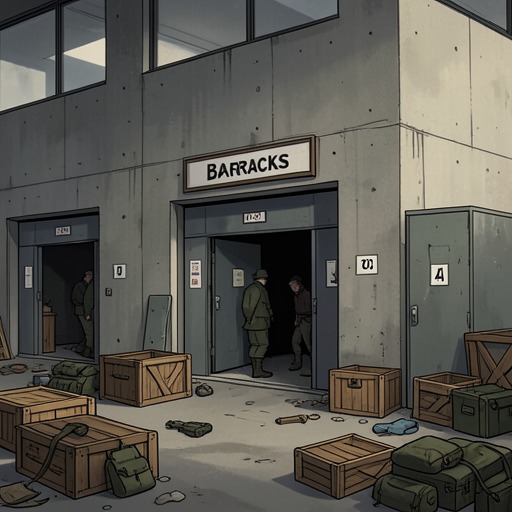
When Wu Dawang visited the Machine Gunners’ barracks, the company had already been sent in five trucks marked “Liberation” to a special military transport station. Its empty building held the disorder left after departure: training equipment lay abandoned, and damage to the vaulting horse and a defaced notice board testified to anger and uncertainty. The contrast with the disorder Wu Dawang and Liu Lian had caused at the Division Commander’s house is pointed. Their disruption had belonged to a private relationship; the barracks’ damage registered the distress of soldiers losing a shared institution and facing unknown futures.
The departure scenes also show the human cost of the administrative process. Soldiers sat through farewell banquets, then, emboldened by drink, sought isolated places to vent their anger on windows and equipment associated with years of collective service. Before leaving, they wept together, expecting never to meet again. The account follows these responses alongside the official sequence of transfers, presenting the disbandment as both a managed reorganization and a rupture in comradeship.
Wu Dawang’s Exception and Expedited Exit
Wu Dawang returned to the barracks during an extended home leave arranged after Liu Lian told the authorities that serious family problems required him to remain away for three months. The Political Instructor explained that the Division Commander had also ordered an exception for him: although promotions were suspended, a city job in Wu Dawang’s native province would be arranged, his family moved there, and suitable work found for his wife. The favor was personal and specific, set apart from the uncertain prospects of the wider force.
At the same time, Wu Dawang was instructed not to return to his former post in the Division Commander’s household or visit it without pressing cause. Restructuring had made personnel in the barracks unstable, and successive household orderlies had incurred the Commander’s anger despite Liu Lian’s efforts to smooth matters over. The dissolution therefore altered Wu Dawang’s access to Liu Lian as well as his military future: the reassignment protected him from the household’s unstable situation while separating him from the place where their affair had unfolded.
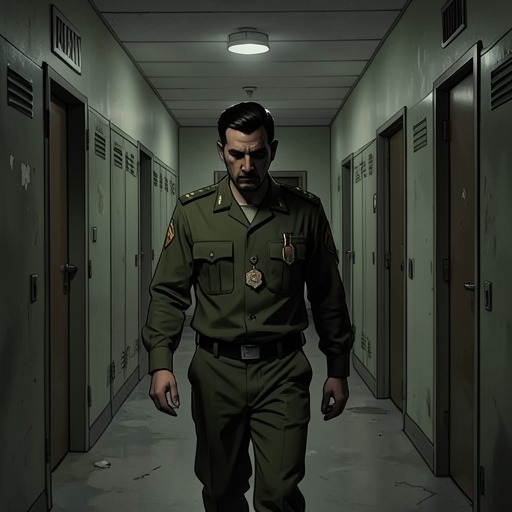
His own departure followed with striking speed. Within a week, he and his family had been provided with work and housing in the city nearest their village. After formal notice of demobilization, he learned that his assignment was the East is Red Tractor Factory, and was told to report there after travelling by train. His superiors helped pack his belongings; the Division supplied cardboard boxes, wooden crates, and rope. The ample preparations and orderly logistics contrast with the haste of the expulsion: everything was ready, although the decisions shaping his future had been made far above him.
Ceremony, Contradiction, and Final Dissolution
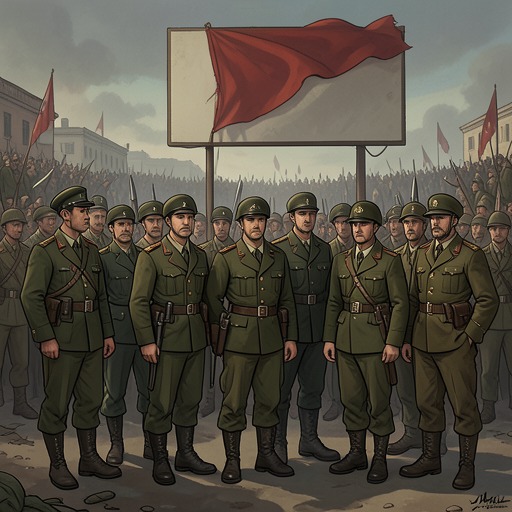
Before Wu Dawang’s train left, his company held a lavish supper and farewell meeting. A hundred uniformed soldiers remained in the mess as songs were sung and quotations from Mao Zedong recited. The Political Instructor announced Wu Dawang’s special early discharge and factory appointment, and the Head of Management publicly awarded him the Third Order of Merit. He was also celebrated as an Exemplary Servant of the People, the only soldier in the Division to receive that distinction. The company greeted the announcement in silent astonishment; neither Wu Dawang nor his immediate officers had known beforehand that the evening would end with this honor.
The ceremony gives the departure a language of distinction and exemplary service, even as Wu Dawang is being removed from the army before the rest of the Division’s fate is settled. His employment and family’s relocation form a protected outcome amid collective uncertainty, but the public explanation does not erase the larger institutional change. At the station, his company came out to shake his hand and wish him well. He had intended not to cry, but began weeping when the jeep’s engine started and his final journey out of the barracks began.
Three days later, the Division’s final demobilization was officially announced. Those who knew about Wu Dawang and Liu Lian’s affair and those who did not were scattered. The secret sank from view along with the social world that might have carried it forward. The ending binds institutional dissolution to narrative erasure: the Division’s personnel disperse, Wu Dawang leaves for civilian life, and the affair is left without a shared unit or community in which its history can remain present.