Wu Dawang rejects Liu Lian’s first naked advance
Serve the People!Wu Dawang rejects Liu Lian’s first naked advance at the moment when his desire meets the authority and political obligations that govern his life. He enters her darkened room but cannot proceed; when she turns on the light, the difference between them as a married woman of rank and her subordinate household orderly becomes impossible for him to ignore. His stated fear of the Division Commander and the Party ends the encounter, while Liu Lian’s rebuke and the Political Instructor’s subsequent interrogation expose the costs of treating a private approach as a matter of military duty.
The encounter and its reversal
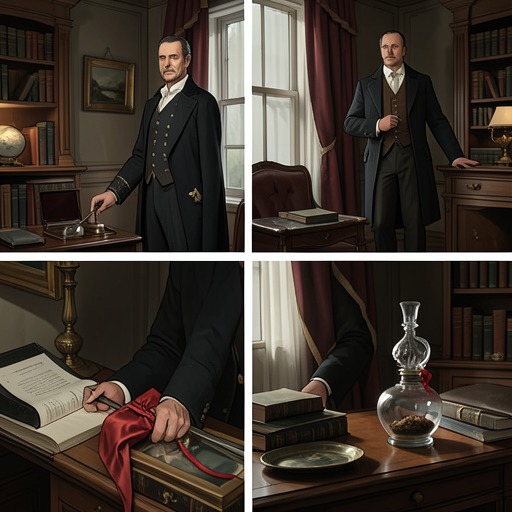
Wu Dawang opens the door and enters a room in darkness. Liu Lian’s gentle inquiry about whether he is all right does not resolve his hesitation. He asks her to turn on the light, then objects that it is too bright. When he threatens to leave if she does not switch it on, she sits up and pulls the cord. The light reveals her naked beneath a mosquito net, with a corner of a red blanket drawn over her thighs. Her red silk brassiere hangs at the bedhead; the exposed scene is not the uncomplicated fulfillment Wu had anticipated, but a confrontation he is unable to meet.
The reversal is sharpened by repetition: the light’s sudden click and the return of his panic echo an earlier failed moment. Wu remains motionless even after Liu Lian has made her advance unmistakable. The scene’s value turns from anticipated intimacy to embarrassment and fear. His body’s hesitation, rather than any explicit rejection at the outset, makes his withdrawal visible before he can explain it.
Fear, rank, and rebuke
When Liu Lian asks him to say what he has to say, Wu admits that he is afraid. Asked of whom, he names the Division Commander and the Party. Liu Lian answers that he seems not to fear her, but her reaction makes clear that she understands his response as a judgment on his character, not simply a confession of political caution. She pulls on her nightgown and tells him, “You're not worth the mud these walls are made of,” adding that she had expected more of him.
The encounter makes their unequal positions explicit. Liu Lian is the Division Commander’s wife; Wu is her General Orderly and cook. The household’s political formula that serving the Division Commander and his wife is serving the People turns a charged private approach into an institutional contradiction. Wu may stand before Liu Lian while she is undressed, but he does not cease to be her subordinate. Once the light is on, the rank relation displaces the intimacy he had approached and leaves him unable to act.
From private refusal to military reprimand
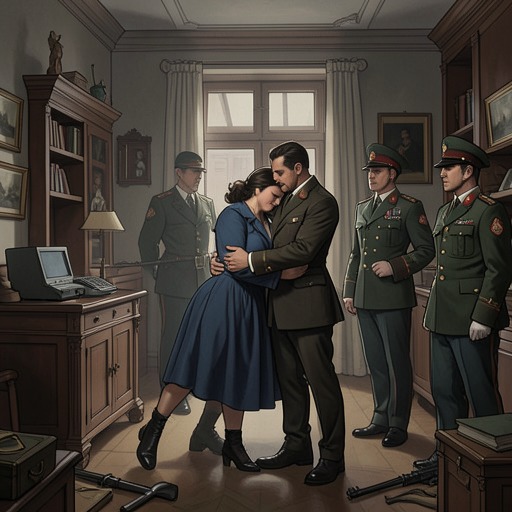
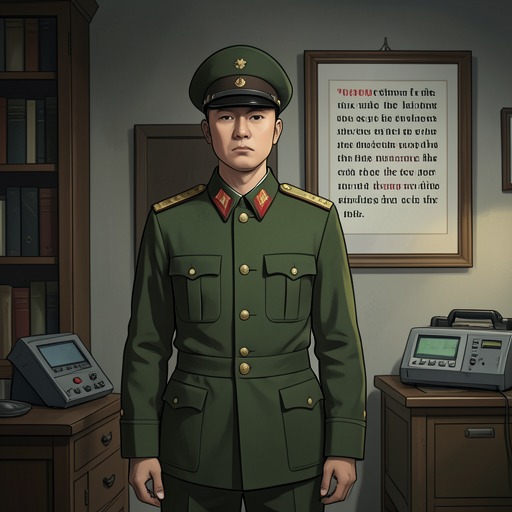
After leaving, Wu crosses the drill ground back to the barracks and worries whether his behavior was right or wrong. The next institutional consequence comes through the Political Instructor, who says Liu Lian has complained by telephone and wants Wu replaced the following morning with someone more knowledgeable about political theory. The Instructor stresses Wu’s standing as a Sergeant, Party member, and decorated soldier, then demands to know how he could have forgotten his responsibility to serve the Division Commander’s wife.
The reprimand expands the personal encounter into a chain of imagined military consequences. The Instructor argues that if Liu Lian is not looked after, the Commander cannot concentrate on meetings in Beijing; impaired concentration could affect the Division’s training and, in turn, the army’s readiness. He invokes the possibility of a wider war to magnify what began as Wu’s failure to meet Liu Lian’s expectations. The episode thus shows military language absorbing private relations: service is invoked not only as a principle but as the justification for supervising the Commander’s household.
The commitments behind the refusal
Wu’s career and marriage are already bound together by a written bargain. Before marrying Zhao Ezi, he promises to win commendations within a year, join the Party within two, and become an official within three, so that he can move her from Wujiagou to a city where she can eat steamed rolls every day. He pledges that if he fails to bring her there, he will not return to the village unless she permits it, and will serve her as she chooses. After the marriage, his mother dies two weeks later, and the narrative presents him as no longer master of his destiny or marital happiness.
The promised climb does not proceed smoothly. Wu works without earning a commendation, then struggles without being admitted to the Party. Letters from his wife and father-in-law asking about his progress increase his anxiety; he contemplates suicide when his name again fails to appear on the lists. The vacancy of Sergeant of the Catering Squad finally provides a route forward. Although the work is dirty and exhausting, it is known to offer quick advancement. Wu becomes Deputy Sergeant, then full Sergeant, joins the Party, and receives commendations, but promotion to officialdom remains out of reach. This history explains why the prospect of advancement matters so much when he is assigned to the Division Commander’s household—and why the encounter with Liu Lian carries more than private emotional risk.
Aftermath and significance
The refusal does not end Wu’s connection to Liu Lian; it marks an early obstacle in the affair’s development. His fear of the Commander and the Party, combined with his subordinate position, initially holds him back, while Liu Lian’s rebuke gives the failure an immediate personal cost. The Political Instructor’s response then converts that cost into a question of service and discipline, revealing how institutional power frames the household relationship.
Later, the Division Commander volunteers at a Beijing seminar organized by the Central Military Commission to test an army-wide restructuring pilot. The Division is to be disbanded, promotions are cancelled, and the Commander arranges a city job for Wu and work for his wife. At the same time, staff turnover and the Commander’s uncertain temper lead the Political Instructor to tell Wu not to return to his old post or visit the house except for pressing business. On hearing this, Wu feels relief that his affair with Liu Lian remains undiscovered. These later circumstances do not erase the first encounter’s significance: the opening refusal establishes the conflict between desire and rank, while the military structures that made him hesitate ultimately shape the separation that threatens the lovers’ reunion.