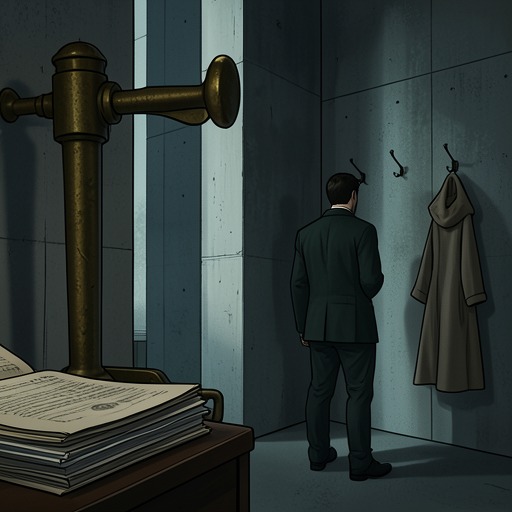
Wu Dawang’s expedited discharge and urban job assignment
Serve the People!Wu Dawang’s expedited discharge and urban job assignment end his military service through a blend of organizational upheaval and personal patronage. As the Division is selected for a restructuring pilot and disbandment, Wu receives work and housing for his family in the city; a hastily arranged public ceremony then recasts this exceptional treatment as recognition of his revolutionary virtue. The outcome is both a practical escape from uncertainty and a pointed irony: the institutions that praise his selfless service have arranged his future through private influence and decisions made beyond his understanding.
Background: A Promise Built Around Advancement
Wu’s civilian prospects have long been bound to military advancement. In his written premarital pledge to Zhao Ezi’s father, he promised to earn commendations within a year, join the Party within two, and become an official within three. If he failed to secure a city home where Zhao Ezi could eat steamed rolls every day, he vowed not to return to Wujiagou unless she permitted it, and promised to serve her as she wished. The pledge made his career more than an ambition: it became the stated condition on which his marriage and his family’s hoped-for move to the city rested.
The first stages of that plan proved difficult. Although Wu worked hard, he initially earned neither a commendation nor Party membership, and letters from his wife and father-in-law intensified his anxiety. His prospects changed after he took on Catering Squad duties. Within a year and a half, he had become a full Sergeant and joined the Party; with the Political Instructor’s help, commendations and awards also became common. Promotion to officialdom, however, remained out of reach. When Liu Lian later assured him that she would help secure a city transfer for his family once promotions resumed, the promise appeared to reconnect his stalled career to the future he had pledged to provide.
The Division’s Dissolution and Wu’s Exception
Wu’s discharge is set in motion by a much larger institutional change. At a seminar in Beijing organized by the Central Military Commission, the Division Commander volunteered the Division for a pilot scheme to streamline and restructure the army. In practical terms, the Division was to be disbanded. Most companies would be demobilized and the remainder transferred; promotions were cancelled while the reorganization proceeded. The same event therefore closes the career paths on which soldiers such as Wu and the Political Instructor had relied, even as it creates a need to allocate civilian jobs and settle personnel quickly.
Wu is told that the Division Commander has made an exception for him: a city job is to be arranged in his native province, his family is to move there, and suitable work is to be found for his wife. The arrangement does not fulfill his old pledge of becoming an official, but it does deliver its central practical goal—a life for his family in the city. Liu Lian had earlier promised to help with that transfer, and the Head of Management later tells Wu that, thanks to her, he has come out better than the rest. The narration leaves the precise workings of that influence unclear, but makes the connection between Liu Lian and Wu’s favorable outcome explicit.
His privileged placement stands out against the uncertainty surrounding the other soldiers. Within a week of his unexpected return to barracks, Wu and his family have been provided with city work and housing, while his comrades worry about their prospects. He needs only to complete and sign forms supplied by army bureaucrats. The formal machinery of assignment is visible, but the speed and exceptional nature of his case suggest that paperwork is carrying out a decision already made elsewhere.
Discharge and Public Recognition
Three days after Wu decides to stay in his dormitory rather than visit Liu Lian, he receives formal notice of demobilization. His superiors tell him to report to the East is Red Tractor Factory, described by the Political Instructor as the largest factory in the city, with a manager whose rank is said to exceed that of a Provincial Governor or Corps Commander. The Captain urges him to save money for city life and tells him that he must travel that day to settle in before starting work the day after tomorrow. The explanation is brisk and logistical; the officers then help him tie up his belongings.
The haste extends to the preparations. The Division supplies cardboard boxes, wooden crates, and rope for Wu’s possessions, and his company arranges a lavish final meal and farewell meeting before his train leaves at 12:30 that night. After dinner, the hundred-strong company remains in the mess in full uniform, first singing and reciting Mao quotations. The Head of Management, unusually present to say goodbye in person, announces that Wu has received the Third Order of Merit. The announcement surprises the assembled soldiers.
The ceremony gives the assignment an official moral explanation. Citing Wu’s study of Mao’s collected works, the Head of Management describes him as an outstanding revolutionary thinker of excellent moral character, successful in putting theory into practice. He names Wu an Exemplary Servant of the People—the only soldier in the Division to receive that distinction—and explains the state-allocated city job as a consequence of service to the People. The officers then urge the company to follow Wu’s example, presenting assistance with his civilian future as something the army grants to those who serve selflessly. Yet neither Wu nor the officers conducting the farewell knew in advance that this ceremony would culminate in the award. The public account of merit thus arrives only after the arrangements have been made, turning a contingent and privately influenced outcome into an exemplary institutional story.
Wu offers no speech. When asked repeatedly to address the company, he accepts the badge of merit, bows impassively to his comrades, and salutes the officers beside him. His silence leaves the ceremony’s claims unendorsed by him, even as his new job and discharge are formally celebrated in his name.
Private Benefit, Unequal Consequences
The assignment gives Wu what years of effort and his marriage pledge had made urgent: civilian work in the city and a route for his family to join him. It does not deliver the official promotion he had sought, and it comes as the Division that enabled his military career is dismantled. The contrast is sharpest in the differing outcomes of the restructuring. Wu’s own future is resolved quickly through a favored exception, while his comrades face uncertain transfers or demobilization and the disruption of returning to their homes.
The text also complicates the idea that Wu’s good fortune is simply a reward for service. Before the discharge, he believes that his affair with Liu Lian may have brought him an honorable exit and city jobs for himself and his wife. As he considers the affair and the dissolution together, he begins to suspect that his romance has been part of a scheme choreographed behind the scenes; the Head of Management’s remark about Liu Lian deepens that suspicion without explaining the full arrangement. At the same time, Wu has been assured that his affair remains undiscovered, and the new placement allows him to leave without returning to Liu Lian’s house. His discharge therefore resolves the practical crisis while leaving the emotional and political meaning of his departure unsettled: the bureaucratic forms are complete, but the relationship between personal favor, institutional recognition, and Wu’s apparent reward remains difficult for him to understand.