Division barracks
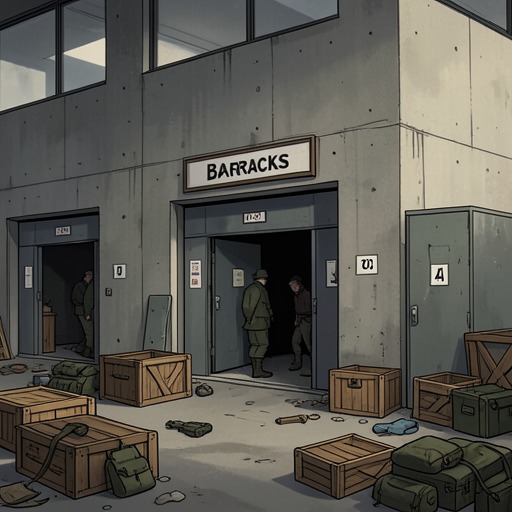
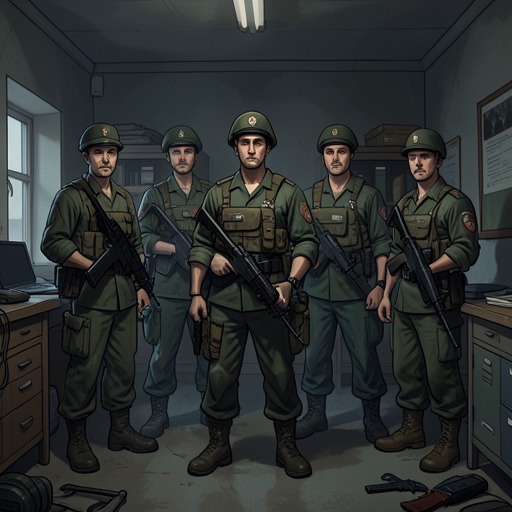
Serve the People!The Division barracks are the central institutional setting of Wu Dawang’s military life: a place of daily routine, political instruction, career competition, and decisions made through both formal orders and personal discretion. They give structure to his rise from an ambitious soldier of peasant origin, but they also become the site from which he is separated when the Division is slated for dissolution. The barracks thus connect intimate personal consequences to the changing organization of the army.
Setting and Daily Routine
The barracks are governed by a disciplined rhythm. The Division Commander leaves home before reveille for drills on the parade ground and returns long after lights-out, while revolution and work dominate his understanding of daily life. For Wu Dawang, the grounds are not only a workplace but also a place where military routine continues after the day’s duties: following a fraught encounter at the Commander’s house, he crosses the drill ground at night and sits alone at its southern end rather than going straight to bed. Around him, older soldiers gather in small groups to talk, drink, and sing revolutionary choruses. The contrast between their sociability and Wu Dawang’s anxious solitude makes the barracks a social space as well as a site of discipline.
A three-part military rule shapes conduct there: soldiers must not say, ask, or do what they should not. Wu Dawang knows this code and, when questioned about his work for a senior officer, recites two of its prohibitions. His Captain tells him that this answer is wrong, underscoring that a familiar rule can be insufficient when the institution expects a more particular account of service. The barracks’ norms are thus conveyed not only through formal routines but also through correction by superiors.
Advancement and the Cost of Ambition
Wu Dawang’s career at the barracks is bound to a promise he made before marrying Zhao Ezi. He pledged to earn commendations within a year, join the Party within two, and become an official within three, with a city home for his wife as the practical measure of success. The promise turns promotion from an abstract ambition into an obligation to his family. When he initially fails to earn a commendation or Party membership, letters from Zhao Ezi and her father heighten his anxiety; he even contemplates suicide as repeated annual lists pass him by.
A vacant post in the Catering Squad offers a route forward. Eight soldiers compete for the position of Sergeant, and the Political Instructor’s judgment matters because the company Captain is away. Wu Dawang’s transfer to the squad as Deputy Sergeant gives him responsibility for the company’s food and water. In the following year and a half, he becomes a full Sergeant, joins the Party, and receives commendations and awards with help from the Political Instructor. Yet officialdom remains out of reach: health testing, limited promotion quotas, and another soldier’s advancement repeatedly frustrate that part of his pledge. The barracks therefore enable real mobility without guaranteeing the final rank he seeks.
Protocol, Private Life, and Discretion
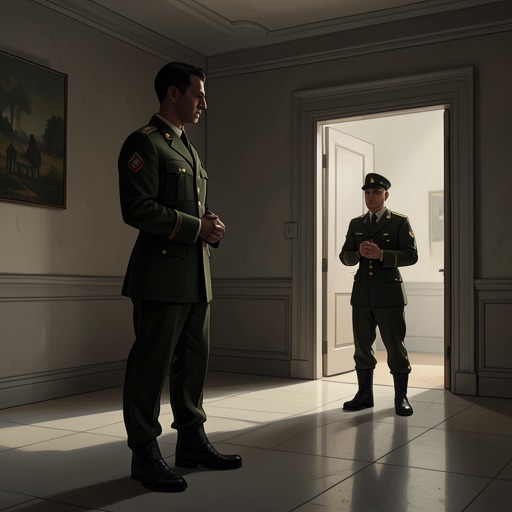
The barracks’ chain of command reaches into the domestic sphere through Wu Dawang’s work as an orderly at the Division Commander’s home. When Liu Lian complains to Wu Dawang’s Captain and Political Instructor about his service, the Political Instructor calls him in and explains that she expects the Commander’s household to be served as an extension of service to the people. He cites Wu Dawang’s standing as a Sergeant and Party member, and his record of awards, to stress the discrepancy between his reputation and the complaint. Rather than immediately removing him, the Instructor gives him another day at the house and takes responsibility for the decision, leaving Wu Dawang to put matters right.
After Wu Dawang and Liu Lian begin an affair, she tells the Captain and Political Instructor that she is afraid to be alone in the house while her husband is away. She also says that Wu Dawang has since given satisfactory service and requests that he sleep there rather than return to the barracks each night. His superiors agree, treating any failure by an orderly as a reflection on the company and inviting her to complain to them as well. The arrangement provides a professional justification for his continued presence, allowing the secret relationship to proceed behind an outward appearance of ordinary duty. His gardening at the house remains visible to passersby as part of that appearance, while the barracks’ orders and accommodations help sustain it.
The Political Instructor’s authority also operates through personal judgment, not just rules. Earlier, he chooses Wu Dawang for the Catering Squad after witnessing him humorously carrying the Instructor’s son on his back. Later, when Wu Dawang returns from leave, the Instructor offers him hospitality, food, and an explanation of the rapidly changing personnel situation. In another encounter, the Captain warns Wu Dawang to tell no one what he has just heard. Such decisions show how the barracks function through a mixture of rank, favors, confidential instruction, and discretionary exceptions.
Recall and the Division’s Disappearance
During Wu Dawang’s leave, the Division’s impending reorganization takes place largely outside his understanding. On his return to the barracks, he finds the Signals Officer sweeping up broken glass and is confused when the officer appears not to hear him. The Political Instructor then brings him inside, gives him hot water and scented soap, and arranges egg noodles after learning that he has not eaten. This careful reception contrasts with the unsettled atmosphere outside and precedes an explanation of the personnel changes.
The Instructor tells Wu Dawang that Liu Lian had reported serious family problems and secured him three months of home leave. He then explains that the Division Commander volunteered at a Beijing seminar organized by the Central Military Commission to test a scheme for streamlining and restructuring the army. The practical consequence is that the Division is to be disbanded and disappear from the military system. Most companies will be demobilized and a minority transferred; promotions are suspended, threatening Wu Dawang’s hope of becoming an official.
Even as the general policy closes off promotion, personal intervention creates an exception for him. Because he is a favorite of the Division Commander and Liu Lian, arrangements are made for a job in a city in his native province, with work for Zhao Ezi and a move for his family. At the same time, repeated turnover among the household orderlies and the Commander’s uncertain temper lead to a specific restriction: Wu Dawang is not to return to his old post or visit the house unless there is an urgent reason. The Instructor’s account relieves Wu Dawang because he believes the affair remains undiscovered, but it also marks the end of his ordinary access to the household and the barracks’ former routines.
Narrative Significance
The barracks embody the overlap between institutional ideals and the practical machinery of advancement. Political language, military discipline, and service obligations are part of everyday life there, while promotions depend on scarce openings, superiors’ recommendations, and circumstance. Wu Dawang’s rise follows this path: a family pledge directs his ambition, the Catering Squad supplies an opening, and the Political Instructor’s support helps him gain rank and recognition. The same mechanisms later grant him exceptional treatment even as collective demobilization cancels promotions for others.
The barracks also frame a sharp reversal in scale. Wu Dawang’s private story initially seems to him to be turning in his favor: he expects an honorable discharge and city opportunities for his family. Yet his return coincides with a plan to erase the Division from the military system, and the fate of his comrades is much less certain than his own. Within a week, he and his family have work and housing in the city, while other soldiers remain anxious about their prospects. The barracks are therefore not simply the setting he leaves; they are the institution that makes his career, constrains his choices, and, at the moment of its own disappearance, arranges an unusually favorable exit for him.