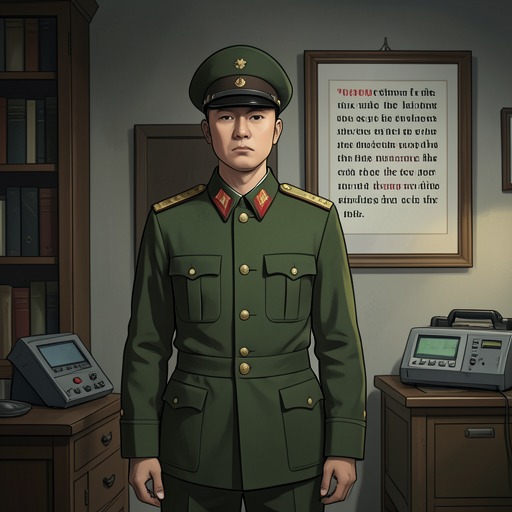
Military Hierarchy and Social Status
Serve the People!Military Hierarchy and Social Status is the system of rank, privilege, and dependence that governs Wu Dawang’s military career and personal life. His rise from ambitious peasant recruit to decorated sergeant brings genuine advancement, but never erases the distance between him and senior officers. The same hierarchy that rewards his service gives powerful people influence over his marriage, his relationship with Liu Lian, and his eventual departure from the army.
Rank, Service, and Unequal Lives
The hierarchy is visible in the contrasting lives of the Division Commander and Liu Lian. The Commander’s days are organized around revolutionary work and military drills, while his much younger wife, trained as a nurse, has stayed at home for five years, living amid the status of her husband’s household. The difference is not simply between two personalities: their positions afford distinct kinds of work, authority, and freedom. Liu Lian is the wife of a senior officer, while Wu Dawang is the officer’s orderly, responsible for the household’s daily needs.
Wu Dawang’s record makes his lowly position especially striking. A veteran revolutionary with commendations and repeated recognition as a Model Soldier, he is nevertheless hungry for further advancement. After impressing the army with his recitation of 286 quotations and three essays by Mao Zedong, and with a four-dish meal and soup prepared during a competition, he is selected as the Division Commander’s full-time orderly and cook. His achievement earns proximity to authority, but proximity is not equality: his new work remains service within the Commander’s household.
For six months, Wu performs that work conscientiously, cooking, growing vegetables, cleaning, tending flower beds, and pruning trees. During a military streamlining initiative, the Commander reduces his household staff to one. Once the Commander leaves for work, the large residence is occupied by Liu Lian and Wu Dawang alone. The arrangement puts them in unusually close daily contact, yet their official positions remain sharply unequal: she is mistress of the house, and he is the soldier assigned to maintain it.
Promotion as a Bargain and a Ladder
The force of rank and status reaches back to Wu Dawang’s entry into military life. In Zhao Village, Accountant Zhao presents army service as more than training: it could lead to Party membership, commendations, promotion, and eventually official status. That official position, Zhao explains, could secure an urban registration permit for his daughter, Zhao Ezi, and enable the couple to move to the city. Military advancement is therefore imagined as a route not only to personal standing but also to family mobility and a state-allocated urban life.
Wu turns that prospect into a written premarital pledge. He promises to earn commendations within a year, join the Party within two, and become an official within three, so he can move Zhao Ezi to the city. The pledge makes marriage contingent on a schedule of institutional achievements, while also setting out the cost of failure: Wu promises not to return to Wujiagou unless Zhao Ezi allows it. Almost immediately after signing, he marries her. The written promise gives his ambition a precise timetable, but it cannot make the promotions he needs available on demand.
When he fails to win a commendation and then fails to gain Party membership, anxiety mounts with each letter from Zhao Ezi or her father asking about his progress. Advancement depends on competition for limited opportunities, not effort alone. Wu eventually competes for a vacant Catering Squad sergeant position, a difficult assignment known to offer faster promotion because of its demanding work. His willingness to serve and his performance in front of the Political Instructor help secure the post. He becomes Deputy Sergeant, then full Sergeant, enters the Party, and receives commendations and awards. Yet officialdom—the status marked by the four-pocket jacket—remains out of reach, blocked at different times by a blood-pressure test, limited promotion quotas, and a rival’s success.
Household Intimacy and the Rank Boundary
The household position that improves Wu’s prospects also places him inside the Division Commander’s private domain. Liu Lian invites him to address her as Sister when they are alone, while retaining the public form Aunt in front of the Commander and others. Wu is moved by the offer, but cannot readily speak the new name: the gulf between the Commander’s wife and her orderly makes even a familial form of address feel socially difficult. His hesitation reveals that emotional closeness does not dissolve the roles imposed by rank.
Their relationship later crosses that boundary, but the surrounding military arrangements continue to shape it. Liu Lian tells Wu Dawang’s Captain and Political Instructor that she is afraid of being alone at night while the Commander is away and asks for Wu to sleep at the house. She presents the request in terms of his satisfactory performance as orderly; the company’s officers approve, treating any failure of household service as a reflection on the company itself. An official duty thus provides cover for private access, and the outward arrangement remains legible as military service even as the relationship changes behind it.
The division between private feeling and public role becomes especially clear when Wu begins to act as if he were the household’s master. He imagines himself as Liu Lian’s husband and, on one occasion, expects her to wash his uniform in the manner he would expect of a wife. Liu points instead to the Serve the People! sign. Its message recalls the role assigned to him at Compound Number One and the subordinate status that his fantasies cannot remove. The incident brings his presumption into collision with the visible rules of the household: intimacy may give him a sense of personal authority, but the sign and the existing chain of command reaffirm who holds the recognized position.
Reorganization, Patronage, and Departure
The military hierarchy operates through organizational decisions as well as face-to-face rank. When Wu returns to the barracks during his furlough, the Political Instructor explains that Liu Lian has requested an extended leave for him because of serious family problems. He also reports that the Division Commander volunteered the division for a pilot scheme to streamline and restructure the army, a decision that means the division will be disbanded. Promotions are suspended as companies are demobilized or transferred, again putting Wu’s ambition in the path of forces beyond his control.
At the same time, the Commander’s favor brings Wu an exception. Although promotion has stopped, the Commander has directed that Wu receive a job in a city in his home province, with housing and work arranged for his family and a job found for his wife. The outcome joins bureaucratic process to private influence: restructuring determines the broad field of choices, while the Commander’s intervention improves Wu’s place within it. Wu’s favored treatment is not presented as a general route open to every soldier; as his fellow servicemen worry about their futures, his own arrangements proceed through forms handled by army officials.
Within a week, Wu and his family have work and housing in the city nearest their village. His departure is organized with conspicuous speed and care: the division supplies boxes, crates, and rope, and his company holds a farewell supper before his late-night train. At the gathering, his early discharge for a factory job is announced, and he receives the Third Order of Merit and the distinction of Exemplary Servant of the People, described as unique within the division. The ceremonial account credits his study of Mao Zedong’s writings and his success in putting theory into practice, even though the officers and Wu himself had not known beforehand that the evening would end with these honors.
Wu’s trajectory therefore ends not with the official promotion he had pursued for years, but with an arranged discharge and a city job as the division disappears. His service has secured real rewards, yet the timing and form of his future are ultimately determined by reorganization and decisions made above him. Military Hierarchy and Social Status captures this tension: diligence can advance a soldier within the institution, and patronage can open a door that routine promotion has closed, but neither gives him command over the institution’s larger changes.