Political Instructor
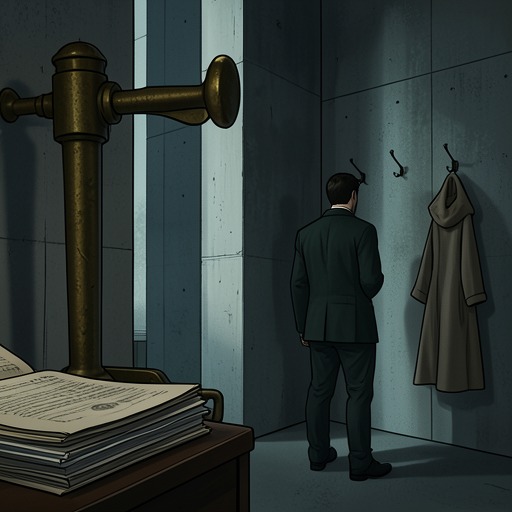
Serve the People!The Political Instructor is Wu Dawang’s immediate political superior, an officer whose speeches translate revolutionary doctrine into instructions about work, loyalty, and personal conduct. He helps turn Wu’s ambition into advancement, rebukes him when Liu Lian complains, and later conveys the arrangements surrounding the Division’s disbandment and Wu’s departure. His role is consequential precisely because it is practical: through interviews, recommendations, reprimands, and orders, he mediates between institutional rules and the lives of the soldiers subject to them.
Position and Political Authority
The Political Instructor operates within a company where political standing and career advancement are closely connected. Wu Dawang is already a decorated soldier, repeatedly named a Model Soldier, but his record alone does not secure the next step. When eight men compete for the vacant Catering Squad position, the Company Captain is away at officer training and the Political Instructor temporarily wields considerable influence over the selection. The candidates court him through domestic service, but Wu distinguishes himself by taking his son out to play and entertaining the child. The episode makes the instructor’s authority both formal and personal: the post is an organizational appointment, yet the decision-maker’s household relationships become part of the contest.
The Political Instructor then tests Wu on the principle of serving others. Wu answers by joining theory to practice, and the instructor accepts the response as thoughtful and practical, while objecting to one analogy. The interview leads to Wu’s transfer as Deputy Sergeant in the Catering Squad, with responsibility for the company’s food and water. This appointment changes the direction of his career. Over the following year and a half, Wu becomes a full Sergeant, joins the Party, and receives commendations and awards with the instructor’s help. The promised promotion to officialdom remains out of reach, however, delayed by a high blood-pressure reading, limited promotion quotas, and other contingencies. The instructor can open doors within the system, but cannot make every institutional obstacle disappear.
Reprimand and a Second Chance
The Political Instructor’s authority also appears in discipline. After Liu Lian telephones to complain about Wu’s conduct, he summons Wu and expresses disappointment: a soldier with awards, Party membership, and a reputation for reliability has, in his account, failed to understand that serving the Division Commander’s household is part of serving the people. He demands to know what Wu has done, while Liu Lian’s request that Wu be replaced gives the complaint an immediate professional consequence.
His reprimand expands from the household dispute into a sweeping political argument. He invokes the hardships of people under Chiang Kai-shek, the presence of foreign enemies, the Army’s unfinished work, and the risks that a lapse in household service might supposedly pose to the Division’s readiness and even wider security. The scale of this rhetoric contrasts sharply with the intimate source of the trouble. He then makes the argument personal: Wu wants promotion and a transfer of his family to the city, and Liu Lian could influence the Division Commander on his behalf. The instructor thus presents the same household service as ideological duty and as a route to private advancement.
Although Liu Lian has asked for a replacement, the Political Instructor decides to send Wu back to the Commander’s house for one more day so he can put matters right. He tells Wu that he will take responsibility for the decision if Liu Lian wants someone to blame, while leaving the outcome to Wu. His intervention combines reprimand with a reprieve: he does not excuse the complaint, but he gives Wu a limited opportunity to recover his position. When Wu later prepares a bowl of sweet egg-drop soup and writes a statement of self-criticism, that response takes place within the political framework the instructor has imposed, though the evidence does not establish that the instructor directed those particular gestures.
Disbandment, Discretion, and Wu’s Departure
When Wu returns from leave to the Division barracks, the Political Instructor greets him with unusual care. He offers water, provides scented soap for washing, asks about the journey, and arranges egg noodles after learning Wu has not eaten lunch. The hospitality precedes an explanation of a changed situation and contrasts with the earlier reprimand: the instructor now manages Wu’s return by calming him and laying out the news in stages.
He tells Wu that Liu Lian has said serious family problems require a three-month period of home leave, and that an extended furlough has been granted. He also explains that the Division Commander volunteered at a Beijing seminar to test a pilot scheme for streamlining and restructuring the Army, a decision that means the Division is to be disbanded. With most companies due for demobilization and a minority for transfer, promotions have been cancelled for the time being. The instructor therefore conveys both the destruction of Wu’s expected promotion path and the exception made for him: the Commander has ordered a city job in Wu’s native province, a move for Wu’s family, and suitable work for his wife.
The Political Instructor also relays why Wu must not return to his old post. The Commander’s household has seen rapid turnover among its orderlies during the unsettled restructuring; despite their caution, each has somehow angered the Commander, while Liu Lian has tried to smooth matters over. Given the Commander’s uncertain temper, Wu is told not to visit the house unless something urgent requires it. The instruction separates Wu from the household where his career and private life have become entangled, while the employment arrangements protect the future he had long sought.
Confidentiality and the Official Farewell
The Political Instructor’s role in the final stages of Wu’s service is shaped by information control as well as personnel decisions. After the Captain discovers that Wu has returned, the Political Instructor helps bring him inside and explain the leave and restructuring arrangements. Later, the Captain orders Wu and the Signals Officer to say nothing about what they have heard or seen, warning that disclosure to the Division Commander could put them all in serious trouble. The episode places the instructor and other company officers within a chain of caution: what is said about the reorganization matters, and knowledge is managed as carefully as assignments.
Wu’s discharge is then presented publicly as a reward for exemplary service. At a farewell meeting attended by the hundred-strong company, the Political Instructor announces Wu’s special early discharge to take a factory job in the city. The Head of Management adds that Wu is receiving the Third Order of Merit and the Division’s unique designation of Exemplary Servant of the People. Neither Wu, his Captain, nor the Political Instructor had known in advance that the evening would take this form. The ceremony recasts a privately arranged exception as a public lesson in selfless service, urging the assembled soldiers to follow Wu’s example. Wu says nothing when asked to address them; he accepts the badge, bows to his comrades, and salutes the officers.
Narrative Significance
The Political Instructor is neither simply a mouthpiece for doctrine nor an all-powerful architect of Wu’s fate. His authority is real but bounded: he can influence an appointment, assist Wu’s rise, discipline him, grant him another chance, and communicate an exceptional job arrangement, yet promotion quotas and the Division’s dissolution exceed his control. His actions reveal how personal judgment and formal organization work together. Wu’s demonstrated usefulness and relationship to the Commander’s household matter alongside Party membership, commendations, assignments, and the reorganization plan.
His political speeches also create a sustained contrast between abstract revolutionary language and ordinary institutional transactions. Service is invoked to justify Wu’s domestic duties, to frame the competition for a post, and later to explain an early discharge and city employment. At the farewell, that language becomes ceremonial recognition, although the arrangement had been made privately and the speakers did not know the precise form the ceremony would take. Through the Political Instructor, the narrative shows doctrine functioning not only as belief but as a vocabulary for supervising conduct, distributing opportunity, and making a personal exception appear to express a collective principle.